

Company News
AWS Security Hub Adds Socket for Supply Chain Security
Socket is now in the AWS Security Hub Extended plan. Adopt it through AWS, apply committed spend, and block malicious open source packages.
By Feross Aboukhadijeh - Aug 04, 2026
MCP server for Google Analytics 4 - query GA4 data with natural language via Claude.
MCP server for Google Analytics 4 -- run reports, realtime data, custom dimensions, and property management via Claude.
npm install mcp-ga4
Or clone the repository:
git clone https://github.com/mharnett/mcp-ga4.git
cd mcp-ga4
npm install
npm run build
mcp-ga4 supports two credential families. Selection is deterministic and
happens once, at startup: an explicit keyfile / service account wins, then
user OAuth, and if neither is configured the server exits with a loud
onboarding error naming both options. There is no machine-local credentials
path baked into the code and no silent runtime failover -- the only
credential inputs are environment variables and (optionally) your own per-user
config.json. (A later 403 therefore surfaces as the API error, not as a
silent switch to the other credential family.)
Precedence: when both families are configured, the keyfile / service account takes precedence over user OAuth.
Use this for any always-on or server deployment. Point
GOOGLE_APPLICATION_CREDENTIALS (or config.json credentials_file) at a JSON
keyfile. The service account must be granted access on the GA4 property
(Admin → Property Access Management → add the service-account email with at least
Viewer). No refresh token is involved -- the server hands the keyfile to the GA4
SDKs directly:
GOOGLE_APPLICATION_CREDENTIALS=/path/to/service-account.json
The keyfile may be a real service-account key or an authorized_user OAuth
token dump -- both are accepted via the keyFile option.
Use this if you want the server to act as a Google user (your own GA4 login). You bring your own Google OAuth client and mint a refresh token once.
In Google Cloud Console, create an OAuth 2.0 Client ID of type Desktop app. Enable the Google Analytics Data API (and the Admin API if you use the custom-dimension tools).
Export your client credentials and run the token helper (uses PKCE, opens a browser, prints the token to stdout):
export GA4_CLIENT_ID=...            # from the Desktop-app client
export GA4_CLIENT_SECRET=...
node get-refresh-token.cjs          # or: npm run auth
Do not redirect this command's stdout to a shared log -- the refresh token is printed there by design.
Copy the printed GA4_REFRESH_TOKEN=... into your environment. At runtime the
server reads these three env vars:
GA4_CLIENT_ID=...
GA4_CLIENT_SECRET=...
GA4_REFRESH_TOKEN=...
The scope requested is read from config.json oauth.scope (see below), so the
helper and the running server never disagree on what you granted.
Scopes live in config.json under oauth.scope. The committed default is:
https://www.googleapis.com/auth/analytics.readonly
https://www.googleapis.com/auth/analytics.edit
analytics.edit is required because ga4_create_custom_dimension mutates the
property via the Admin API. If you only need read access, override oauth.scope
in your own config.json to analytics.readonly alone and re-run the helper.
Security: Never share your .mcp.json file or commit it to git -- it may contain API credentials. Add .mcp.json to your .gitignore.
Set a property ID plus one of the auth families above:
GA4_PROPERTY_ID=123456789
# then EITHER the OAuth trio (GA4_CLIENT_ID/SECRET/REFRESH_TOKEN)
# OR a service account: GOOGLE_APPLICATION_CREDENTIALS=/path/to/service-account.json
Create a config.json in the project root to map multiple GA4 properties to
project directories. The server auto-detects which property to use based on the
caller's working directory. Credentials come from the environment (Option A/B
above); config.json may optionally carry a credentials_file service-account
path for a config-only SA setup.
{
  "oauth": {
    "scope": "https://www.googleapis.com/auth/analytics.readonly https://www.googleapis.com/auth/analytics.edit"
  },
  "clients": {
    "client-a": {
      "name": "Client A",
      "folder": "/path/to/client-a/project",
      "property_id": "123456789"
    },
    "client-b": {
      "name": "Client B",
      "folder": "/path/to/client-b/project",
      "property_id": "987654321"
    }
  }
}
Single-property mode:
{
  "mcpServers": {
    "ga4": {
      "command": "npx",
      "args": ["mcp-ga4"],
      "env": {
        "GA4_PROPERTY_ID": "123456789",
        "GOOGLE_APPLICATION_CREDENTIALS": "/path/to/credentials.json"
      }
    }
  }
}
Multi-client mode:
{
  "mcpServers": {
    "ga4": {
      "command": "node",
      "args": ["/path/to/mcp-ga4/dist/index.js"]
    }
  }
}
Claude Desktop: Add to ~/Library/Application Support/Claude/claude_desktop_config.json (macOS) or %APPDATA%\Claude\claude_desktop_config.json (Windows).
Top pages:
dimensions=pagePath, metrics=screenPageViews, order_by=screenPageViews
Traffic sources:
dimensions=sessionSource,sessionMedium, metrics=sessions,totalUsers
Daily trend:
dimensions=date, metrics=sessions,totalUsers
Campaign performance:
dimensions=sessionCampaignName, metrics=sessions,conversions
Device breakdown:
dimensions=deviceCategory, metrics=sessions,totalUsers
| Tool | Description |
|---|---|
ga4_get_client_context | Returns the active GA4 property ID and client name |
ga4_run_report | Run a standard GA4 report with dimensions, metrics, date range, and filters |
ga4_realtime_report | Query realtime data (last 30 minutes) |
ga4_list_custom_dimensions | List all custom dimensions for the property |
ga4_create_custom_dimension | Create a new custom dimension |
ga4_list_custom_metrics | List all custom metrics for the property |
ga4_list_data_streams | List web/app data streams and their measurement IDs |
ga4_send_feedback | Submit feedback on a query result |
ga4_suggest_improvement | Suggest a new query pattern or improvement |
Use YYYY-MM-DD for absolute dates, or these relative shortcuts:
todayyesterday7daysAgo30daysAgo90daysAgoDimensions: date, dateHour, eventName, pagePath, pageTitle, sessionSource, sessionMedium, sessionCampaignName, country, city, deviceCategory, browser, operatingSystem, landingPage, pageReferrer, newVsReturning, firstUserSource, firstUserMedium, firstUserCampaignName
Metrics: sessions, totalUsers, newUsers, activeUsers, screenPageViews, eventCount, conversions, engagedSessions, engagementRate, averageSessionDuration, bounceRate, sessionsPerUser, screenPageViewsPerSession, userEngagementDuration
Built on:
@google-analytics/data -- GA4 Data API for reports@google-analytics/admin -- GA4 Admin API for property managementcockatiel -- resilience (retry, circuit breaker)pino -- structured loggingMIT
Built by Mark Harnett / drak-marketing
FAQs
MCP server for Google Analytics 4 - query GA4 data with natural language via Claude.
The npm package mcp-ga4 receives a total of 40 weekly downloads. As such, mcp-ga4 popularity was classified as not popular.
We found that mcp-ga4 demonstrated a healthy version release cadence and project activity because the last version was released less than a year ago. It has 1 open source maintainer collaborating on the project.
Did you know?

Socket for GitHub automatically highlights issues in each pull request and monitors the health of all your open source dependencies. Discover the contents of your packages and block harmful activity before you install or update your dependencies.
Company News
Socket is now in the AWS Security Hub Extended plan. Adopt it through AWS, apply committed spend, and block malicious open source packages.
Research
/Security News
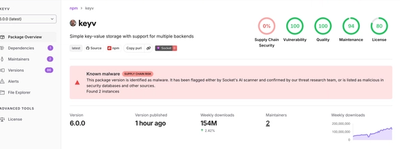
Popular npm packages keyv and cacheable compromised.

Security News
A misconfiguration gave three Anthropic models internet access, and one, believing it was in a simulation, shipped a credential-stealing package to PyPI.