
Company News
AWS Security Hub Adds Socket for Supply Chain Security
Socket is now in the AWS Security Hub Extended plan. Adopt it through AWS, apply committed spend, and block malicious open source packages.
By Feross Aboukhadijeh - Aug 04, 2026
mcp-imagenate
Advanced tools
MCP server and embeddable library for image generation using multiple providers (Google Gemini, OpenAI, BFL FLUX)

An MCP server for image generation using multiple providers: Google Gemini, OpenAI (gpt-image), and BFL FLUX.
| Name | Model ID | Best for |
|---|---|---|
nano-banana-2 | gemini-3.1-flash-image-preview | Fast, high-volume generation |
nano-banana-pro | gemini-3-pro-image-preview | Highest quality output |
| Name | Model ID | Best for |
|---|---|---|
gpt-image-2 | gpt-image-2 | Latest generation, improved detail |
| Name | Model ID | Best for |
|---|---|---|
flux-2-klein | klein-4b | Fast, lightweight generation |
flux-2-pro | pro-preview | Balanced quality and speed |
flux-2-max | max | Maximum quality |
npx mcp-imagenate
Or install globally:
npm install -g mcp-imagenate
Set API keys for the providers you want to use:
# Google Gemini (at least one)
export GEMINI_API_KEY=your_key_here
# or
export NANO_BANANA_API_KEY=your_key_here

# OpenAI (at least one)
export OPENAI_API_KEY=your_key_here
# or
export GPT_IMAGE_API_KEY=your_key_here

# BFL FLUX
export BFL_API_KEY=your_key_here
Add to your claude_desktop_config.json:
{
  "mcpServers": {
    "mcp-imagenate": {
      "command": "npx",
      "args": ["mcp-imagenate"],
      "env": {
        "GEMINI_API_KEY": "your_key_here",
        "NANO_BANANA_OUTPUT_DIR": "/path/to/image/output"
      }
    }
  }
}
| Variable | Required | Description |
|---|---|---|
GEMINI_API_KEY | * | Google AI Studio API key |
NANO_BANANA_API_KEY | * | Alternative to GEMINI_API_KEY (takes precedence) |
OPENAI_API_KEY | * | OpenAI API key |
GPT_IMAGE_API_KEY | * | Alternative to OPENAI_API_KEY (takes precedence) |
BFL_API_KEY | * | BFL FLUX API key |
NANO_BANANA_OUTPUT_DIR | No | Base directory for saved images. When set, all output and input paths are sandboxed within this directory. Recommended for production. |
* At least one provider API key must be set.
generate_image| Parameter | Type | Default | Description |
|---|---|---|---|
prompt | string (1-32,000 chars) | - | Text prompt describing the image |
model | see Models above | "gpt-image-2" | Model to use (available models depend on configured API keys) |
resolution | "1K" | "2K" | "4K" | "1K" | Output image resolution |
aspectRatio | see below | "1:1" | Aspect ratio of the image |
mode | "image" | "image_and_text" | "image" | Return image only, or image with description (Google models only) |
thinking | "none" | "auto" | "auto" | Controls model thinking (Google models only) |
outputDir | string | "." | Directory where images will be saved |
inputImages | string[] | - | File paths of images to send alongside the prompt (Google models, and OpenAI gpt-image models via the images.edit endpoint) |
1:1, 2:3, 3:2, 3:4, 4:3, 9:16, 16:9, 21:9
Returns a JSON object:
{
  "model": "gemini-3.1-flash-image-preview",
  "savedFiles": ["/path/to/image-1.png"],
  "settings": {
    "resolution": "1K",
    "aspectRatio": "9:16",
    "mode": "image"
  },
  "description": "..."
}
descriptionis only present whenmodeis"image_and_text".
Besides the standalone MCP server, this package can be embedded in another host — an app, or another MCP server that wants to expose image generation as its own tool.
import { createRegistry, generateImageToDisk } from "mcp-imagenate";

// Keys are passed in explicitly; nothing here reads process.env.
const registry = createRegistry({ openai: myOpenAIKey, google: myGoogleKey });

if (registry.models.length === 0) {
  throw new Error("No image provider is configured");
}

const outcome = await generateImageToDisk({
  registry,
  prompt: "a calico cat asleep on a warm keyboard",
  model: registry.defaultModel!,
  aspectRatio: "16:9",
  outputDir: "/somewhere/to/write",
  // outputBaseDir defaults to null, meaning no path sandboxing. Set it to a
  // directory to confine both output and input paths within that directory.
});

console.log(outcome.savedFiles);
The library entry point never reads process.env, writes to stdio, or exits the
process. To read keys from the conventional environment variables anyway, use the
keysFromEnv() helper. The standalone server is available at mcp-imagenate/server.
| Export | Purpose |
|---|---|
createRegistry(keys) | Build a registry of the models available for the given keys |
keysFromEnv(env?) | Read provider keys from environment variables |
generateImageToDisk(options) | Generate images and write them to disk |
resolveOutputDir / resolveInputImagePath | Path sandboxing helpers (opt-in) |
NANO_BANANA_OUTPUT_DIR is set, both output and input image paths are sandboxed within this directory. Symlinks that resolve outside the sandbox are rejected. For library embedders this is opt-in via outputBaseDir, since the host usually controls which paths reach the call.MIT
FAQs
MCP server and embeddable library for image generation using multiple providers (Google Gemini, OpenAI, BFL FLUX)
We found that mcp-imagenate demonstrated a healthy version release cadence and project activity because the last version was released less than a year ago. It has 1 open source maintainer collaborating on the project.
Did you know?

Socket for GitHub automatically highlights issues in each pull request and monitors the health of all your open source dependencies. Discover the contents of your packages and block harmful activity before you install or update your dependencies.
Company News
Socket is now in the AWS Security Hub Extended plan. Adopt it through AWS, apply committed spend, and block malicious open source packages.
Research
/Security News
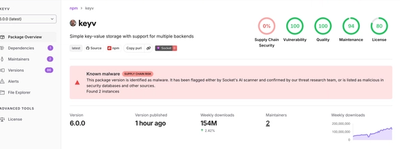
Popular npm packages keyv and cacheable compromised.

Security News
A misconfiguration gave three Anthropic models internet access, and one, believing it was in a simulation, shipped a credential-stealing package to PyPI.