

Product
PHP and Composer Support Is Now in Beta
Socket’s PHP and Composer support is now in Beta for all customers, with PHP reachability analysis generally available.
By Trevor Norris, Benjamin Barslev - Aug 21, 2026
medusa-plugin-einvoice
Advanced tools
EN 16931 e-invoicing for Medusa v2 — generate and validate XRechnung, Peppol BIS 3.0 and Factur-X (CII) XML from your orders, locally and for free.
EN 16931 e-invoicing for Medusa v2. When an order is placed, generate a compliant XRechnung, Peppol BIS 3.0 or Factur-X (CII) XML document from the order, validate it against the business rules before storing it, and attach the verdict to the order.
Generation and validation run locally and for free via
@attestwire/en16931 — a
zero-dependency TypeScript implementation of the rules. There is no API to sign
up for, no per-invoice cost, and no network call in the default configuration.
npm install medusa-plugin-einvoice
// medusa-config.ts
module.exports = defineConfig({
  plugins: [
    {
      resolve: "medusa-plugin-einvoice",
      options: {
        seller: {
          name: "Beispiel Handels GmbH",
          vatId: "DE123456789",
          legalRegistrationId: "HRB 12345 B",
          address: {
            line1: "Hauptstraße 1",
            city: "Berlin",
            postalCode: "10115",
            countryCode: "DE",
          },
          // BR-DE-2/5/6/7: all three are mandatory for XRechnung.
          contact: {
            name: "Buchhaltung",
            email: "rechnungen@beispiel.example",
            phone: "+49 30 1234567",
          },
          electronicAddress: { schemeId: "9930", value: "DE123456789" },
        },
        // BR-DE-1: XRechnung requires payment instructions.
        payment: {
          meansCode: "58",
          iban: "DE02120300000000202051",
          accountName: "Beispiel Handels GmbH",
        },
        paymentTermDays: 30,
      },
    },
  ],
})
npx medusa db:migrate
That is the whole setup. Place an order and the plugin generates the document,
validates it, stores it, and writes a report to order.metadata.einvoice. The
order details page in the admin gains an E-invoice panel with the status,
any rule failures, and a download button.
Node 20.19+ or 22.12+ is required (the same floor as Medusa 2.19). This is
load-bearing rather than incidental: the validation engine is an ESM-only
package and a Medusa plugin compiles to CommonJS, so the plugin relies on
Node's require(esm) support, which is unflagged from exactly those versions.
| Buyer country | Profile (profile: "auto") | Syntax |
|---|---|---|
| DE | xrechnung-ubl | UBL 2.1 |
| FR | facturx-en16931 | CII D16B |
| anywhere else | peppol-bis-3 | UBL 2.1 |
Override globally with profile, or per country with
profileByCountry: { AT: "peppol-bis-3" }.
For a French buyer this plugin emits the Factur-X CII XML payload. It does
not build the PDF/A-3 container that makes a file a Factur-X invoice. The
underlying library reads that container (extractFacturX) and deliberately does
not write one.
So: if your counterparty wants the XML — which is what portals, access points
and the Chorus Pro/PPF pipeline consume — you have it. If you need the
human-readable PDF with the XML embedded, you need a PDF/A-3 step this plugin
does not provide. Take the XML from GET /admin/orders/:id/einvoice?format=xml
and embed it with a PDF library of your choice.
Nothing is stored before it is validated, and a document that fails is stored flagged and logged rule by rule:
[einvoice] RE-2026-1042: xrechnung-ubl FAILED validation with 1 error(s).
[einvoice]   BR-DE-15 (BT-10): A German public-sector buyer requires a Leitweg-ID …
[einvoice]     fix: set buyerReference to the Leitweg-ID your client gave you
[einvoice]     https://attestwire.com/rules/BR-DE-15
The same findings land on the order:
// order.metadata.einvoice
{
  "invoice_number": "RE-2026-1042",
  "profile": "xrechnung-ubl",
  "valid": false,
  "errors": [{ "rule": "BR-DE-15", "field": "BT-10", "fix": "…", "docs": "https://attestwire.com/rules/BR-DE-15" }],
  "notes": [{ "code": "VAT_INTRA_COMMUNITY", "level": "info", "message": "…" }],
  "reconciliation": { "matches": true, "deltas": [ /* … */ ] }
}
An invoice never blocks an order. A failed generation is logged and stored; the checkout is unaffected.
This is the part worth reading before you trust it in production.
Tax-inclusive pricing. EN 16931's BT-146 is a net unit price. When
is_tax_inclusive is set, VAT is divided out at 8 decimals before the quantity
is applied — rounding the unit price to 2 decimals first is what makes a
multi-line order a cent short. The line amount is then rounded as BR-DEC-*
requires.
Discounts become line allowances (BG-27), not document allowances. A Medusa
promotion arrives as an adjustment on the item it discounted. A line allowance
inherits that line's VAT treatment; a document allowance carries its own
category and rate, so hoisting a per-item discount to document level means
inventing a rate for it — and getting the VAT breakdown wrong as soon as an
order mixes 19 % and 7 % goods. An adjustment that is itself tax-inclusive has
VAT removed at the line's rate. A negative adjustment becomes a line charge
(BG-28), because BR-41/BR-42 require both to be stated positively.
Shipping becomes a document charge (BG-21, reason code FC). A
shipping-method promotion becomes a document allowance (BG-20) at the shipping
rate — it is the one discount with no line to sit on. Set shippingAsLine: true
if you would rather see freight as an invoice line.
Totals are computed, not copied. The engine derives BT-106…BT-115 from the
lines, so the document is always internally consistent. Medusa's own totals are
then compared and any disagreement is reported as a TOTALS_MISMATCH note.
Set declareTotals: true to write Medusa's figures into the document instead
and let BR-CO-10…16 reject the mismatch outright — useful for catching an
accounting bug, disruptive as a default.
VAT categories are inferred, and every inference leaves a note. Medusa knows how much tax it charged, never why it charged none. Zero can mean four different things:
| Situation | Category | Option |
|---|---|---|
| rate > 0 | S | — |
| zero, same country | Z | zeroRateCategory |
| zero, EU buyer with a VAT id | AE | intraCommunityCategory (K for goods) |
| zero, EU buyer without a VAT id | Z + warning | — |
| zero, non-EU buyer | G | — |
AE, K and G also put the standard exemption sentence in BT-22.
Multi-currency passes currency_code through as BT-5. If VAT must be
reported in another currency (BT-6/BT-111) the plugin does not attempt it: the
required exchange rate is not on the order, and inventing one would be a tax
statement.
Multiple tax lines at different rates on one item are summed, because
EN 16931 allows one category and one rate per line — with a MULTIPLE_TAX_LINES
warning.
Buyer identity comes from the billing address, falling back to shipping with
a warning. Company name wins over person name. The buyer's VAT id and Peppol
endpoint come from order metadata (vat_id, einvoice_buyer_endpoint), because
Medusa has nowhere else to keep them.
Everything above works with no account. Setting attestwireApiKey adds two
things, neither of which anything depends on:
options: {
  attestwireApiKey: process.env.ATTESTWIRE_API_KEY,
  createValidationRecords: true, // default when a key is set
  checkRuleCurrency: true,       // default when a key is set
}
record_url. The invoice itself
never leaves your process — the hosted side keeps a SHA-256 fingerprint and
the findings, nothing more./v1/versions at boot. If the pinned
library trails the current ruleset you get one warning naming the rule ids
added since. Silence when current.Both fail soft. An invoice is never blocked by a network problem, and the local verdict is always the one that produced your XML.
GET  /admin/orders/:id/einvoice              → the stored document + report
GET  /admin/orders/:id/einvoice?format=xml   → download the XML
POST /admin/orders/:id/einvoice { force }    → generate / regenerate
Programmatically, from anywhere in your app:
import { generateEInvoiceWorkflow } from "medusa-plugin-einvoice/workflows"

const { result } = await generateEInvoiceWorkflow(container).run({
  input: { order_id: "order_123" },
})
Or without Medusa at all — the mapping layer is framework-free:
import { buildEInvoice } from "medusa-plugin-einvoice/lib"

const { xml, valid, errors } = buildEInvoice(order, options)
| Option | Default | Meaning |
|---|---|---|
seller | — | Required. Name, address, VAT id, contact. |
profile | "auto" | Fixed profile, or country-derived. |
profileByCountry | {} | Per-country override. |
events | ["order.placed"] | Also accepts "order.completed". |
invoiceNumberPrefix | "" | Prefixed to the order's display_id. |
invoiceNumberMetadataKey | — | Order metadata key that overrides the number. |
buyerReferenceMetadataKey | "buyer_reference" | BT-10 / Leitweg-ID. |
buyerEndpointMetadataKey | "einvoice_buyer_endpoint" | BT-49, { schemeId, value }. |
buyerVatIdMetadataKey | "vat_id" | BT-48. |
defaultUnitCode | "C62" | BT-130 unit of measure. |
zeroRateCategory | "Z" | Domestic zero rate. |
intraCommunityCategory | "AE" | "K" for goods. |
vatExemptionReasons | — | BT-120 per category. E has no default. |
shippingAsLine | false | Freight as a line instead of BG-21. |
payment / paymentTerms / paymentTermDays | — | BG-16, BT-20, BT-9. |
declareTotals | false | Write Medusa's totals into BT-106…115. |
totalsTolerance | 0.02 | Reconciliation tolerance. |
failOnWarnings | false | Treat warnings as failures. |
storeXml | true | Keep the XML in the plugin's table. |
writeOrderMetadata | true | Write the report to order.metadata. |
attestwireApiKey | — | Enables the hosted layer. |
In scope and working: order → EN 16931 XML (UBL and CII), local validation with rule ids and docs links, storage, order metadata report, admin panel, download endpoint, workflow API, tax-inclusive pricing, promotions, shipping, multi-currency, reverse charge and export.
Not in scope, and here is what you would need instead:
381 document. The underlying library supports credit notes fully
(one field), so this is a mapping gap, not a capability gap.payment.captured as a trigger. Its payload is a payment id, not an
order id; resolving one to the other reliably is left to your own subscriber.display_id with
an optional prefix. Several jurisdictions require a gap-free sequence per
seller, which an order id is not.npm install
npm test # 42 mapping tests, every fixture validated by the engine
npm run typecheck
npm run build # medusa plugin:build
The test suite's standing rule: every fixture that should produce a sendable
invoice must come back valid: true from the engine, and one that should not
must fail by naming the rule.
Only needed after changing the model in src/modules/einvoice/models/. The
Medusa CLI builds its own MikroORM config for this command, so it reads
DB_HOST/DB_PORT/DB_USERNAME/DB_PASSWORD rather than DATABASE_URL, and
it connects to a database named medusa-einvoice, which must exist:
DB_HOST=localhost DB_PORT=5432 DB_USERNAME=postgres DB_PASSWORD=postgres \
  npm run db:generate
The diff is taken against .snapshot-medusa-einvoice.json, which is committed
next to the migrations. Keep it committed — without it the next run emits a
duplicate create-table migration instead of an incremental one.
MIT
FAQs
EN 16931 e-invoicing for Medusa v2 — generate and validate XRechnung, Peppol BIS 3.0 and Factur-X (CII) XML from your orders, locally and for free.
We found that medusa-plugin-einvoice demonstrated a healthy version release cadence and project activity because the last version was released less than a year ago. It has 1 open source maintainer collaborating on the project.
Product
Socket’s PHP and Composer support is now in Beta for all customers, with PHP reachability analysis generally available.
Product
Socket is bringing experimental protection to Firefox, scanning 97,000+ extensions in Mozilla's official directory for malware and risky updates.
Research
/Security News
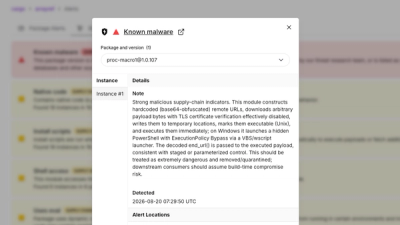
Three compromised Rust crates pulled in a malicious dependency that downloaded and executed cross-platform malware during Cargo builds.