
Research
/Security News
Popular npm Packages in the keyv and Cacheable Namespaces Compromised in Active Supply Chain Attack
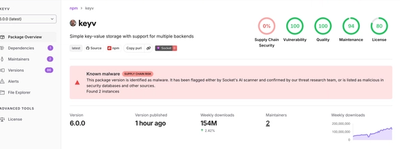
Popular npm packages keyv and cacheable compromised.
By Socket Research Team - Aug 04, 2026
memento-mcp
Advanced tools
Persistent memory for AI agents.
AI agents have anterograde amnesia — every session starts blank. The Memento Protocol gives agents a structured way to remember, not by recording everything, but by writing instructions to their future selves. Memories decay, consolidate, and evolve — like biological memory, not a log file.
npx memento-mcp init
This creates .memento.json, detects your agent (Claude Code, Codex, Gemini CLI, OpenCode), writes the correct MCP config, and registers hooks — all in one command.
git clone https://github.com/myrakrusemark/memento-protocol.git
cd memento-protocol && npm install
Verify the install:
npm run test:smoke
You should see all tools listed and "All smoke tests passed."
curl -X POST https://memento-api.myrakrusemark.workers.dev/v1/auth/signup \
  -H "Content-Type: application/json" \
  -d '{"workspace": "my-project"}'
No email, no password, no OAuth. One curl, one key. Optionally include "email" for account recovery later.
Save the api_key from the response — you'll need it next.
Claude Code — .mcp.json in your project root (or ~/.claude.json globally):
{
  "mcpServers": {
    "memento": {
      "command": "npx",
      "args": ["-y", "memento-mcp"]
    }
  }
}
OpenAI Codex — .codex/config.toml:
[mcp_servers.memento]
command = "npx"
args = ["-y", "memento-mcp"]
Gemini CLI — .gemini/settings.json:
{
  "mcpServers": {
    "memento": {
      "command": "npx",
      "args": ["-y", "memento-mcp"]
    }
  }
}
OpenCode — opencode.json:
{
  "mcp": {
    "memento": {
      "type": "local",
      "command": ["npx", "-y", "memento-mcp"],
      "enabled": true
    }
  }
}
Set credentials via .memento.json (created by npx memento-mcp init) or environment variables MEMENTO_API_KEY, MEMENTO_API_URL, MEMENTO_WORKSPACE.
The MCP server connects at startup. Restart so it picks up the new config.
> memento_health()              # verify connection
> memento_remember(             # store your first memory
    content: "API uses /v2 endpoints. Auth is Bearer token in header.",
    type: "instruction",
    tags: ["api", "auth"]
  )
> memento_recall(query: "api auth")   # find it again
That's it. The agent reads memory at session start, updates it as it works, and writes instructions for next time.
Paste this block into your project's CLAUDE.md to teach your agent memory discipline:
## Memory (Memento Protocol)

On session start:
1. `memento_health` — verify connection
2. `memento_item_list` — check active work items and their next actions
3. `memento_recall` with current task context — find relevant past memories

During work — actively manage your own memories:
- `memento_remember` when you learn something, make a decision, or discover a pattern
- `memento_recall` before starting any subtask — someone may have already figured it out
- `memento_item_update` as you make progress — don't wait until the end
- `memento_item_create` when new work emerges
- `memento_skip_add` the moment you hit a dead end (with expiry)
- `memento_consolidate` when recall returns 3+ overlapping memories on the same topic
- Delete or archive items that are done or wrong — stale memory is worse than no memory

Writing discipline:
- Instructions, not logs: "API moved to /v2 — update all calls" not "checked API, got 404"
- Tag generously — tags power recall and consolidation
- Set expiration on time-sensitive facts
- The test: could a future you, with zero context, read this and know exactly what to do?

Your memories are yours. Create, update, and delete them whenever the work demands it —
not just at session boundaries.
Installing Memento gives your agent memory. The Protocol is the system you build around it — orientation after context loss, automatic recall, writing discipline, distillation before context resets, identity that persists across sessions.
Full guide: The Protocol on hifathom.com.
Hooks automate memory at session boundaries — recall on every message, distillation before context loss, identity injection at session start. Five production-ready scripts are included in scripts/:
| Script | What it does |
|---|---|
memento-sessionstart-identity.sh | Injects identity crystal + version check at session start |
memento-userprompt-recall.sh | Recalls memories relevant to the user's message |
memento-stop-recall.sh | Recalls memories from the assistant's own output (autonomous work) |
memento-precompact-distill.sh | Extracts memories from the conversation before context compression |
memento-codex-notify.sh | Stores post-turn summaries from Codex CLI as memory observations |
npx memento-mcp init auto-detects your agent and registers the appropriate hooks. Not all agents support the same hook events — here's what gets wired up:
| Hook | Claude Code | Gemini CLI | Codex CLI |
|---|---|---|---|
| Session start / identity | SessionStart | SessionStart | — |
| Recall on user message | UserPromptSubmit | BeforeAgent | — |
| Recall on assistant output | Stop | SessionEnd | — |
| Pre-compaction distillation | PreCompact | PreCompress | — |
| Post-turn memory storage | — | — | notify |
OpenCode uses a TypeScript plugin system — MCP tools work, but hooks require a different integration pattern.
See scripts/README.md for setup, configuration, and how to write your own hooks.
Browse and manage memories visually at hifathom.com/memento/dashboard. Paste your API key and workspace name to connect.
Full reference docs at hifathom.com/memento:
npm test              # Run unit + integration tests
npm run lint          # Lint with ESLint
npm run format:check  # Check formatting with Prettier
npm run test:smoke    # Quick smoke test of all tools
MIT
FAQs
The Memento Protocol — persistent memory for AI agents
The npm package memento-mcp receives a total of 21 weekly downloads. As such, memento-mcp popularity was classified as not popular.
We found that memento-mcp demonstrated a healthy version release cadence and project activity because the last version was released less than a year ago. It has 1 open source maintainer collaborating on the project.
Did you know?

Socket for GitHub automatically highlights issues in each pull request and monitors the health of all your open source dependencies. Discover the contents of your packages and block harmful activity before you install or update your dependencies.
Research
/Security News
Popular npm packages keyv and cacheable compromised.

Security News
A misconfiguration gave three Anthropic models internet access, and one, believing it was in a simulation, shipped a credential-stealing package to PyPI.

Security News
/Company News
Socket has joined the new Composer and Packagist sponsorship program as a launch sponsor, supporting the team that keeps PHP's package ecosystem secure.