
Product
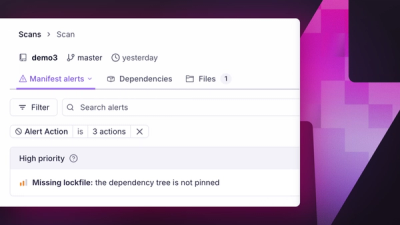
Introducing Manifest Alerts
Socket now detects supply chain risks in project manifests, starting with missing lockfiles that can make dependency installs non-reproducible.
By André Staltz, Trevor Norris - Jun 16, 2026
My LIL'CAT, which is short for **My Largly Intricated Library 'n' Cool Artificial Things**, is a JavaScript based Physics library, which is written using ES6 "class" Syntax, and it is then transpiled using webpack.

My LIL'CAT, which is short for My Largly Intricated Library 'n' Cool Artificial Things, is a JavaScript based Physics library, which is written using ES6 "class" Syntax, and it is then transpiled using webpack.
For now there are three main classes:
VectorBodyWorldHere they are listed in an ascending order of complexity: a vector is the core unit, on top of which you can make Bodies, which are, for nows, just rigid bodies.
The bodies have a lot of properties and methods which rely heavily on Vectors.
Then there is the World class, which contains all of its "children" Bodies, and it also has stuff like Gravity, which it then passes down to each one of its children.
Everything is being tested through Jest, although I started using it only recently, so up until now there has not been any TDD / Red Green Refractor type of thing going on, although I'll be doing it, from now on.
If you want to contribute I'd be grateful! Do not hesitate to fork this repo, if you want to help a poor noobie with his little side-project!
If you want to know the state of development, check out the TODO.todo file: it will list all the stuff I'm currently doing, or all the stuff I have done. If you want to open it using a pleasing graphic, you should use some extension like "To Do Tasks", which is available for most major text editors.
First of all, you'll want to install all of the required npm modules. To do so run the command npm install
To use this library, you'll need to build it (at least for now). To do so, run npm run build:lib.
After this you'll need to run the command npm run build and, at this point you'll have the compiled library in the /lib folder.
If you want to run the unit tests you can either use npm run test, which will run all tests once, or use npm run dev:test, which will enter watch mode for testing.
For now, if you want to use the library, you'll need to use something like Webpack (you can actually use this repo as an empty example), and write all your code in the app.js file. To build the app, run npm run build:app. The compiled, bundled file will be saved in the /dist folder, under the name of bundle.js. You can also use a live development server with hot module reloading by running npm run serve. Note that, if you use it, compiled files will be stored in memory, and won't actually be saved on your hard drive.
FAQs
My LIL'CAT, which is short for **My Largly Intricated Library 'n' Cool Artificial Things**, is a JavaScript based Physics library, which is written using ES6 "class" Syntax, and it is then transpiled using webpack.
We found that my-lil-cat demonstrated a not healthy version release cadence and project activity because the last version was released a year ago. It has 1 open source maintainer collaborating on the project.
Did you know?

Socket for GitHub automatically highlights issues in each pull request and monitors the health of all your open source dependencies. Discover the contents of your packages and block harmful activity before you install or update your dependencies.
Product
Socket now detects supply chain risks in project manifests, starting with missing lockfiles that can make dependency installs non-reproducible.

Research
/Security News
The trojanized extensions use TinyGo-compiled WebAssembly and Solana transaction memos to resolve command-and-control infrastructure.

Security News
Anthropic says the directive cited national security concerns over a narrow jailbreak, but offered no specific technical details.