
Research
/Security News
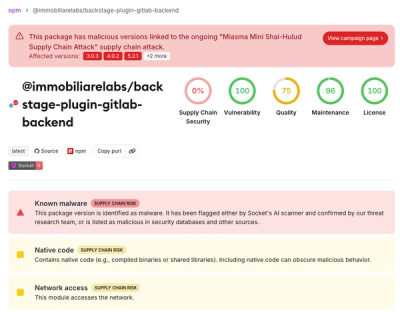
Miasma Mini Shai-Hulud Hits ImmobiliareLabs npm Packages
Miasma Mini Shai-Hulud hits @immobiliarelabs Backstage plugins, targeting GitLab and LDAP auth packages on npm.
By Socket Research Team - Jun 26, 2026
najm-email
Advanced tools
Email plugin for Najm API framework with multi-provider support.
bun add najm-email
import { Server } from 'najm-core';
import { email } from 'najm-email';

const server = new Server()
  .use(email({
    provider: {
      provider: 'resend',
      apiKey: process.env.RESEND_API_KEY!,
    },
    defaultFrom: 'noreply@example.com',
  }))
  .listen(3000);
import { Service } from 'najm-core';
import { EmailService } from 'najm-email';

@Service()
export class NotificationService {
  constructor(private email: EmailService) {}

  async sendWelcomeEmail(user: { email: string; name: string }) {
    await this.email.send({
      to: user.email,
      subject: 'Welcome!',
      html: `<h1>Welcome, ${user.name}!</h1>`,
    });
  }
}
email({
  provider: {
    provider: 'resend',
    apiKey: process.env.RESEND_API_KEY!,
  },
  defaultFrom: 'noreply@example.com',
})
email({
  provider: {
    provider: 'smtp',
    host: 'smtp.gmail.com',
    port: 587,
    auth: {
      user: process.env.SMTP_USER!,
      pass: process.env.SMTP_PASS!,
    },
  },
  defaultFrom: 'noreply@example.com',
})
email({
  provider: {
    provider: 'sendgrid',
    apiKey: process.env.SENDGRID_API_KEY!,
    sandboxMode: false, // Set to true for testing
  },
  defaultFrom: 'noreply@example.com',
})
email({
  provider: {
    provider: 'console',
    logLevel: 'debug', // 'info' | 'debug'
  },
  defaultFrom: 'dev@localhost',
})
import { email, MemoryProvider } from 'najm-email';

const server = new Server()
  .use(email({
    provider: { provider: 'memory' },
  }));

// In tests
const emailService = container.get(EmailService);
const memoryProvider = emailService.getProvider<MemoryProvider>();

// Assert emails were sent
expect(memoryProvider.assertSentTo('user@example.com')).toBe(true);
expect(memoryProvider.getEmailCount()).toBe(1);
send(message: EmailMessage): Promise<SendResult>Send a single email.
const result = await emailService.send({
  to: 'user@example.com',
  subject: 'Hello',
  text: 'Plain text content',
  html: '<p>HTML content</p>',
});

if (result.success) {
  console.log('Sent:', result.messageId);
} else {
  console.error('Failed:', result.error);
}
sendBulk(messages: EmailMessage[]): Promise<BulkSendResult>Send multiple emails.
const result = await emailService.sendBulk([
  { to: 'user1@example.com', subject: 'Hello 1', text: 'Hi!' },
  { to: 'user2@example.com', subject: 'Hello 2', text: 'Hi!' },
]);

console.log(`Sent: ${result.sent}, Failed: ${result.failed}`);
sendText(to, subject, text, from?): Promise<SendResult>Convenience method for text emails.
await emailService.sendText(
  'user@example.com',
  'Subject',
  'Plain text content'
);
sendHtml(to, subject, html, from?): Promise<SendResult>Convenience method for HTML emails.
await emailService.sendHtml(
  'user@example.com',
  'Subject',
  '<h1>HTML content</h1>'
);
interface EmailMessage {
  // Recipients
  to: string | EmailAddress | (string | EmailAddress)[];
  cc?: string | EmailAddress | (string | EmailAddress)[];
  bcc?: string | EmailAddress | (string | EmailAddress)[];

  // Sender
  from?: string | EmailAddress;
  replyTo?: string | EmailAddress;

  // Content
  subject: string;
  text?: string;
  html?: string;

  // Attachments
  attachments?: EmailAttachment[];

  // Metadata
  headers?: Record<string, string>;
  priority?: 1 | 3 | 5; // 1=high, 3=normal, 5=low
  tags?: string[];
  metadata?: Record<string, any>;
}

interface EmailAddress {
  email: string;
  name?: string;
}

interface EmailAttachment {
  filename: string;
  content: Buffer | string;
  contentType?: string;
  cid?: string; // For inline images
  disposition?: 'attachment' | 'inline';
}
Subscribe to email lifecycle events:
@Service()
export class EmailLogger {
  constructor(private email: EmailService) {}

  onInit() {
    this.email.on('email:sending', ({ message }) => {
      console.log('Sending to:', message.to);
    });

    this.email.on('email:sent', ({ message, result }) => {
      console.log('Sent:', result.messageId);
    });

    this.email.on('email:failed', ({ message, error }) => {
      console.error('Failed:', error.message);
    });
  }
}
interface EmailConfig {
  // Provider configuration (required)
  provider: ProviderConfig;

  // Default sender (optional)
  defaultFrom?: string | EmailAddress;

  // Default reply-to (optional)
  defaultReplyTo?: string | EmailAddress;

  // Enable debug logging (optional)
  debug?: boolean;

  // Retry configuration (optional)
  retry?: {
    attempts?: number; // Default: 1
    delay?: number;    // Default: 1000ms
  };
}
Use email for password reset, verification, etc:
import { Service } from 'najm-core';
import { EmailService } from 'najm-email';
import { TokenService } from 'najm-auth';

@Service()
export class PasswordResetService {
  constructor(
    private email: EmailService,
    private token: TokenService,
  ) {}

  async sendResetEmail(user: { id: string; email: string }) {
    // Generate reset token
    const resetToken = await this.token.generatePasswordResetToken(user.id);

    // Send email
    await this.email.send({
      to: user.email,
      subject: 'Reset Your Password',
      html: `
        <h1>Password Reset</h1>
        <p>Click the link below to reset your password:</p>
        <a href="https://example.com/reset?token=${resetToken}">
          Reset Password
        </a>
      `,
    });
  }
}
Use the MemoryProvider for testing:
import { describe, test, expect, beforeEach } from 'bun:test';
import { Server } from 'najm-core';
import { email, EmailService, MemoryProvider } from 'najm-email';

describe('Email Tests', () => {
  let server: Server;
  let emailService: EmailService;
  let memoryProvider: MemoryProvider;

  beforeEach(async () => {
    server = new Server({ isolated: true })
      .use(email({ provider: { provider: 'memory' } }));

    await server.listen(3100);

    emailService = server.container.get(EmailService);
    memoryProvider = emailService.getProvider<MemoryProvider>();
  });

  test('should send welcome email', async () => {
    await emailService.send({
      to: 'user@example.com',
      subject: 'Welcome',
      text: 'Welcome to our app!',
    });

    expect(memoryProvider.assertSentTo('user@example.com')).toBe(true);
    expect(memoryProvider.assertSentWithSubject('Welcome')).toBe(true);
  });
});
Create custom providers by extending BaseProvider:
import { BaseProvider, EmailMessage, SendResult } from 'najm-email';

export class MyCustomProvider extends BaseProvider {
  readonly name = 'custom';

  async initialize(): Promise<void> {
    // Initialize your provider
  }

  async send(message: EmailMessage): Promise<SendResult> {
    // Implement sending logic
    return this.success('message-id-123');
  }
}
MIT
FAQs
Email plugin for Najm API framework with multi-provider support
We found that najm-email demonstrated a healthy version release cadence and project activity because the last version was released less than a year ago. It has 1 open source maintainer collaborating on the project.
Did you know?

Socket for GitHub automatically highlights issues in each pull request and monitors the health of all your open source dependencies. Discover the contents of your packages and block harmful activity before you install or update your dependencies.
Research
/Security News
Miasma Mini Shai-Hulud hits @immobiliarelabs Backstage plugins, targeting GitLab and LDAP auth packages on npm.

Security News
Rolldown paused Rust React Compiler integration after a 5MB binary size increase raised concerns about shipping React-specific code to all Vite users.

Security News
/Research
Mini Shai-Hulud expands into the Go ecosystem after hitting LeoPlatform npm packages and targeting GitHub Actions workflows.