

Research
/Security News
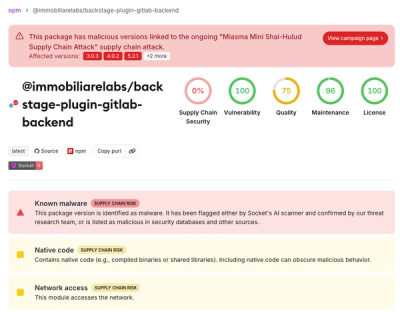
Miasma Mini Shai-Hulud Hits ImmobiliareLabs npm Packages
Miasma Mini Shai-Hulud hits @immobiliarelabs Backstage plugins, targeting GitLab and LDAP auth packages on npm.
By Socket Research Team - Jun 26, 2026
MCP (Model Context Protocol) plugin for the Najm framework
Build MCP tools, resources, and prompts with decorators — connect any LLM to your API in minutes.


najm-mcp is a Najm plugin that exposes your API as an MCP server — compatible with Claude, ChatGPT, Gemini, Cursor, Windsurf, VS Code Copilot, and any other MCP-enabled LLM client.
You write one decorator. Every LLM can use it.
@McpServer()
export class ProductTools {
  constructor(private svc: ProductService) {} // same DI as your REST controllers

  @Tool({ name: 'search_products', description: 'Search the product catalog' })
  async search(
    @Arg('query', z.string()) query: string,
    @Arg('limit', z.number().default(10)) limit: number,
  ) {
    return this.svc.search(query, limit); // reuse your existing service
  }
}
That's it. No transport config. No SDK boilerplate. No duplicate business logic.
| Client | Transport | Config key |
|---|---|---|
| Claude.ai | Streamable HTTP | Remote URL |
| Claude Desktop | SSE or stdio | Config file |
| ChatGPT | Streamable HTTP | Remote URL |
| Gemini / AI Studio | Streamable HTTP | Remote URL |
| Cursor | SSE or stdio | .cursor/mcp.json |
| Windsurf | SSE | mcp_config.json |
| VS Code Copilot | SSE | .vscode/mcp.json |
All three MCP transports supported: Streamable HTTP, SSE, stdio.
bun add najm-mcp @modelcontextprotocol/sdk zod
# or
npm install najm-mcp @modelcontextprotocol/sdk zod
Peer dependencies: najm-core, hono, reflect-metadata, zod
Latest DX enhancements make MCP tools much leaner:
string, object/array, null/undefined, and explicit content payloads)null / undefined tool returns now normalize to "OK"McpResult(...) and McpError(...)IdArg(...) and IntArg(...)catchErrors on @Tool(...) and @Bridge(...) for stable fallback errorsQuick migration example:
// Before
@Tool({ name: 'list_books', description: 'List books' })
async listBooks() {
  try {
    const books = await this.repo.list();
    return McpJson(books);
  } catch (error) {
    return McpError(`Failed to fetch books: ${String(error)}`);
  }
}

// After
@Tool({ name: 'list_books', description: 'List books', catchErrors: 'Failed to fetch books' })
async listBooks() {
  return await this.repo.list();
}
// src/server.ts
import 'reflect-metadata';
import { Server } from 'najm-core';
import { mcp } from 'najm-mcp';
import * as features from './features';

export const server = new Server()
  .use(mcp({
    name: 'my-api',
    version: '1.0.0',
  }))
  .base('/api')
  .load(features);
// src/features/products/product.tools.ts
import { McpServer, Tool, Arg } from 'najm-mcp';
import { z } from 'zod';
import { ProductService } from './product.service';

@McpServer()
export class ProductTools {
  constructor(private svc: ProductService) {}

  @Tool({ name: 'get_product', description: 'Get a product by ID' })
  async getProduct(
    @Arg('id', z.string().uuid().describe('Product ID')) id: string,
  ) {
    return this.svc.findById(id);
  }
}
// src/features/products/index.ts
export { ProductController } from './product.controller';
export { ProductService }    from './product.service';
export { ProductTools }      from './product.tools'; // add this
bun run src/main.ts
Your MCP server is now live:
POST /api/mcp — Streamable HTTP (Claude.ai, ChatGPT, Gemini)GET /api/mcp — Server probeGET /api/mcp/tools — Human-readable discoveryConfigure which transports to enable:
.use(mcp({
  name: 'my-api',
  version: '1.0.0',
  transports: ['http', 'sse'], // default: ['http']
  path: '/mcp',                // default: '/mcp'
  cors: true,                  // default: true
}))
Stateless. Works in serverless, Next.js, Vercel, and any runtime.
POST /mcp   ← Claude.ai, ChatGPT, Gemini
GET  /mcp   ← probe endpoint
GET  /mcp/tools ← discovery endpoint
Persistent connection. Requires a long-lived server (Bun, Node.js). Not suitable for serverless.
GET  /mcp/sse       ← opens session (Claude Desktop, Cursor, Windsurf)
POST /mcp/messages  ← sends messages into session
For local LLM clients (Claude Desktop, Cursor). Runs as a separate process.
Create an entrypoint file in your project:
// src/mcp.ts
import 'reflect-metadata';
import { serveMcpStdio } from 'najm-mcp';
import { server } from './server';

await serveMcpStdio(server);
SSE (local server):
// ~/Library/Application Support/Claude/claude_desktop_config.json
{
  "mcpServers": {
    "my-api": {
      "url": "http://localhost:3000/mcp/sse"
    }
  }
}
stdio (recommended for local dev):
{
  "mcpServers": {
    "my-api": {
      "command": "bun",
      "args": ["run", "/absolute/path/to/src/mcp.ts"]
    }
  }
}
In Claude.ai → Settings → Integrations → Add MCP Server:
URL:    https://your-domain.com/mcp
Header: Authorization: Bearer <your-token>
// .cursor/mcp.json
{
  "mcpServers": {
    "my-api": {
      "url": "http://localhost:3000/mcp/sse"
    }
  }
}
// ~/.codeium/windsurf/mcp_config.json
{
  "mcpServers": {
    "my-api": {
      "serverUrl": "http://localhost:3000/mcp/sse"
    }
  }
}
// .vscode/mcp.json
{
  "servers": {
    "my-api": {
      "type": "sse",
      "url": "http://localhost:3000/mcp/sse"
    }
  }
}
# Streamable HTTP
npx @modelcontextprotocol/inspector http://localhost:3000/mcp

# SSE
npx @modelcontextprotocol/inspector sse http://localhost:3000/mcp/sse

# stdio
npx @modelcontextprotocol/inspector bun src/mcp.ts
najm-mcp works inside the existing Najm + Next.js setup with zero changes to your route file.
// src/server.ts
import 'reflect-metadata';
import { Server } from 'najm-core';
import { mcp } from 'najm-mcp';
import * as features from './features';

export const server = new Server()
  .use(mcp({
    name: 'my-api',
    version: '1.0.0',
    path: '/mcp',              // final route becomes /api/mcp with base('/api')
    transports: ['http'],      // stateless — serverless safe
  }))
  .base('/api')
  .load(features);

// app/api/[...route]/route.ts — unchanged
import { handle } from 'najm-core';
import { server } from '@/server';

export const GET    = handle(server);
export const POST   = handle(server);
export const PUT    = handle(server);
export const PATCH  = handle(server);
export const DELETE = handle(server);
// next.config.ts
const nextConfig = {
  serverExternalPackages: ['reflect-metadata'],
};
MCP available at POST /api/mcp — works from Claude.ai, ChatGPT, and Gemini.
mcp(config) — plugin factoryimport { mcp } from 'najm-mcp';
.use(mcp({
name: string; // required — shown in LLM client
version: string; // required — e.g. '1.0.0'
path?: string; // default: '/mcp'
transports?: ('http' | 'sse' | 'stdio')[]; // default: ['http']
cors?: boolean; // default: true
auth?: {
type: 'bearer' | 'api-key';
validate: (token: string) => boolean | Promise<boolean>;
};
}))
@McpServer() — class decoratorMarks a class as an MCP tool/resource/prompt provider.
Registers it in the DI container automatically — no need to also add @Service().
@McpServer()
export class WeatherTools {
  constructor(private weatherSvc: WeatherService) {} // DI works exactly like @Controller
}
@Tool(meta) — method decoratorExposes a method as an MCP tool.
Supports both forms:
@Tool({
  name: string;        // tool identifier (snake_case recommended)
  description: string; // shown to the LLM
  catchErrors?: string; // optional fallback prefix for unexpected errors
})

@Tool('Get current weather for a city')
// name auto-derived from method name (camelCase -> snake_case)
@Tool('Get current weather for a city')
async getWeather(
  @Arg('city', z.string().describe('City name')) city: string
) {
  return this.svc.fetch(city);
}
catchErrors is useful for converting unexpected throws into a stable error message:
@Tool({ name: 'list_books', description: 'List books', catchErrors: 'Failed to fetch books' })
async listBooks() {
  return await this.repo.list();
}
// -> on unexpected throw: { isError: true, content: [{ type: 'text', text: 'Failed to fetch books: <details>' }] }
@ToolGroup(prefix) — class decoratorPrefixes all tool names in a class to avoid collisions and improve grouping for LLMs.
@McpServer()
@ToolGroup('orders')
class OrderTools {
  @Tool('Get order by ID')
  get(@Arg('id', z.string()) id: string) {}
  // -> registered as orders_get
}
@McpTool(meta) — method decorator (object form)@McpTool accepts either a string description or an object with description and behavioral hints. Prefer the object form when the tool is destructive, read-only, idempotent, or touches an open world (network, filesystem):
// String form — most cases
@McpTool('Get a user')
async getUser(@Params('id') id: string) {}

// Object form — when hints matter
@McpTool({ description: 'Delete a user', destructive: true, idempotent: false })
async deleteUser(@Params('id') id: string) {}

@McpTool({ description: 'Search the web', readOnly: true, openWorld: true })
async search(@Body() body: { query: string }) {}

@McpTool({
  description: 'Delete a user',
  destructive: true,
  confirm: { level: 'danger', message: 'users.confirm.delete' },
})
async deleteUser(@Params('id') id: string) {}
| Field (authoring) | MCP wire field |
|---|---|
readOnly | readOnlyHint |
destructive | destructive |
idempotent | idempotent |
openWorld | openWorldHint |
confirm is Najm metadata, not MCP wire annotation. Use confirm: true for a default confirmation, or pass { level, message }. message may be literal text or an i18n key resolved by the consumer using the active user language.
@Annotations(meta) — method decorator (deprecated)Deprecated — use the object form of
@McpTool({ description, destructive, ... })instead. Will be removed in the next minor.
// old — still works through deprecation window
@McpTool('Delete a user')
@Annotations({ destructive: true, idempotent: false })
async deleteUser(@Params('id') id: string) {}
@Bridge(description, options?) — method decoratorExposes a @Service() method directly as a tool (no wrapper @McpServer class needed).
import { Service } from 'najm-core';

@Service()
class ProductService {
  @Bridge('Search product catalog', { catchErrors: 'Search failed' })
  async search(@Arg('query', z.string()) query: string) {
    return this.repo.search(query);
  }
}
@Resource(meta) — method decoratorExposes content the LLM can read as a resource.
@Resource({
  uri: string;          // supports templates: 'products://catalog/{category}'
  name: string;
  description?: string;
  mimeType?: string;    // default: 'application/json'
})
@Resource({
  uri: 'docs://guide/{section}',
  name: 'API Guide',
  mimeType: 'text/markdown',
})
async getGuide(
  @Arg('section', z.string()) section: string,
) {
  return { content: await this.docs.getSection(section) };
}
@Prompt(meta) — method decoratorExposes a reusable prompt template.
@Prompt({
  name: string;
  description?: string;
})
@Prompt({
  name: 'review_code',
  description: 'Generate a code review prompt',
})
async reviewCode(
  @Arg('code', z.string())     code: string,
  @Arg('language', z.string()) lang: string,
) {
  return {
    messages: [{
      role: 'user' as const,
      content: {
        type: 'text',
        text: `Review this ${lang} code:\n\n${code}`,
      },
    }],
  };
}
@Arg(name, schema) — parameter decoratorDefines a tool/resource/prompt argument with a Zod schema.
@Arg(name: string, schema: z.ZodTypeAny)
async myTool(
  @Arg('id',     z.string().uuid())                     id: string,
  @Arg('limit',  z.number().int().min(1).max(100))      limit: number,
  @Arg('filter', z.enum(['active', 'inactive']))        filter: string,
  @Arg('tags',   z.array(z.string()).optional())        tags?: string[],
) {}
Also available shorthand decorators:
import { StringArg, NumberArg, BoolArg, EnumArg, IdArg, IntArg } from 'najm-mcp';

async search(
  @StringArg('query', 'Search query') query: string,
  @NumberArg('limit', 'Max results', { min: 1, max: 100, default: 10 }) limit: number,
  @BoolArg('inStock', 'Only in-stock', { optional: true }) inStock?: boolean,
  @EnumArg('sort', 'Sort order', ['asc', 'desc']) sort: 'asc' | 'desc',
  @IdArg('bookId', 'Book identifier') bookId: string,
  @IntArg('chapter', 'Chapter number', { min: 0 }) chapter: number,
) {}
@Validate(schema) — DTO-style tool validation (recommended)You can validate MCP tool input using the same @Validate decorator from najm-validation.
This avoids writing many @Arg(...) decorators and gives one DTO-style input object.
import { Validate } from 'najm-validation';

const createOrderDto = z.object({
  productId: z.string().uuid(),
  quantity: z.number().int().min(1).default(1),
});

type CreateOrderDto = z.infer<typeof createOrderDto>;

@McpServer()
class OrderTools {
  @Tool('Create order')
  @Validate(createOrderDto)
  async createOrder(input: CreateOrderDto) {
    return { ok: true, input };
  }
}
Notes:
@Validate(schema) and @Validate({ body: schema }) are supported for MCP tools.@Validate cannot be combined with @Arg(...) on the same method.Tool methods can return plain values directly. najm-mcp will normalize them into MCP tool results:
string -> text contentobject / array -> pretty JSON textnull / undefined -> "OK"{ content: [...] } (optionally with isError) -> passed through as-isMcpText, McpJson, McpResult, McpError, McpImage, McpList — typed result helpersimport { McpText, McpJson, McpResult, McpError, McpImage, McpList } from 'najm-mcp';
return McpText('ok');
return McpJson({ ok: true });
return McpResult({ success: true, message: 'saved' });
return McpError('Validation failed', { field: 'title' });
return McpImage(base64, 'image/png');
return McpList([McpText('summary'), McpJson(data)]);
McpException — semantic tool errorsimport { McpException, McpErrorCode } from 'najm-mcp';
throw new McpException('User not found', McpErrorCode.NOT_FOUND);
GET /mcp/tools — discovery endpointLists registered tools, resources, prompts, and argument names.
curl http://localhost:3000/mcp/tools
Discovery is gated by
config.authonly. When you configureauth, the auth middleware coversGET /mcpandGET /mcp/tools, so tool names, descriptions, and argument shapes require a valid token. When you rely on the najm-auth Bearer fallback (noconfig.auth), discovery is unauthenticated — tool metadata is public even though tool execution still resolves auth. If your tool names/descriptions are sensitive, setconfig.auth.
serveMcpStdio(server, options?) — stdio entrypointStarts an MCP server over stdio for use with Claude Desktop, Cursor, and other local clients. Boots the Najm DI container without starting an HTTP server.
// src/mcp.ts
import 'reflect-metadata';
import { serveMcpStdio } from 'najm-mcp';
import { server } from './server';

await serveMcpStdio(server, {
  onError: (error) => {
    console.error(error);
  },
});
The key feature of najm-mcp is that @McpServer() classes share the same DI container
as @Controller() classes. The same service instance powers both.
// product.service.ts — written once
@Service()
export class ProductService {
  async search(query: string, limit: number) {
    return this.repo.search(query, limit);
  }
}

// product.controller.ts — REST
@Controller('/products')
export class ProductController {
  constructor(private svc: ProductService) {}

  @Get('/search')
  search(@Query('q') q: string) {
    return this.svc.search(q, 10);
  }
}

// product.tools.ts — MCP
@McpServer()
export class ProductTools {
  constructor(private svc: ProductService) {} // same singleton

  @Tool({ name: 'search_products', description: 'Search the product catalog' })
  async search(
    @Arg('query', z.string()) query: string,
    @Arg('limit', z.number().default(10)) limit: number,
  ) {
    return this.svc.search(query, limit); // same method
  }
}
Protect your MCP endpoints with bearer tokens or API keys:
.use(mcp({
  name: 'my-api',
  version: '1.0.0',
  auth: {
    type: 'bearer', // or 'api-key' (reads x-api-key header)
    validate: async (token) => {
      return token === process.env.MCP_SECRET;
      // or verify JWT, check database, etc.
    },
  },
}))
⚠️ The built-in
oauthoption mounts a DEV-ONLY stub. It authenticates nobody (any visitor who clicks "Allow" gets a code) and exchanges codes for a single static token. It is intended for local development against MCP clients that require an OAuth flow. It refuses to mount whenNODE_ENV=productionunless you explicitly setoauth: { unsafeDevStub: true }(do not). For real deployments use a proper OAuth provider (Auth0, Keycloak, …) or thenajm-authplugin with JWT.
import 'reflect-metadata';
import { Server, Service } from 'najm-core';
import { mcp, McpServer, Tool, Resource, Prompt, Arg } from 'najm-mcp';
import { z } from 'zod';

// ─── Service (shared with REST) ───────────────────────────────────────────────
@Service()
class WeatherService {
  async getCurrent(city: string) {
    return { city, temp: 22, condition: 'sunny' };
  }

  async getForecast(city: string, days: number) {
    return Array.from({ length: days }, (_, i) => ({
      day: i + 1, temp: 20 + i, condition: 'clear',
    }));
  }
}

// ─── MCP Tools ────────────────────────────────────────────────────────────────
@McpServer()
class WeatherTools {
  constructor(private svc: WeatherService) {}

  @Tool({ name: 'get_weather', description: 'Get current weather for a city' })
  async getWeather(
    @Arg('city', z.string().describe('City name')) city: string,
  ) {
    return this.svc.getCurrent(city);
  }

  @Tool({ name: 'get_forecast', description: 'Get weather forecast' })
  async getForecast(
    @Arg('city', z.string())                                       city: string,
    @Arg('days', z.number().int().min(1).max(7).default(3))        days: number,
  ) {
    return this.svc.getForecast(city, days);
  }

  @Resource({
    uri: 'weather://cities/{region}',
    name: 'City List',
    mimeType: 'application/json',
  })
  async getCities(
    @Arg('region', z.string()) region: string,
  ) {
    return { content: ['London', 'Paris', 'Tokyo'].filter(c => c.startsWith(region)) };
  }

  @Prompt({ name: 'weather_report', description: 'Generate a weather report prompt' })
  async weatherReport(
    @Arg('city', z.string()) city: string,
  ) {
    return {
      messages: [{
        role: 'user' as const,
        content: {
          type: 'text',
          text: `Write a friendly weather report for ${city} based on the current conditions.`,
        },
      }],
    };
  }
}

// ─── Server ───────────────────────────────────────────────────────────────────
await new Server()
  .use(mcp({
    name: 'weather-api',
    version: '1.0.0',
    transports: ['http', 'sse'],
  }))
  .load(WeatherService, WeatherTools)
  .listen(3000);
MIT
FAQs
MCP plugin for Najm framework
We found that najm-mcp demonstrated a healthy version release cadence and project activity because the last version was released less than a year ago. It has 1 open source maintainer collaborating on the project.
Did you know?

Socket for GitHub automatically highlights issues in each pull request and monitors the health of all your open source dependencies. Discover the contents of your packages and block harmful activity before you install or update your dependencies.
Research
/Security News
Miasma Mini Shai-Hulud hits @immobiliarelabs Backstage plugins, targeting GitLab and LDAP auth packages on npm.

Security News
Rolldown paused Rust React Compiler integration after a 5MB binary size increase raised concerns about shipping React-specific code to all Vite users.

Security News
/Research
Mini Shai-Hulud expands into the Go ecosystem after hitting LeoPlatform npm packages and targeting GitHub Actions workflows.