

Company News
AWS Security Hub Adds Socket for Supply Chain Security
Socket is now in the AWS Security Hub Extended plan. Adopt it through AWS, apply committed spend, and block malicious open source packages.
By Feross Aboukhadijeh - Aug 04, 2026
Obra CTO: a local-first MCP that scores a codebase's Build Readiness. Your code never leaves your machine; your own Claude reads it and runs your tests. The free preview of Obra's role lineup.
A local-first MCP server that scores your codebase's Build Readiness. You install it in your own Claude. Your Claude reads your code on your machine and runs your tests there. Nothing is uploaded.
This is the free preview of Obra's role lineup, and it stays free and local. The CTO reads your code and tells you what an investor's technical diligence would find: real security holes, weak design decisions, and the gaps that stop a serious review. The rest of the team (the Obra CFO for funding-ready materials, and more) lives in the Build with Obra community.
Two free, local, open-source MCPs built to work as a pair:
Run the CTO first. The CFO reads its report as grade-A technical evidence. The method, the deep versions, and Obra in beta live in Build with Obra.
A tool that reads your code should not ship your code somewhere. Your source never
leaves your machine. This server makes exactly one kind of network call, and only
when you run the dependency check: it sends your package names and versions to the
OSV vulnerability database, never a line of your code (you can see the single call
in src/deps.ts). Everything else is local: it returns counts, presence flags, a
redacted secrets scan, and a score. You can read every line of this server before
you run it, which is the point of keeping it open.
The Obra CTO Score, out of 100, calibrated to your stage (prototype, MVP, or growth), across six dimensions:
| Dimension | Weight |
|---|---|
| Security | 25 |
| Product reality (what is actually built) | 20 |
| Robustness | 15 |
| Architecture | 15 |
| Maintainability | 15 |
| Deploy readiness | 10 |
Every finding carries an evidence grade: A verified, B multiple sources, C partial or inferred, D claim only, E speculation. The score is built from grade A and C evidence, what is true in your code, not what a deck says. When the CTO runs your tests and they pass, reliability becomes grade A. A deck-scorer can never earn that.
Point it at a real project and you get a scored report with a ranked risk register. Here is a run on a scrappy Supabase app (anonymized):
# Obra CTO Score: financeapp
## 46 / 100 · Not yet ready
Assessed as: mobile (react-native, expo)  |  Backend: supabase

| Dimension        | Score | Evidence |
|------------------|-------|----------|
| Security         | 6/25  | A |
| Product reality  | 20/20 | A |
| Robustness       | 3/15  | A |
| Architecture     | 9/15  | A |
| Maintainability  | 6/15  | A |
| Deploy readiness | 2/10  | C |

## Top Risks
- [critical] RLS policies defined but never enabled; data may be open to any authenticated user
    Fix: enable row level security on every table, then verify a second user cannot read your rows.
- [high] Access control gap: a privileged action checks only that the user is logged in, not that they own the resource
- [medium] No tests found
On a well-built app it scores high and credits the good engineering. It is calibrated, not a fear machine.
scan_project reads the project and returns mechanical signals.check_dependencies checks your locked dependencies against the OSV vulnerability
database. Only package names and versions leave your machine, never your code.run_tests runs your test suite (this executes code, so your Claude asks first)
and parses the pass and fail counts.prepare_code_review selects your highest-signal files (schema and policy files,
entry points, security-relevant code) and hands them to your Claude with a checklist
tuned to your stack, including a Backend-as-a-Service lens (Supabase, Firebase) and a
design red-team that critiques the architecture, not just the code.score_build_readiness produces the Obra CTO Score with a Top Risks register.A normal run is: scan, check dependencies, run tests, prepare the code review, then score.
Add it to your Claude MCP config (Claude Desktop or Claude Code):
{
  "mcpServers": {
    "obra-cto": {
      "command": "npx",
      "args": ["-y", "obra-cto"]
    }
  }
}
Then ask your Claude: "Score this project's build readiness with Obra CTO."
Prefer to run from source? Clone the repo, run npm install && npm run build, and
point the config at node /absolute/path/to/obra-cto/dist/index.js.
Not a linter, not a security scanner, not a replacement for your own Claude reading the code. It is technical-diligence readiness inside funding readiness: the question an investor's CTO would ask, answered from your real code.
The Obra CTO is the free preview. To go further:
See the whole toolset and where it is going at https://get-obra.com/build
The full method and the community live in Build with Obra: https://www.skool.com/build-with-obra-5361/about
Apache-2.0.
FAQs
Obra CTO: a local-first MCP that scores a codebase's Build Readiness. Your code never leaves your machine; your own Claude reads it and runs your tests. The free preview of Obra's role lineup.
The npm package obra-cto receives a total of 100 weekly downloads. As such, obra-cto popularity was classified as not popular.
We found that obra-cto demonstrated a healthy version release cadence and project activity because the last version was released less than a year ago. It has 1 open source maintainer collaborating on the project.
Did you know?

Socket for GitHub automatically highlights issues in each pull request and monitors the health of all your open source dependencies. Discover the contents of your packages and block harmful activity before you install or update your dependencies.
Company News
Socket is now in the AWS Security Hub Extended plan. Adopt it through AWS, apply committed spend, and block malicious open source packages.
Research
/Security News
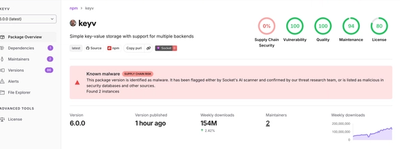
Popular npm packages keyv and cacheable compromised.

Security News
A misconfiguration gave three Anthropic models internet access, and one, believing it was in a simulation, shipped a credential-stealing package to PyPI.