OpenClaw

OpenClaw (Termux Fork) is a Termux-optimized fork designed to run a personal AI assistant natively on Android without root access.
中文文档 | English README
🚀 Termux Compatibility Fork
Run full-featured OpenClaw on any Android device — even a $30 used phone!
Website · Docs · Vision · DeepWiki · Getting Started · Updating · Showcase · FAQ · Wizard · Nix · Docker · Discord
Preferred setup: run the onboarding wizard (openclaw onboard) in your terminal.
The wizard guides you step by step through setting up the gateway, workspace, channels, and skills. The CLI wizard is the recommended path and works on macOS, Linux, and Windows (via WSL2; strongly recommended).
Works with npm, pnpm, or bun.
New install? Start here: Getting started
Subscriptions (OAuth):
Key Adaptations
- ✅ Full Android/Termux compatibility - no root required for basic usage
- ✅ Original experience preserved - identical features and UI
- ✅ Budget-friendly - runs on old/used Android phones ($30+)
- ✅ Termux-specific path handling - adapted for Android filesystem
- ✅ sqlite-vec compiled from source - works on arm64 Android
- ✅ PM2 service management - reliable background operation
See ANDROID_FIXES.md and ANDROID_FIXES_CN.md for detailed compatibility patches.
📸 Gallery

📱 Advanced Capabilities (Sensors & Hardware)
Unlike running on a server or PC, OpenClaw on Android can interact directly with the physical world via Termux API.
Note: Install the Termux:API app and run pkg install termux-api to unlock these features.
- Sensors: Access light, proximity, gravity sensors, and GPS location.
- Haptic Feedback: Communicate not just via voice but with vibration patterns and flashlight signals.
- Multimedia: Control music playback, volume, and use system-level TTS (Text-to-Speech).
- Telephony: Send/receive SMS, make calls, and access contacts directly.
- App Interaction: Launch other apps (
am start ...) or perform deep linking.
For Rooted Devices:
With Root access, OpenClaw becomes a true 24/7 AI Server:
- Auto-Start: Configure boot scripts for server-grade resilience (auto-recover after power loss).
- Extreme Efficiency: Mod for Battery-less DC Power to run 24x365 with negligible energy usage.
- Remote Access: Bind to 0.0.0.0 or use Tailscale to manage your assistant securely from anywhere.
- Full Control: Simulate touch inputs, manage system processes, and run unattended automations.
Expandable Capabilities (via Termux API):
- 📸 Vision: Access front/rear cameras for photography, video recording, or home surveillance.
- 🔋 Status: Monitor battery level, WiFi signal strength, and Bluetooth connections.
- 🗣️ Voice: Use system TTS for speech output and microphone for offline wake-word detection.
- 📩 Telephony: Auto-read/send SMS, block spam calls, or act as an SMS forwarding gateway.
🛸 Ultimate Form: Matrix Cluster (Multi-Device)
When you have multiple idle phones, OpenClaw can form a Local Distributed Cluster:
- Audio Matrix: Create a microphone array for precise source localization or a surround sound system.
- Visual Matrix: 360° panoramic surveillance or "Bullet Time" multi-angle recording.
- Edge Cluster: Aggregate CPU power (e.g., 10x Snapdragon 865) to run larger local models via distributed inference.
- Sensor Grid: Scatter phones as independent nodes (light/noise/vibration) to build a true whole-house perception network.
Models (selection + auth)
Install (recommended) - Termux
Runtime: Node ≥22 (installed automatically by deploy script).
One-Click Deploy (English)
git clone https://github.com/yunze7373/openclaw-termux.git
cd openclaw-termux
./Install_termux.sh --full
One-Click Deploy (Chinese Version)
git clone https://github.com/yunze7373/openclaw-termux.git
cd openclaw-termux
./Install_termux_cn.sh --full
The script will:
- Install dependencies (nodejs-lts, pnpm, pm2, etc.)
- Configure environment variables
- Build the project
- Compile sqlite-vec from source for Android/arm64
- Set up PM2 service
After deployment, run:
openclaw onboard --install-daemon
Quick start (TL;DR) - Termux
Full beginner guide (auth, pairing, channels): Getting started
source ~/.bashrc
openclaw onboard --install-daemon
openclaw gateway --port 18789 --verbose
openclaw message send --to +1234567890 --message "Hello from OpenClaw"
openclaw agent --message "Ship checklist" --thinking high
Upgrading? ./Install_termux.sh --update or Updating guide.
Development channels
- stable: tagged releases (
vYYYY.M.D or vYYYY.M.D-<patch>), npm dist-tag latest.
- beta: prerelease tags (
vYYYY.M.D-beta.N), npm dist-tag beta.
- dev: moving head of
main, npm dist-tag dev (when published).
Switch channels (git + npm): openclaw update --channel stable|beta|dev.
Details: Development channels.
From source (development) - Termux
For development and debugging on Termux:
git clone https://github.com/yunze7373/openclaw-termux.git
cd openclaw-termux
./Install_termux.sh --deps
pnpm install --no-frozen-lockfile --ignore-scripts
pnpm exec tsdown
pnpm build:plugin-sdk:dts
pnpm ui:build
./scripts/fix-sqlite-vec.sh
node --import tsx openclaw.mjs gateway --port 18789 --verbose
pnpm build
./openclaw.mjs gateway start
Termux-specific Notes
- Root not required for basic usage - Gateway, messaging, AI agents all work in Termux userspace
- With root access (optional), you can:
- Use
iptables for port forwarding (expose services on privileged ports like 80/443)
- Access Android system services directly
- Run background services more reliably via
init.d or Magisk modules
- Mount external storage with full permissions
- sqlite-vec - compiled from source for Android/arm64 (no prebuilt binaries)
- PM2 recommended - Termux lacks systemd, use PM2 for service management
- SSL certificates - configured automatically via
$PREFIX/etc/tls/cert.pem
Security defaults (DM access)
OpenClaw connects to real messaging surfaces. Treat inbound DMs as untrusted input.
Full security guide: Security
Default behavior on Telegram/WhatsApp/Signal/iMessage/Microsoft Teams/Discord/Google Chat/Slack:
- DM pairing (
dmPolicy="pairing" / channels.discord.dmPolicy="pairing" / channels.slack.dmPolicy="pairing"; legacy: channels.discord.dm.policy, channels.slack.dm.policy): unknown senders receive a short pairing code and the bot does not process their message.
- Approve with:
openclaw pairing approve <channel> <code> (then the sender is added to a local allowlist store).
- Public inbound DMs require an explicit opt-in: set
dmPolicy="open" and include "*" in the channel allowlist (allowFrom / channels.discord.allowFrom / channels.slack.allowFrom; legacy: channels.discord.dm.allowFrom, channels.slack.dm.allowFrom).
Run openclaw doctor to surface risky/misconfigured DM policies.
Highlights
- Local-first Gateway — single control plane for sessions, channels, tools, and events.
- Multi-channel inbox — WhatsApp, Telegram, Slack, Discord, Google Chat, Signal, BlueBubbles (iMessage), iMessage (legacy), Microsoft Teams, Matrix, Zalo, Zalo Personal, WebChat, macOS, iOS/Android.
- Multi-agent routing — route inbound channels/accounts/peers to isolated agents (workspaces + per-agent sessions).
- Voice Wake + Talk Mode — always-on speech for macOS/iOS/Android with ElevenLabs.
- Live Canvas — agent-driven visual workspace with A2UI.
- First-class tools — browser, canvas, nodes, cron, sessions, and Discord/Slack actions.
- Companion apps — macOS menu bar app + iOS/Android nodes.
- Onboarding + skills — wizard-driven setup with bundled/managed/workspace skills.
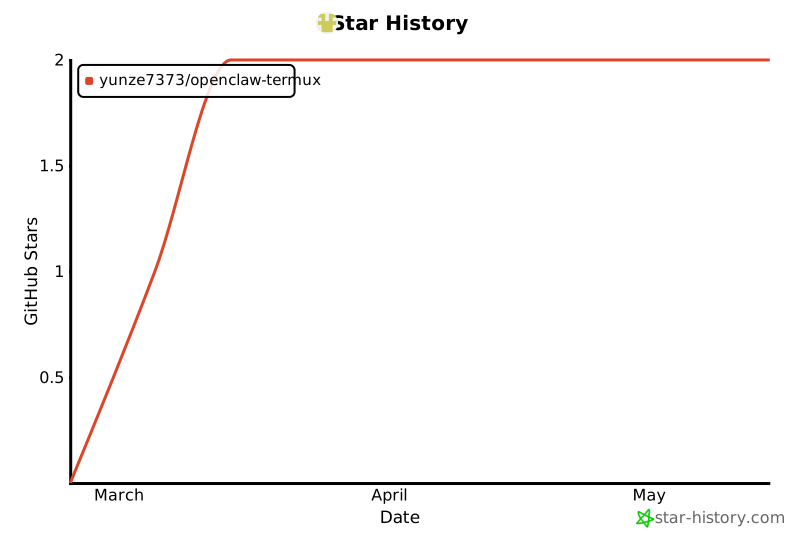
Star History
Everything we built so far
Core platform
- Gateway WS control plane with sessions, presence, config, cron, webhooks, Control UI, and Canvas host.
- CLI surface: gateway, agent, send, wizard, and doctor.
- Pi agent runtime in RPC mode with tool streaming and block streaming.
- Session model:
main for direct chats, group isolation, activation modes, queue modes, reply-back. Group rules: Groups.
- Media pipeline: images/audio/video, transcription hooks, size caps, temp file lifecycle. Audio details: Audio.
Channels
- Channels: WhatsApp (Baileys), Telegram (grammY), Slack (Bolt), Discord (discord.js), Google Chat (Chat API), Signal (signal-cli), BlueBubbles (iMessage, recommended), iMessage (legacy imsg), Microsoft Teams (extension), Matrix (extension), Zalo (extension), Zalo Personal (extension), WebChat.
- Group routing: mention gating, reply tags, per-channel chunking and routing. Channel rules: Channels.
Apps + nodes
- macOS app: menu bar control plane, Voice Wake/PTT, Talk Mode overlay, WebChat, debug tools, remote gateway control.
- iOS node: Canvas, Voice Wake, Talk Mode, camera, screen recording, Bonjour pairing.
- Android node: Canvas, Talk Mode, camera, screen recording, optional SMS.
- macOS node mode: system.run/notify + canvas/camera exposure.
Tools + automation
- Browser control: dedicated openclaw Chrome/Chromium, snapshots, actions, uploads, profiles.
- Canvas: A2UI push/reset, eval, snapshot.
- Nodes: camera snap/clip, screen record, location.get, notifications.
- Cron + wakeups; webhooks; Gmail Pub/Sub.
- Skills platform: bundled, managed, and workspace skills with install gating + UI.
Runtime + safety
Ops + packaging
How it works (short)
WhatsApp / Telegram / Slack / Discord / Google Chat / Signal / iMessage / BlueBubbles / Microsoft Teams / Matrix / Zalo / Zalo Personal / WebChat
               │
               ▼
┌───────────────────────────────┐
│            Gateway            │
│       (control plane)         │
│     ws://127.0.0.1:18789      │
└──────────────┬────────────────┘
               │
               ├─ Pi agent (RPC)
               ├─ CLI (openclaw …)
               ├─ WebChat UI
               ├─ macOS app
               └─ iOS / Android nodes
Key subsystems
Tailscale access (Gateway dashboard)
OpenClaw can auto-configure Tailscale Serve (tailnet-only) or Funnel (public) while the Gateway stays bound to loopback. Configure gateway.tailscale.mode:
off: no Tailscale automation (default).serve: tailnet-only HTTPS via tailscale serve (uses Tailscale identity headers by default).funnel: public HTTPS via tailscale funnel (requires shared password auth).
Notes:
gateway.bind must stay loopback when Serve/Funnel is enabled (OpenClaw enforces this).- Serve can be forced to require a password by setting
gateway.auth.mode: "password" or gateway.auth.allowTailscale: false.
- Funnel refuses to start unless
gateway.auth.mode: "password" is set.
- Optional:
gateway.tailscale.resetOnExit to undo Serve/Funnel on shutdown.
Details: Tailscale guide · Web surfaces
Remote Gateway (Linux is great)
It’s perfectly fine to run the Gateway on a small Linux instance. Clients (macOS app, CLI, WebChat) can connect over Tailscale Serve/Funnel or SSH tunnels, and you can still pair device nodes (macOS/iOS/Android) to execute device‑local actions when needed.
- Gateway host runs the exec tool and channel connections by default.
- Device nodes run device‑local actions (
system.run, camera, screen recording, notifications) via node.invoke.
In short: exec runs where the Gateway lives; device actions run where the device lives.
Details: Remote access · Nodes · Security
macOS permissions via the Gateway protocol
The macOS app can run in node mode and advertises its capabilities + permission map over the Gateway WebSocket (node.list / node.describe). Clients can then execute local actions via node.invoke:
system.run runs a local command and returns stdout/stderr/exit code; set needsScreenRecording: true to require screen-recording permission (otherwise you’ll get PERMISSION_MISSING).system.notify posts a user notification and fails if notifications are denied.canvas.*, camera.*, screen.record, and location.get are also routed via node.invoke and follow TCC permission status.
Elevated bash (host permissions) is separate from macOS TCC:
- Use
/elevated on|off to toggle per‑session elevated access when enabled + allowlisted.
- Gateway persists the per‑session toggle via
sessions.patch (WS method) alongside thinkingLevel, verboseLevel, model, sendPolicy, and groupActivation.
Details: Nodes · macOS app · Gateway protocol
Agent to Agent (sessions_* tools)
- Use these to coordinate work across sessions without jumping between chat surfaces.
sessions_list — discover active sessions (agents) and their metadata.sessions_history — fetch transcript logs for a session.sessions_send — message another session; optional reply‑back ping‑pong + announce step (REPLY_SKIP, ANNOUNCE_SKIP).
Details: Session tools
Skills registry (ClawHub)
ClawHub is a minimal skill registry. With ClawHub enabled, the agent can search for skills automatically and pull in new ones as needed.
ClawHub
Chat commands
Send these in WhatsApp/Telegram/Slack/Google Chat/Microsoft Teams/WebChat (group commands are owner-only):
/status — compact session status (model + tokens, cost when available)/new or /reset — reset the session/compact — compact session context (summary)/think <level> — off|minimal|low|medium|high|xhigh (GPT-5.2 + Codex models only)/verbose on|off/usage off|tokens|full — per-response usage footer/restart — restart the gateway (owner-only in groups)/activation mention|always — group activation toggle (groups only)
Apps (optional)
The Gateway alone delivers a great experience. All apps are optional and add extra features.
If you plan to build/run companion apps, follow the platform runbooks below.
macOS (OpenClaw.app) (optional)
- Menu bar control for the Gateway and health.
- Voice Wake + push-to-talk overlay.
- WebChat + debug tools.
- Remote gateway control over SSH.
Note: signed builds required for macOS permissions to stick across rebuilds (see docs/mac/permissions.md).
iOS node (optional)
- Pairs as a node via the Bridge.
- Voice trigger forwarding + Canvas surface.
- Controlled via
openclaw nodes ….
Runbook: iOS connect.
Android node (optional)
- Pairs via the same Bridge + pairing flow as iOS.
- Exposes Canvas, Camera, and Screen capture commands.
- Runbook: Android connect.
Agent workspace + skills
- Workspace root:
~/.openclaw/workspace (configurable via agents.defaults.workspace).
- Injected prompt files:
AGENTS.md, SOUL.md, TOOLS.md.
- Skills:
~/.openclaw/workspace/skills/<skill>/SKILL.md.
Configuration
Minimal ~/.yunze7373/yunze7373.json (model + defaults):
{
  agent: {
    model: "anthropic/claude-opus-4-6",
  },
}
Full configuration reference (all keys + examples).
Security model (important)
- Default: tools run on the host for the main session, so the agent has full access when it’s just you.
- Group/channel safety: set
agents.defaults.sandbox.mode: "non-main" to run non‑main sessions (groups/channels) inside per‑session Docker sandboxes; bash then runs in Docker for those sessions.
- Sandbox defaults: allowlist
bash, process, read, write, edit, sessions_list, sessions_history, sessions_send, sessions_spawn; denylist browser, canvas, nodes, cron, discord, gateway.
Details: Security guide · Docker + sandboxing · Sandbox config
- Link the device:
pnpm openclaw channels login (stores creds in ~/.openclaw/credentials).
- Allowlist who can talk to the assistant via
channels.whatsapp.allowFrom.
- If
channels.whatsapp.groups is set, it becomes a group allowlist; include "*" to allow all.
- Set
TELEGRAM_BOT_TOKEN or channels.telegram.botToken (env wins).
- Optional: set
channels.telegram.groups (with channels.telegram.groups."*".requireMention); when set, it is a group allowlist (include "*" to allow all). Also channels.telegram.allowFrom or channels.telegram.webhookUrl + channels.telegram.webhookSecret as needed.
{
  channels: {
    telegram: {
      botToken: "123456:ABCDEF",
    },
  },
}
- Set
SLACK_BOT_TOKEN + SLACK_APP_TOKEN (or channels.slack.botToken + channels.slack.appToken).
- Set
DISCORD_BOT_TOKEN or channels.discord.token (env wins).
- Optional: set
commands.native, commands.text, or commands.useAccessGroups, plus channels.discord.allowFrom, channels.discord.guilds, or channels.discord.mediaMaxMb as needed.
{
  channels: {
    discord: {
      token: "1234abcd",
    },
  },
}
- Requires
signal-cli and a channels.signal config section.
- Recommended iMessage integration.
- Configure
channels.bluebubbles.serverUrl + channels.bluebubbles.password and a webhook (channels.bluebubbles.webhookPath).
- The BlueBubbles server runs on macOS; the Gateway can run on macOS or elsewhere.
- Legacy macOS-only integration via
imsg (Messages must be signed in).
- If
channels.imessage.groups is set, it becomes a group allowlist; include "*" to allow all.
- Configure a Teams app + Bot Framework, then add a
msteams config section.
- Allowlist who can talk via
msteams.allowFrom; group access via msteams.groupAllowFrom or msteams.groupPolicy: "open".
- Uses the Gateway WebSocket; no separate WebChat port/config.
Browser control (optional):
{
  browser: {
    enabled: true,
    color: "#FF4500",
  },
}
Docs
Use these when you’re past the onboarding flow and want the deeper reference.
Advanced docs (discovery + control)
Operations & troubleshooting
Deep dives
Workspace & skills
Platform internals
Email hooks (Gmail)
Android (Termux) Compatibility
This fork is specifically optimized for running OpenClaw on Android via Termux. We have implemented over 50 compatibility fixes to ensure a stable and feature-rich experience on mobile devices.
Key Adaptations
For a detailed list of all fixes, see ANDROID_FIXES.md.
See CONTRIBUTING.md for guidelines, maintainers, and how to submit PRs.
AI/vibe-coded PRs welcome! 🤖
Special thanks to Mario Zechner for his support and for
pi-mono.
Special thanks to Adam Doppelt for lobster.bot.
Thanks to all clawtributors:


![clawdinator[bot]](https://avatars.githubusercontent.com/in/2607181?v=4&s=48 "clawdinator[bot]")


![google-labs-jules[bot]](https://avatars.githubusercontent.com/in/842251?v=4&s=48 "google-labs-jules[bot]")