

Company News
AWS Security Hub Adds Socket for Supply Chain Security
Socket is now in the AWS Security Hub Extended plan. Adopt it through AWS, apply committed spend, and block malicious open source packages.
By Feross Aboukhadijeh - Aug 04, 2026
openclaw-channel-telegram-userbot
Advanced tools
OpenClaw channel plugin — Telegram userbot via MTProto (GramJS)
OpenClaw channel plugin that connects your personal Telegram account (not a bot) to OpenClaw via MTProto. Your AI assistant responds as you — from your real Telegram account.
openclaw plugins install openclaw-channel-telegram-userbot
Go to my.telegram.org, create an app, and note the api_id and api_hash.
cd openclaw-channel-telegram-userbot
bun run src/auth.ts
Follow the prompts to log in. You'll receive a session string (optionally encrypted with your machine ID).
openclaw config set channels.telegram-userbot.apiId 12345678
openclaw config set channels.telegram-userbot.apiHash "your_api_hash"
openclaw config set channels.telegram-userbot.sessionString "your_session_string"
Or add to ~/.openclaw/openclaw.json:
{
  channels: {
    "telegram-userbot": {
      apiId: 12345678,
      apiHash: "abc123...",
      sessionString: "1BQA...",
      allowFrom: ["*"],
      replyDelaySec: 2,
      groups: {
        "*": { requireMention: true }
      }
    }
  }
}
openclaw plugins enable telegram-userbot
| Key | Type | Default | Description |
|---|---|---|---|
apiId | number | required | Telegram API ID |
apiHash | string | required | Telegram API Hash |
sessionString | string | required | GramJS session (from auth helper) |
allowFrom | string[] | ["*"] | Allowed chat IDs (* = all) |
denyFrom | string[] | [] | Denied chat IDs (overrides allowFrom) |
replyDelaySec | number | 2 | Delay before reply (seconds) |
groups | object | {} | Per-group settings |
groups.*.requireMention | boolean | false | Only respond when mentioned |
groups.*.enabled | boolean | true | Enable/disable group |
conversations.maxMessages | number | 20 | Max messages per chat history |
conversations.defaultSystemPrompt | string | "" | System prompt for all chats |
conversations.systemPrompts | object | {} | Per-chat system prompts |
conversations.dataDir | string | ~/.openclaw/telegram-userbot | History storage path |
Session strings are encrypted with your machine's hardware ID by default (AES-256-GCM via node-machine-id). Encrypted sessions are useless if copied to another machine.
Override with a custom key:
export OPENCLAW_TELEGRAM_SESSION_KEY=my-secret-key
Conversation data: History is stored in ~/.openclaw/telegram-userbot/ as JSON files. These may contain sensitive chat content. Ensure appropriate file permissions on multi-user systems.
Recommendations:
allowFrom / denyFrom to limit accessreplyDelaySec > 0 to avoid rate limitsbun install
bun run lint # check code with Biome
bun run lint:fix # auto-fix
bun run typecheck # TypeScript check
bun test # run tests
MIT
FAQs
OpenClaw channel plugin — Telegram userbot via MTProto (GramJS)
The npm package openclaw-channel-telegram-userbot receives a total of 5 weekly downloads. As such, openclaw-channel-telegram-userbot popularity was classified as not popular.
We found that openclaw-channel-telegram-userbot demonstrated a healthy version release cadence and project activity because the last version was released less than a year ago. It has 1 open source maintainer collaborating on the project.
Did you know?

Socket for GitHub automatically highlights issues in each pull request and monitors the health of all your open source dependencies. Discover the contents of your packages and block harmful activity before you install or update your dependencies.
Company News
Socket is now in the AWS Security Hub Extended plan. Adopt it through AWS, apply committed spend, and block malicious open source packages.
Research
/Security News
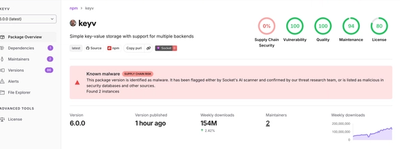
Popular npm packages keyv and cacheable compromised.

Security News
A misconfiguration gave three Anthropic models internet access, and one, believing it was in a simulation, shipped a credential-stealing package to PyPI.