
Research
/Security News
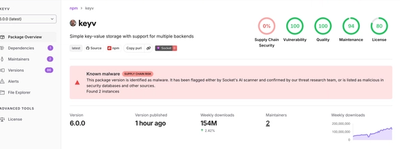
Popular npm Packages in the keyv and Cacheable Namespaces Compromised in Active Supply Chain Attack
Popular npm packages keyv and cacheable compromised.
By Socket Research Team - Aug 04, 2026
opentakeoff-mcp
Advanced tools
OpenTakeoff MCP server — drive the takeoff engine from your MCP client over stdio.
Listed in the official MCP registry as
io.github.Kentucky-ai/opentakeoff, on Glama,
and on Smithery.
No clone, no build — point your MCP client at the published package:
{
  "mcpServers": {
    "opentakeoff": {
      "command": "npx",
      "args": ["-y", "opentakeoff-mcp"]
    }
  }
}
Works with Claude Code (claude mcp add opentakeoff -- npx -y opentakeoff-mcp), Claude Desktop, Cursor, or any stdio MCP client. Node 20+.
No Node, no npm: download opentakeoff-mcp.mcpb from the
latest release and
double-click it — Claude Desktop installs the server with its dependencies
bundled. Built by npm run mcpb and attached automatically to every mcp-v*
release. The bundle is platform-neutral on purpose: it excludes the optional
native canvas, so every JSON tool and the text/metadata resources work
everywhere; the sheet-image resource and the view_sheet tool say exactly
what's missing where rendering isn't available.
The takeoff engine — One-Click Area, the scale model, conditions, totals — on
stdio for your MCP client. An agent can open a plan, read the title block,
set the scale, click rooms, and hand back the same takeoff payload the browser
app autosaves. Same engine, same math: the server imports
web/src/lib/{oneclick,sheets,geometry,totals} directly, so a shape committed
here is field-identical to one committed on the canvas.
Build from the repository root so the Dockerfile can bundle the shared web engine:
docker build -f mcp/Dockerfile -t opentakeoff-mcp .
docker run --rm -i opentakeoff-mcp
Mount local plans read-only and pass that container path to load_plan:
docker run --rm -i -v "$PWD/demo:/plans:ro" opentakeoff-mcp
docker run --rm -i -e OPENTAKEOFF_MCP_TRACE=1 -v "$PWD/demo:/plans:ro" opentakeoff-mcp
For example, load /plans/sample-plan.pdf after mounting demo/.
Both web/ and mcp/ need their dependencies (the engine's pdf.js lives in
web/node_modules):
cd web && npm install
cd ../mcp && npm install
node --import tsx server.ts        # speaks MCP on stdio
Then register it with your MCP client (any stdio MCP client works):
{
  "mcpServers": {
    "opentakeoff": {
      "command": "node",
      "args": ["--import", "tsx", "/absolute/path/to/opentakeoff/mcp/server.ts"]
    }
  }
}
Point command at node directly, as above — never npm start in a client
config: npm prints its banner to stdout, and stdout is the MCP wire. (Same
reason the server redirects console.log to stderr before pdf.js loads —
see src/hush.ts.)
tsx is a runtime dependency, not a build tool: the engine is imported
straight from web/src/lib as TypeScript, so plain node can't run it.
For tool-call debugging, opt into structured stderr tracing:
OPENTAKEOFF_MCP_TRACE=1 node --import tsx server.ts
Each tool call writes one JSON line to stderr with the tool name, duration, sheet, result size, and error flag. The trace never writes to stdout and never includes document text, shape vertices, or result payload content.
| Tool | What it does |
|---|---|
load_plan | Open a plan PDF from disk. Default replaces the whole session; merge: true ADDS the document to the working set (#152) — plans + schedule + addenda as one takeoff, sheet graph spanning the whole set, marked set covering every worked sheet. Returns per-sheet dims, title-block sheet_number, and the detected drawn scale where present. |
sheet_info | One sheet's dims, vector segment count, scale status, detected suggestion, committed shape count. |
set_scale | Set a sheet's scale — exactly one of label, upp, calibrate {p1, p2, feet}, use_detected. |
one_click | One-Click Area at (x, y): the sealed flood engine bounded by the plan linework, traced, vertices snapped — the SAME feet-true arguments the canvas passes at a click (gap sealing up to a door width, door-swing wedge inclusion, the half-foot minimum-passage rule), so an MCP trace and a canvas click at one seed measure the same square footage (pinned against the bench corpus goldens in test/parity.test.ts). Every trace carries the engine's account of itself: confidence 0–1 with confidence_factors naming each deduction (gap_sealed_px, door_wedges, min_pass_delta, …) — a review prioritizer, never a verification; a low score is a view_sheet {overlay: true} audit prompt, not a fact. On a SCANNED sheet (no usable linework) the flood falls back automatically to the rendered pixels — same engine as the canvas — with raster_traced disclosed on the reply and on the shape's origin (#154). Pass condition to commit (the full account stamps origin centrally at the commit); role: "deduct" subtracts. |
detect_rooms | Batch One-Click: reads every room-number label off the sheet's text layer and floods each — one call instead of read_sheet_text + reasoning + N one_click calls, through the SAME sealed engine per room (confidence + the engine account ride each room and its committed origin). Only cleanly-traced rooms come back; everything skipped is counted and reasoned in withheld (degenerate / duplicate / implausible / unresolved), never dropped silently. To commit: assign_from_schedule: true routes each room through its OWN room-finish schedule row and commits under the FLOOR finish that row states (rooms the schedule can't answer for return in unresolved[] with reasons and re-seedable coordinates); or pass condition to commit every room under one stated tag. |
measure_polygon | Area + perimeter of a polygon you supply (min 3 verts). Requires scale. |
measure_line | Length of an open polyline (min 2 points). Requires scale. |
derive_base | Base LF from committed rooms: for every floor shape of a source condition, commits a linear base run tracing that room's boundary, quantified net of the door openings YOU state per room ({shape_id, lf} — your claim, recorded on origin.derived; the tool never guesses). All-or-nothing; one undo step. |
derive_transitions | The transition where two finishes meet: pass two finish tags and the tag to commit under, and every committed room of each is compared against every room of the other. The catch this is built around — flood-traced rooms do not share edges, a partition puts 4–8″ between them — so proximity comes in two flavours and they are never conflated. A butt joint (rings running together inside one open space, within an inch) is the transition and commits as a linear shape, origin.derived naming both parents, the tags, and the measured gap. A wall-separated run means the rooms are adjacent across a partition, where the transition is a threshold in a doorway that nothing in the trace record locates (the flood engine reports how much boundary it sealed, never where) — those return in withheld with length, gap in inches, and an at point to view_sheet, as questions rather than a confident wrong number. max_gap_in (default 12) only ever turns more of the plan into questions, never into committed LF. All-or-nothing; one undo step. |
measure_surface | Wall SF: an open run traced along the wall, quantified as traced LF × the condition's height (the canvas's H knob — pass height_ft to set it, or set it once with edit_condition). Wall tile, wainscot, wall systems. Refuses without a height, minting nothing. |
place_count | EA markers: one point, one each — thresholds, stair nosings, floor boxes. No scale required (EA is scale-free). One shape per point; the whole call is one undo step. |
symbol_sweep | Every instance of a repeated plan symbol, from ONE example: marquee a tight seed_rect around a single drain/threshold/fixture symbol and the vector linework is searched deterministically for every other placement — translation plus 0/90/180/270 rotation and mirroring (both on by default). Score = length-weighted fraction of the seed's segments matched within tolerance_px; ≥ 0.92 is a match, the 0.75–0.92 band returns in withheld with reasons (never committed, never dropped silently), and the work cap is disclosed when it bites. scope: "set" sweeps the whole working set, counting on PLAN-role sheets only (the sheet graph decides; every excluded sheet disclosed in skipped with role and reason) — and the seed rect may sit on a detail or legend sheet, which then serves as the fingerprint SOURCE while staying excluded from counting: the estimator's "click the assembly in the detail, count it on the plans" gesture. Per-sheet results carry their own match/withheld lists, per-sheet cap accounting, and wall-clock elapsed_ms. commit: true + condition commits every match center as an EA count marker — the whole sweep (set-wide included) is one undo step, origin.method "symbol_sweep" with per-marker score, transform, and seed source (origin.symbol.seed). No scale required. |
sweep_schedule_row | Take off a schedule row's mark from the row itself: pass the row's key (e.g. T1) and the tool reads the row from the set's schedule tables (the row is the condition's cited source), anchors a fingerprint on the marker the tag is DRAWN as on a plan sheet (a deterministic pad ladder around the tag text; where the tag occurs more than once the fingerprint must recur at a second occurrence — anchor.corroborated — before it is trusted), and sweeps every plan-role sheet. The count is geometry AND text agreeing: drafting reuses one bubble shape across many marks, so a match counts only when the row's own tag sits within the marker footprint (its bbox rides the match as tag_at evidence); a match labeled with a sibling key is excluded and says whose it is, an unlabeled match is withheld as a question, a tag drawn with no matching marker is text_only. Refusal over guessing, each with the reason and the fix: no such row, an ambiguous key, a tag drawn on no plan sheet, no repeatable marker linework — a fingerprint is never guessed from text alone. commit: true commits the counted matches under the row's own key — one undo step, origin.assignment {source: "schedule"} plus the anchor and row citation on origin.symbol.seed. No scale required. |
takeoff_summary | Per-condition totals + grand totals, computed by the Report's rules. |
export_takeoff | The full opentakeoff.takeoff_canvas.v1 payload — exactly what the app autosaves. Inline, and to disk with path. |
delete_shape | Remove a committed shape by id. |
edit_shape | Revise a committed shape instead of redoing it: new verts, a different condition, a different role, a label (the room it belongs to — what per-room reporting groups by; "" clears it), or any combination — quantities recomputed from the result. Refuses shapes a human affirmed. |
edit_materials | Add/remove/patch supporting-materials rows on a condition — the coverage-rate lines (adhesive at N sf/gal, grout at N lf/bag, …) that turn a measured quantity into an order quantity, matching the canvas's Supporting Materials panel. basis is area | linear | count | seam_lf — the last is the figured roll-layout seam length a weld rod or seam tape is bought by (set roll_setup on the condition first; without one it reads 0, because nothing has decided how that floor gets cut). condition mints on first touch, like one_click/measure_polygon. No review gate (materials rows are quantity config, not traced geometry) — edits directly, reversible with undo_last. |
edit_condition | Set a condition's waste %, ×N multiplier, height_ft (the H knob measure_surface quantifies against), and roll_setup (the roll-goods opt-in: seams figured, cuts packed, the reply echoes the order — cuts, order_lf, rolls, order_qty — and export_report's roll_goods block carries the same rows; null opts out) — the knobs that turn measured quantities into order quantities. Resolves an existing finish tag or errors — a typo must not mint an empty condition. No review gate; one undo_last step restores the knobs verbatim. |
export_report | The computed Report document — opentakeoff.report.v1, the same JSON the canvas Report exports: gross + waste-adjusted quantities, the computed materials buy list per condition plus the project-wide roll-up, per-sheet base subtotals, and scale provenance. The contract for pricing consumers — export_takeoff carries materials as config rows, takeoff_summary strips them. Inline, and to disk with path. |
import_takeoff | The way back in: load a takeoff_canvas.v1 file (a prior export_takeoff, or the app's own save) through the SAME merge rules as the app's Sheet-menu import — finish-tag identity joins conditions (this session's knobs win), new ids append, duplicates skip (idempotent re-import), this session's calibration wins per sheet. Resume, extend, or audit. |
export_marked_pdf | The marked-up planset — the deliverable. Writes a distribution-ready PDF: a legend cover (per-condition totals, swatches, by-sheet breakdown) plus every sheet that carries work, vector-copied from the source with shapes, hatches, per-shape quantity chips, and annotations burned in — built by the same module as the canvas's MARKED SET button. Machine-traced shapes are disclosed as pending human review on the document itself, and the cover states where the finish tags came from (Finish assignment: N schedule-resolved · N agent-asserted · …, plus any rooms the last assign run withheld). Default path: <plan> - marked set.pdf next to the plan. Works without @napi-rs/canvas. |
list_shapes | The mid-session inventory: every committed shape's id, sheet, condition, role, quantities, room label, review state, and assignment verdict (schedule | asserted — where its finish tag came from) in one compact read — the ids edit_shape/delete_shape assume you have, without pulling the whole export_takeoff payload. Filters by sheet/condition narrow; empty is a result, not an error. |
undo_last | Step back over your own last n mutations, newest first. Exact inverses: a commit is removed, an edit restored verbatim, a delete re-inserted where it was, a materials edit's whole array restored, a condition edit's waste/multiplier pair restored. A whole detect_rooms sweep is one step. |
annotate | Place a note ABOUT the work — cloud/highlight (rect), text (at), callout (at + target), arrow (from + to — plank/seam direction), bubble (at + optional r — keynote circle, centered text), dimension (from + to — a dimension line with end ticks, labelled with the measured length at the sheet's scale; the one annotation the scale gate applies to — an unscaled sheet refuses like the measure tools). Attach to a condition and it wears that scope's colour on the canvas and in the marked set. No review gate: notes are not geometry. |
list_annotations | Every annotation with its condition RESOLVED to a finish tag, coordinates back in image px; filter by sheet/condition. unattached counts the link_annotation candidates. verdicts[] is the approval family's inventory — every mark with its actor stated, a condition filter reaching a verdict through its target shape. |
link_annotation | Attach an existing annotation to a condition (or detach with an empty tag) — the canvas's Attach/Detach control, reachable by an agent. |
mark_verdict | The agent's pencil-signature on work it checked — the agent half of the approval family (#176). Mints the graphite AGENT diamond, and structurally nothing else: the tool takes no actor input, so the estimator's APPROVED ring stays behind the canvas's human-only Approve tool. Target a committed shape_id (anchored on the shape — a room's centroid, a run's midpoint — with the id recorded as provenance) or a sheet + at point; optional short text rides the record. Touches no quantity; renders on the canvas and in the marked set, whose cover tallies the split (Approval stamps: N estimator-approved · M agent-marked); rides the annotations payload through export_takeoff/import_takeoff and the app's own saves. One mark per shape. |
delete_verdict | Lift an agent verdict mark by id. Agent marks only — the estimator's seal is human ink and is refused, the same line edit_shape holds on reviewed shapes. undo_last re-seats a lifted mark exactly where it was. |
read_sheet_text | Positioned page text (image px), optionally restricted to a region — title blocks, room labels, finish schedules. |
find_text | Locate a known string — the complement to read_sheet_text (which returns what a region says; this finds where a string sits). Case-insensitive substring match per pdf.js text run; each hit's center feeds straight into one_click's seed. |
sheet_graph | The plan-set INDEX (#87): every sheet's role with evidence, the schedule tables found, every room tag with its stacked name, the detail callouts — how an agent decides WHAT to measure without a human enumerating rooms. |
resolve_tag | ONE room tag → its room-finish schedule row → each code's finish/material definition, every edge cited (sheet + literal text + bbox). Refusal over guessing: unresolved comes back with a reason, never as silence. |
find_schedule | Locate a schedule table by kind ("room finish", "material") — sheet, title, headers, row count, and a view_sheet-ready region. |
sheet_context | The region's STRUCTURE in one frame: classified vector segments (endpoints as drawn, meta byte per segment), text spans with bboxes, and hatch-family instances with content-derived ids — same pattern spec ⇒ same id anywhere on the sheet, so plan↔legend matching is id === id. Decimation is declared and counted on every reply: kept + dropped === total_in_region, cap applies longest-first so walls survive. |
view_sheet | The agent's eyes: render the sheet (or an image-px crop) to PNG. overlay burns committed shapes in (solid = human-affirmed, dashed = unreviewed) to verify geometry landed; grid burns in a calibrated 1-ft/5-ft measuring grid with foot labels ("auto" from the set scale, or the drawing scale like "1/4") so dimensions are counted off cells, not guessed. |
edit_shape and undo_last exist because an agent that can only append has
one recovery move: delete and re-derive. The loop they enable instead —
commit → view_sheet overlay:true → see the ring overshot into the corridor
→ move those two vertices → look again — is the loop a human estimator
already runs, and it is the difference between an agent that drafts and one
that works.
Two rules hold the surface honest:
origin.reviewed === true is work a
human affirmed, and no agent verb touches it. This server has no review gate
of its own, so the guard is inert here — it is the contract that makes the
surface safe to port to a host that does have one. The approval family
holds the same line at the mark itself: mark_verdict can mint only the
AGENT diamond (there is no actor input to misuse), and delete_verdict
refuses the estimator's APPROVED seal outright.edit_shape bumps origin.agent_edits
and touches nothing in the human-correction vocabulary (edited, edits,
proposed_verts_norm). Those fields mean a human corrected the machine;
merging a machine's own fix into them would corrupt the one signal that
measures whether the machine is getting better.Every JSON tool declares an outputSchema, and every reply carries the
payload as structuredContent — typed, machine-validated on every call —
alongside the same compact JSON in a single text item for clients that predate
structured output. view_sheet is the one image tool: its reply is a PNG
content item plus a JSON meta text item (image replies aren't structured
output, so it declares no schema by design). Failures come back as
isError: true with {"error": "..."} — never a dropped connection.
Tools let an agent act; resources let it see. When a plan loads, the sheet
set becomes browsable natively (resources/list re-announces itself via
list_changed):
| URI | Contents |
|---|---|
takeoff://sheets | The plan index — file, page count, every sheet's dims, title-block number, detected scale, scale state, shape count. Always listed; before any plan loads it says so and points at load_plan. |
takeoff://sheet/{page} | One sheet's metadata (JSON), addressed by 1-based page number. |
takeoff://sheet/{page}/text | The sheet's text, joined — title block, room labels, schedules. Positions live in the read_sheet_text tool. |
takeoff://sheet/{page}/image | The page rendered to PNG, long edge capped at 1568 px — the native resolution of vision-model eyes. Rendered lazily, cached until the next load_plan. |
Page numbers — not file-derived sheet keys — address resources, so URIs stay
clean regardless of the PDF's name; the human-facing key (plan.pdf#2) and
title-block number (A-101) ride along as the resource name and title.
Rendering uses @napi-rs/canvas, declared as this package's own optional
dependency so a plain npx opentakeoff-mcp installs the prebuilt binary and
arrives with eyes; on a platform without a prebuilt binary every non-raster
capability still works and the image read explains exactly what's missing.
The intended agent loop: read takeoff://sheets → look at
takeoff://sheet/{page}/image → pick click targets → measure with the tools.
An image coordinate maps to the tool space (image px at render scale 2.0) by
multiplying by width_px / <image pixel width>.
All coordinates are image pixels at render scale 2.0: PDF points × 2,
origin top-left, y down. This is the browser canvas's native space, so
coordinates round-trip 1:1 with the app. Every sheet payload carries its dims
in both px and pt; text positions from read_sheet_text are in the same
space, which makes them usable directly as click targets.
set_scale { use_detected: true }.measure_polygon and measure_line refuse without a scale:
Set the scale for <sheet> first — use set_scale (detected: <label>).one_click without a scale returns a px-only preview
(area_px2, perimeter_px) with a warning, and commits nothing.upp is real feet per image px at render scale 2.0, per sheet — the same
number the app stores as units_per_px.The bundled demo plan, as a copy-pasteable session (this is also the shape of
test/e2e.test.ts):
load_plan       { "path": "/absolute/path/to/opentakeoff/demo/sample-plan.pdf" }
                → sheet "sample-plan.pdf", 2448×1584 px, sheet_number "A-101",
                  detected_scale "1/4\" = 1'-0\""
read_sheet_text { "sheet": "sample-plan.pdf", "region": { "x0": 1468, "y0": 871, "x1": 2448, "y1": 1584 } }
                → the title block: A-101, SCALE: 1/4" = 1'-0"
set_scale       { "sheet": "sample-plan.pdf", "use_detected": true }
one_click       { "sheet": "sample-plan.pdf", "x": 600,  "y": 1084, "condition": "CPT-1" }   → ~438 SF
one_click       { "sheet": "sample-plan.pdf", "x": 1640, "y": 1084, "condition": "CPT-1" }   → ~438 SF
one_click       { "sheet": "sample-plan.pdf", "x": 600,  "y": 464,  "condition": "CPT-1" }   → ~438 SF
one_click       { "sheet": "sample-plan.pdf", "x": 1600, "y": 464,  "condition": "CPT-1" }   → ~438 SF
takeoff_summary {}                                        → CPT-1, 4 shapes, ~1752 SF
export_takeoff  { "path": "/tmp/takeoff.json" }           → the app's save payload
export_marked_pdf {}                                      → the marked-up planset PDF,
                                                            written next to the plan
A takeoff finishes with both exports: export_marked_pdf is what a human
reviews (construction takeoffs are no good without markup), export_report is
what pricing consumes.
Sheet keys follow the app's codec: page 1 is the bare file name
(plan.pdf), pages 2+ are plan.pdf#2. Tools also accept the title-block
sheet number (A-101) wherever a sheet is named.
one_click and detect_rooms
fall back to the sheet's rendered pixels where vectors can't bound the room
(#154) — disclosed as raster_traced — but a scan with no text layer still
has nothing for detect_rooms/sheet_graph/resolve_tag to read: seeds
come from you (view_sheet, then one_click). The raster path needs the
same optional @napi-rs/canvas as view_sheet.load_plan replaces the session by default; merge: true builds a multi-document working set (#152). Reloading a merged file is refused — reload = replace, deliberately.export_takeoff (the app's exact save payload,
nothing lost in translation) and export_marked_pdf (the reviewable marked
planset) are the ways out.npm run typecheck
npm test # session + tool-layer + e2e, against demo/sample-plan.pdf
MCP releases live in the mcp-v* tag namespace — bare v* tags belong to
the app (v0.2.0, v0.3.0 are app releases). Releases publish via npm trusted
publishing: the tag push fires .github/workflows/publish-mcp.yml, which
runs straight through — no approval click — and publishes the npm artifact
over OIDC with a provenance attestation (no npm token exists anywhere —
the npm package designates that exact repo + workflow as its trusted
publisher), followed by the MCP registry entry, the GitHub release, and the
MCPB bundle. The release environment's required-reviewer gate existed
briefly and was deliberately removed (2026-07-22) — the tag push is the one
human decision, and it's already admin-gated, so a second click added
friction without adding safety.
# 1. bump the version — all three fields together:
#    package.json .version, server.json .version, server.json .packages[0].version
# 2. tag and push — this fires the whole release, fully unattended:
git tag mcp-v<version> && git push origin mcp-v<version>
⚠️ Because there's no approval step, an accidental or mistyped mcp-v* tag
publishes to npm immediately, and npm unpublish is heavily restricted —
double-check the version before tagging.
The workflow checks version consistency, runs the full publish gate
(prepublishOnly = typecheck + tests + build), publishes to npm and the
official MCP registry, verifies the registry listing, and creates the GitHub
release (titled opentakeoff-mcp <version>). A re-run skips the npm publish
if that version already shipped, so a transient failure downstream is safe to
retry.
Smithery isn't part of the automated release above — it needs a separate,
manual publish after any tool signature change, because of a genuine spec
conflict between two validators: the official MCPB validator (what
npm run mcpb gates on) rejects a tools[].inputSchema key outright, while
Smithery's registry rejects a bundle without real inputSchema per tool
(smithery-ai/cli#770, #797, #787 — no manifest satisfies both). The canonical
dist-mcpb/opentakeoff-mcp.mcpb stays spec-compliant for Claude Desktop / the
official registry / Glama; scripts/build-smithery-mcpb.mjs builds a
Smithery-only bundle instead, with live-introspected tools + inputSchema baked
in, packed with a plain zip (bypassing mcpb validate, which would reject it):
npm run build
node scripts/build-smithery-mcpb.mjs
smithery mcp publish dist-smithery/opentakeoff-mcp.mcpb -n Kentucky-ai/opentakeoff
FAQs
OpenTakeoff MCP server — drive the takeoff engine from your MCP client over stdio.
The npm package opentakeoff-mcp receives a total of 1,102 weekly downloads. As such, opentakeoff-mcp popularity was classified as popular.
We found that opentakeoff-mcp demonstrated a healthy version release cadence and project activity because the last version was released less than a year ago. It has 1 open source maintainer collaborating on the project.
Did you know?

Socket for GitHub automatically highlights issues in each pull request and monitors the health of all your open source dependencies. Discover the contents of your packages and block harmful activity before you install or update your dependencies.
Research
/Security News
Popular npm packages keyv and cacheable compromised.

Security News
A misconfiguration gave three Anthropic models internet access, and one, believing it was in a simulation, shipped a credential-stealing package to PyPI.

Security News
/Company News
Socket has joined the new Composer and Packagist sponsorship program as a launch sponsor, supporting the team that keeps PHP's package ecosystem secure.