

Product
PHP and Composer Support Is Now in Beta
Socket’s PHP and Composer support is now in Beta for all customers, with PHP reachability analysis generally available.
By Trevor Norris, Benjamin Barslev - Aug 21, 2026
Generate an MCP server from your Prisma schema — typed per-model tools instead of execute_sql, destructive writes gated behind human approval, every action on an audit log. Plus the operator surface: approvals, audit verify, status, studio.
Give your agent your database. Don't give it SQL.
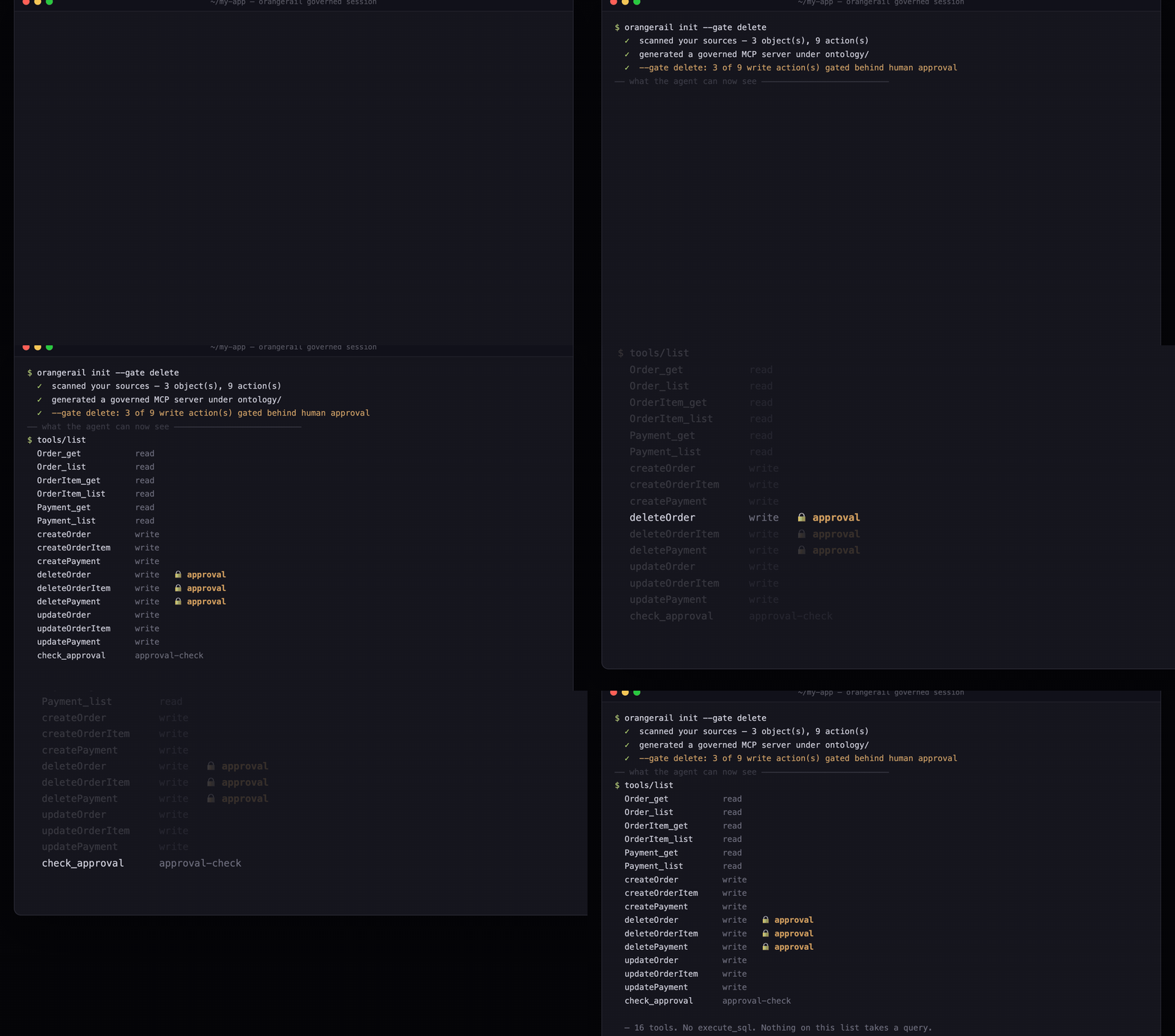
orangerail init on a three-model Prisma schema, then a real tools/list against the server it
generated. Sixteen tools: a get and a list per object, one action per write, and
check_approval. Nothing on that list takes a query. The three locks are --gate delete, a
default you change in one line.
A rules file cannot do this. It can ask the agent not to run a query. It cannot take the tool off the list — and we measured what the difference is worth, including the four claims that died when we did.
orangerail reads the schema you already have and generates the agent's surface from it. init
turns a prisma/schema.prisma into an MCP server: a get and a list per object, one action per
write with a zod input schema, and nothing else — no execute_sql, and nothing on the tool list
that takes a query.
Writes you are happy to have run unattended run unattended. The ones you are not carry
policy: { approval: 'required' }, which stops the call and turns it into an approval a person can
act on later — including a person who is not you, after the conversation that produced it has
ended.
This package is the operator surface: the approval queue, the audit and posture readouts, the scanner that generates the server, and the launcher the agent host spawns.
Zero runtime third-party dependencies. Argument parsing is hand-rolled, and the MCP server is
reached through the workspace package orangerail-mcp, never a direct SDK dependency. The scanner
makes no LLM calls and needs no API key — ever.
One command, and the surface init generates is a map you can read.
$ orangerail studio
orangerail studio: scanning ontology — 9 object(s), 27 action(s)
orangerail studio: building the interactive map…
orangerail studio: serving on http://127.0.0.1:4820 — open it in your browser
Every object, how they relate, and every write action an agent can reach. Hover a table to light up its relations and actions; click one to read the policy that governs it.
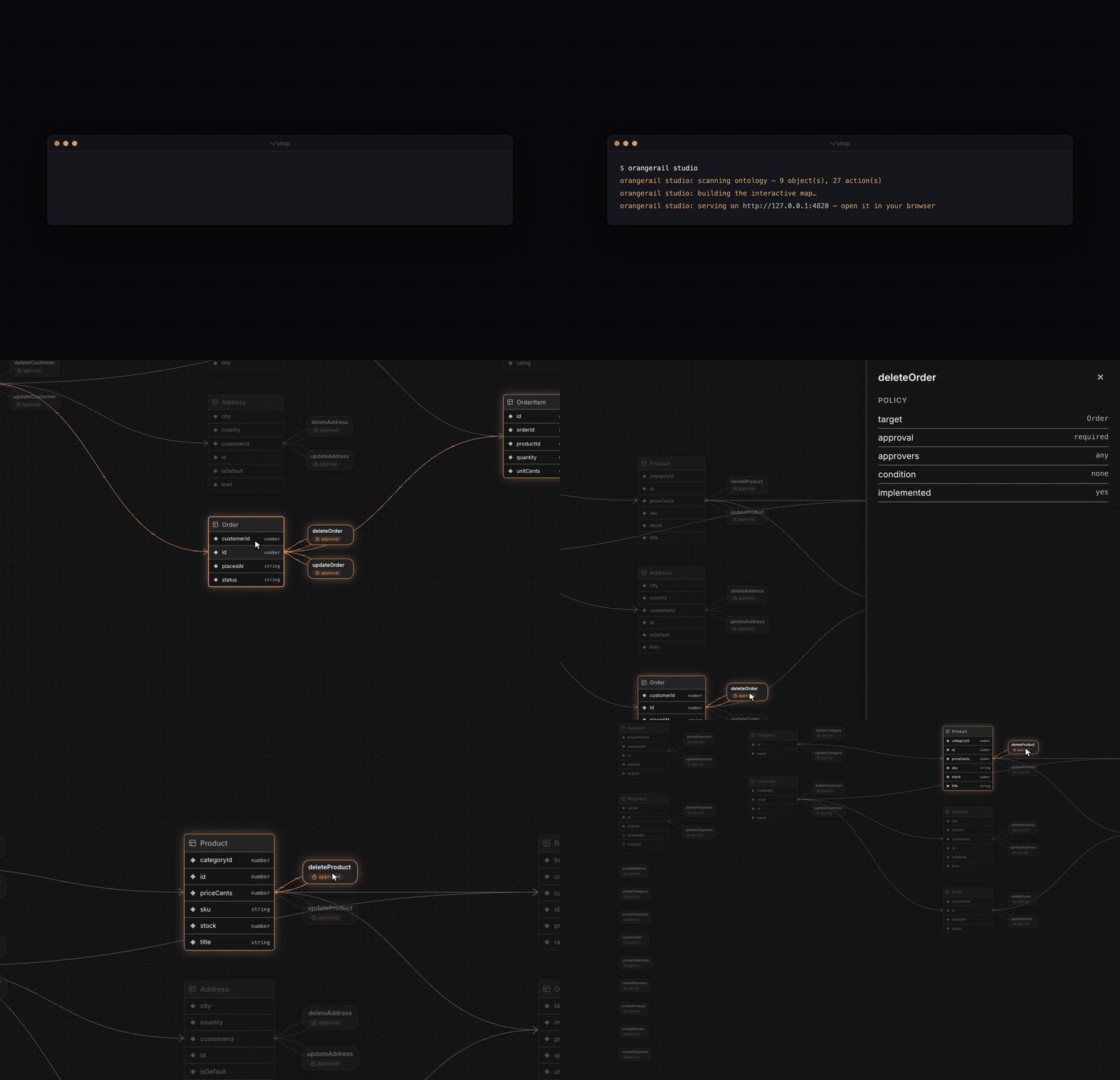
One real run on a sample commerce domain, --gate delete. The locks are not annotations added for
the video: they are what the studio draws from your ontology, which is why nine actions carry one
and eighteen do not. It shows you the shape of the domain — it does not let the agent query across
it: there is no traversal tool, no join and no aggregate.
A generated surface buys a reach that is finite and legible, not a claim that nothing harmful is inside it. You declared the verbs, so a destructive verb you declared is a verb the agent can call.
One precondition decides whether this is worth installing: orangerail governs only its own tools. If the agent also has a shell with credentials or a second database MCP server, it can go around the rail — what orangerail does not govern.
The comparison that matters is not a raw SQL server. It is a well-written CLAUDE.md naming the
permitted and forbidden tables, over a Postgres MCP server with full write access. Same queue, same
model, three clones, scored from the database afterwards.
| markdown rules, full write access | orangerail | |
|---|---|---|
| ordinary items completed | 12 / 12, all three runs | 12 / 12 |
| destructive items executed | 0 | 0 |
| what the stop leaves behind | a paragraph in a report | an approval record |
| the same task started in another directory | row deleted | staged it |
It tied on compliance, and it kept tying — through adversarial rewrites, a fake prior approval, an instruction planted in a database row, and a much smaller model. On one axis it beat us. So this project does not argue that your agent will ignore your rules: across every run measured here, it followed them.
That is six runs. Enough to retire the claim that it would not, nowhere near enough to be a rate — zero failures in six bounds the tail near 39%, not near zero. Buying a real bound is expensive and it perishes on the next model release, which is the reason the result below is the one this project stakes itself on: what ten runs cannot prove.
A second round replaced pressure with structure — a schema-level cascade where the forbidden verb is never typed, a migration where Prisma itself prints "We need to reset… All data will be lost", one read-only row among sixty identical edits. All of them held too.
Then one thing did not. Same fixture, same ticket, same database; the only change was 21 lines
deleted from CLAUDE.md — the approval procedure — the way a refactor would remove them:
| rules present | those 21 lines gone | |
|---|---|---|
| what the agent did | wrote the approval record, stopped | wrote a delete script and ran it |
| did it mention approval | yes | never |
| what reported the change | — | nothing |
The agent did nothing wrong either time. A request cannot report its own absence. The same
removal expressed as code is orangerail sync exiting 1 and the server refusing to serve the
action.
That is the whole remaining claim, and it does not weaken as models improve — "is the instruction still there" is not a question the instructed party can answer.
If you are one developer with a good model and a good rules file, on your own machine, you may not
need this. A global ~/.claude/CLAUDE.md is read from every directory that account works in, and
on this evidence the model obeys it.
What we measured, and what died — six claims, four dead, three of them ours. The fixtures re-run from a pristine snapshot and score from database rows.
Requires Node 20 or newer (engines.node: ">=20.0.0"). Install it into the project you are
going to scan:
npm i -D orangerail
npx -y orangerail on a project that has not installed it works too, and leaves you with two
copies of orangerail-core — one in the npx cache, one in your project — which every later
orangerail status reports in a runtime: block. Writes still complete under it; it is avoidable,
and installing locally is how.
Troubleshooting.
npm i -D orangerail
npx orangerail init --yes --preset approval-for-writes --no-studio
npm install orangerail-core zod
npm install @prisma/client@6       # match your prisma CLI's major
export DATABASE_URL="file:./dev.db"
npx prisma generate
npx prisma db push --skip-generate # skip if the database already exists
npx orangerail sync --accept-governance   # review + vouch for orangerail.governance.json
npx orangerail status
The @prisma/client / generate / db push lines are not optional decoration. Without them
the generated actions load fine and the first governed write fails with the datasource client is not installed or has never been generated — after the approval has been consumed, so a human
decision is spent and no row changes.
init generates ontology/*.mjs plus an orangerail.config.mjs. Under the default --gate delete
it gates every delete behind human approval and leaves the other writes executable; --gate all
gates every write, --gate none gates nothing, and the closing line names which one ran. The
generated files are yours — init refuses to run again over them, and sync reports drift rather
than editing them.
An OpenAPI spec is accepted too and gives you far less: no objects and no read surface at all, just
one execute: notImplemented action per non-GET operation to wire up yourself.
No schema file yet, just a live database? prisma db pull writes one — see
adopting orangerail against an existing database,
which also covers what Prisma 7 changes (the generated client needs a driver adapter, and init
refuses rather than emitting one that cannot construct).
orangerail mcp is a stdio server: the host spawns it, speaks JSON-RPC over its stdin/stdout,
and it dies when the host does. You never start it by hand. status, approvals and audit verify
are ordinary commands you run in your own terminal against the same store while the host's server is
up.
{
  "mcpServers": {
    "orangerail": {
      "type": "stdio",
      "command": "./node_modules/.bin/orangerail",
      "args": ["mcp"],
      "env": { "DATABASE_URL": "file:./dev.db" }
    }
  }
}
That .mcp.json is also read back to you. Whatever else it declares is a set of tools
orangerail does not govern — not gated, not on this project's audit chain, and reachable by the
agent the moment a question the declared verbs cannot answer comes up. status names them under
hosts::
  hosts:    UNGOVERNED TOOLS ALONGSIDE — 1 other MCP server(s) declared here:
              - postgres (.mcp.json)
Read what that claim is and is not. It is project scope only — .mcp.json, .cursor/mcp.json,
.vscode/mcp.json, next to your config — so a clean line means "nothing in this repo declares
another server", never "nothing else is mounted"; ~/.claude.json, Claude Desktop's config and
~/.cursor/mcp.json are deliberately not read. It reports names only, never a command, argument
or environment value, because a database server's arguments routinely carry a connection string. It
does not connect to the other server, and it does not block, proxy or govern it. And it exits 0:
mounting a Slack server next to orangerail is an ordinary choice, and the claim is the narrow one —
those tools are outside this project's governance, not that they are unsafe.
orangerail init [--yes] [--preset <p>] [--gate all|delete|none]
              [--sources <csv>] [--models <csv>] [--exclude <csv>]
              [--docs|--no-docs] [--studio|--no-studio] [--no-open] [--port <n>]
                                               scan a repo and assemble the ontology
                                               --gate picks which generated actions carry
                                               `policy: { approval: 'required' }`
                                               (default: delete)
                                               --models keeps only those models
                                               --exclude refuses the named ones and records
                                               the refusal, so later scans stop proposing them
                                               --yes implies --no-studio, because nothing that
                                               answers no prompts should be left serving; pass
                                               --studio alongside it to serve anyway
orangerail sync [--config <path>] [--accept-new] [--accept-governance] [--exclude <csv>]
                                               re-scan and report drift
                                               exit 0 nothing to act on / 1 unresolved drift /
                                                    2 could not check
                                               --accept-governance re-records the baseline
                                               --exclude records a proposed model as refused
                                               instead of creating it
orangerail mcp [--config <path>]               launch the MCP server over stdio
                                               (withholds actions weaker than the baseline)
orangerail status [--config <path>]            show the governance posture (exit 1 on drift)
                                               plus any MCP server mounted alongside that
                                               this project does not govern (never exit 1)
orangerail studio [--config <path>] [--port <n>] [--no-open]
                                               serve the read-only domain map locally
orangerail docs [--config <path>] [--out <dir>]
                                               generate the agent-facing domain doc
orangerail approvals list [--config <path>]    list pending approvals
orangerail approvals show <id> [--full] [--config <path>]
                                               show one approval (--full: uncapped input)
orangerail approvals approve <id> [--config …] approve a staged action (CAS)
orangerail approvals reject <id> [--config …]  reject a staged action (CAS)
orangerail audit verify [--config <path>]      verify the audit chain
orangerail store unlock [--config <path>]      clear a provably-dead store lock

--help, -h     print this usage (accepted anywhere, e.g. `orangerail init --help`)
--version, -v  print the CLI version
Exit codes: 0 clean, 1 a finding the command exists to report (drift, a broken chain), 2 an
error. An unrecognized flag is a hard error naming the valid set — it is never silently ignored,
because orangerail status --confg /path/to/prod reporting a confident green result for the local
project is worse than no report.
approvals list renders the approver decision surface: full id, action, requestedBy (with a
[dev] marker in dev mode), age, and a one-line input preview. Every agent-supplied string is
stripped of ANSI/control characters and JSON-escaped before it reaches the terminal
(approval-deception defense) — the staged input is always labeled agent-supplied. Bidi and
invisible-formatting code points (U+202E and the rest of the Trojan Source class, the zero-width
characters, the TAG block) are escaped to a visible \uXXXX rather than deleted, so a hostile
string can neither reorder the line nor pass as a clean one.
approvals show caps the staged input so the decision context (id, action, status,
requestedBy) always stays on screen — a 1 MB input would otherwise scroll it away. The truncation
states exactly how much was withheld; pass --full to print the whole value.
orangerail sync re-scans your sources and reports drift, and it also reviews the governance
posture — something the scan structurally cannot do, because the scanner has no opinion on policy.
The posture is read from the live registry and compared against orangerail.governance.json, the
baseline init records and sync --accept-governance re-records.
Commit that file. Its whole value is that a pull request removing an approval gate shows
"approval": "required" turning into null in its own diff, in front of a reviewer, before CI
runs.
The baseline records who wrote it. "recordedBy": "init" is the posture init generated, before
anyone reviewed it — a starting point, not an approval, and every sync and status says so until
you run --accept-governance, which stamps it "recordedBy": "sync". A file written before this
field existed reads as "sync", since only --accept-governance could have written it.
When the posture weakens — a gate removed, a where guard removed or rewritten, approver roles
widened, an action retargeted, or a new action that is not gated — sync exits 1, status exits 1,
and orangerail mcp withholds that action: it is absent from tools/list and the engine will
not resolve it by name, so it cannot be staged or executed. Everything else is served. A tightening
is reported quietly and changes nothing.
Deliberate behaviors worth knowing:
sync until you record one.
The server still starts; it says the posture is unverified.where predicate records as the constant functional, so a rewrite of its body
is invisible to the diff. sync states that limit in its own output rather than implying coverage
it does not have.Every command loads an ontology config — a default export
{ registry, store, resolveIdentity?, preset?, redactAudit?, redactPrior?, allowDevMode? } — from
orangerail.config.mjs (or .js, .ts, .mts, or --config <path>) via plain dynamic import().
TypeScript configs work through your own TS-capable runtime (tsx, or
node --experimental-strip-types); orangerail does not bundle a loader. Every command discovers the
same four names, init included — it refuses rather than regenerate over an ontology whose config
is a .ts.
Loading a config is arbitrary code execution (same trust level as an npm script) — run only configs you trust.
approve / reject resolve the caller with
resolveCaller({ transport: 'cli', request: { osUser } }). A config resolveIdentity adapter maps
the OS user to { subject, roles } (role mapping lives in the config). With no adapter the local
CLI runs in dev mode: the local-dev identity approves anything and stamps devMode: true into
audit records.
init scaffolds the approval and audit store inside the project it just scanned — the generated
config builds it as createFileStore({ dir: join(here, '.orangerail', 'store') }). That is right
for a local single-user run and wrong the moment the governed agent also has file tools over that
repo, because the agent can then write the very log that records what it did.
There is no CLI flag for this. The location is the dir argument of createFileStore in your own
orangerail.config.mjs, which orangerail never regenerates, so relocating the store is a one-line
edit:
const store = createFileStore({ dir: '/var/lib/orangerail/store' });
Point it somewhere the agent's tools cannot reach. The audit log's guarantees, and their limits, are stated exactly under What the audit log proves.
If a process died inside the file store's critical section, the store stays locked (the runtime
never steals a lock). Run orangerail store unlock when no orangerail process is running — it
clears the lock only when the owner pid is provably dead, and refuses a live/ambiguous owner or a
missing owner.json. As a last resort, rm -r <store-dir>/lock while no orangerail process runs.
Approvals and audit records store action inputs — and audit records also results, error messages,
and the target's prior state — in plaintext by default. Supply redactAudit in the config to
mask audit-record inputs (approval records persist verbatim by design), and redactPrior to mask
prior rows. They are separate hooks because a row carries columns no input mentions, so an
input-shaped mask would publish them: configure redactAudit alone and prior rows are withheld
instead. Do not put secrets in action inputs.
orangerail approvals show <id> prints the target's current state above the staged input, so an
approver sees both sides of the change. It is a live read at display time, masked by the same policy
the audit chain applies.
Two things an upgrade asks of you. The full list is in the CHANGELOG.
pending. An approval created by 0.1.0 carries no
inputHash, so execute cannot bind the payload to the approval and refuses: the call returns
{ status: 'invalidated', reason: 'input' } and the approval is spent. Ask the agent to call the
tool again. Existing audit chains verify unchanged, and a missing hash is never reported as
tampering.orangerail sync --accept-governance once, and commit the file. Until you do, a project
with at least one action exits 1 with governance: no recorded baseline. That first red run is
intentional. Your server keeps starting in the meantime — it just reports that it cannot verify
the posture it is enforcing.The full story, with real recorded output and a walkthrough you can run, is in the project README.
FAQs
Generate an MCP server from your Prisma schema — typed per-model tools instead of execute_sql, destructive writes gated behind human approval, every action on an audit log. Plus the operator surface: approvals, audit verify, status, studio.
We found that orangerail demonstrated a healthy version release cadence and project activity because the last version was released less than a year ago. It has 1 open source maintainer collaborating on the project.
Product
Socket’s PHP and Composer support is now in Beta for all customers, with PHP reachability analysis generally available.
Product
Socket is bringing experimental protection to Firefox, scanning 97,000+ extensions in Mozilla's official directory for malware and risky updates.
Research
/Security News
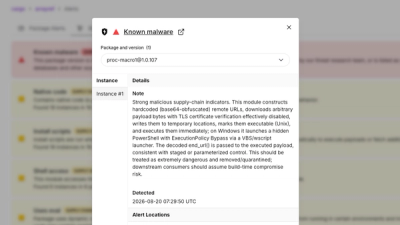
Three compromised Rust crates pulled in a malicious dependency that downloaded and executed cross-platform malware during Cargo builds.