

Company News
AWS Security Hub Adds Socket for Supply Chain Security
Socket is now in the AWS Security Hub Extended plan. Adopt it through AWS, apply committed spend, and block malicious open source packages.
By Feross Aboukhadijeh - Aug 04, 2026
outflow-mcp
Advanced tools
MCP server exposing an Outflow workspace's live architecture graph as context for AI coding agents
An MCP (Model Context Protocol) server that exposes a live Outflow architecture graph as context for AI coding agents — Claude Code, Claude Desktop, or any other MCP-compatible client. Lets an agent ask "what does this file depend on", "what breaks if I change this", or "did my last batch of edits introduce a circular dependency" against your workspace's real, currently-live graph.
It's a thin client over Outflow's existing /api/v1 REST API and the
workspace graph routes — no graph logic
is duplicated here.
This package is developed inside the main Outflow monorepo but published from a standalone public mirror: https://github.com/laurells/outflow-mcp — that's the repo MCP registries/crawlers point at, and where
npm publishruns from. Changes here get synced there before each release.
ofk_...)
is shown once — copy it..../workspace/<id>/...) or workspace settings.cd packages/mcp-server
npm install
npm run build
claude mcp add or the equivalent config file):
{
  "mcpServers": {
    "outflow": {
      "command": "node",
      "args": ["/absolute/path/to/outflow/packages/mcp-server/dist/index.js"],
      "env": {
        "OUTFLOW_BASE_URL": "https://your-outflow-domain.com",
        "OUTFLOW_API_KEY": "ofk_...",
        "OUTFLOW_WORKSPACE_ID": "your-workspace-id"
      }
    }
  }
}
OUTFLOW_BASE_URL defaults to http://localhost:3000
if omitted.| Tool | Use it to ask |
|---|---|
find_node | Is this file tracked? What's its ID? |
list_nodes | What's deprecated / low health / a given type? |
get_dependencies | What does this file rely on? |
get_impact | What breaks if I change this file? (blast radius) |
find_path | How are these two files connected? |
get_architecture_health | What's the overall health grade and at-risk nodes? |
find_architecture_smells | Any circular deps, god nodes, or dead code right now? |
get_architecture_graph | Give me the whole graph at a zoom level. |
get_last_session_recap | What happened in my last coding session? |
All tools that take a path accept a partial match (e.g. "ApiClient" will
match src/ApiClient.ts) — you never need to know Outflow's internal
file::/method:: ID format. An ambiguous partial match returns an error
listing the candidates instead of guessing.
server/ or web/,
and has no build-time dependency on them. It only talks to a running
Outflow instance over HTTP using an API key, so it works equally well
pointed at localhost or a deployed instance.get_dependencies/get_impact and find_architecture_smells/find_path
call workspace graph routes that (as of this package's introduction) were
extended to accept Authorization: Bearer ofk_... alongside the existing
cookie-session auth — see server/src/graph/pathRouter.ts and
smellsRouter.ts.FAQs
MCP server exposing an Outflow workspace's live architecture graph as context for AI coding agents
The npm package outflow-mcp receives a total of 24 weekly downloads. As such, outflow-mcp popularity was classified as not popular.
We found that outflow-mcp demonstrated a healthy version release cadence and project activity because the last version was released less than a year ago. It has 1 open source maintainer collaborating on the project.
Did you know?

Socket for GitHub automatically highlights issues in each pull request and monitors the health of all your open source dependencies. Discover the contents of your packages and block harmful activity before you install or update your dependencies.
Company News
Socket is now in the AWS Security Hub Extended plan. Adopt it through AWS, apply committed spend, and block malicious open source packages.
Research
/Security News
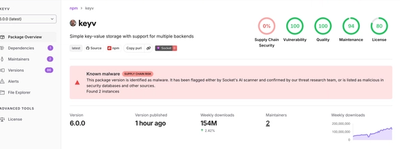
Popular npm packages keyv and cacheable compromised.

Security News
A misconfiguration gave three Anthropic models internet access, and one, believing it was in a simulation, shipped a credential-stealing package to PyPI.