

Company News
AWS Security Hub Adds Socket for Supply Chain Security
Socket is now in the AWS Security Hub Extended plan. Adopt it through AWS, apply committed spend, and block malicious open source packages.
By Feross Aboukhadijeh - Aug 04, 2026
package-guard-mcp
Advanced tools
MCP server: the pre-install supply-chain guard for AI coding agents: verify a package exists (catch slopsquat/hallucinations), check vulnerabilities & malware (OSV), detect typosquats, audit a whole dependency list. Deterministic, free, no LLM.
An MCP server that vets a package before your agent installs it. It checks that the name is registered, that OSV has no advisory against it, and how new and how downloaded it is. Deterministic, no LLM, free.
LLMs regularly suggest package names that don't exist, and attackers register those hallucinated names to slip malware into agent-run installs. People call it slopsquatting. The check for it is a registry lookup: if npm or PyPI has no package by that name, verify_package returns likely_hallucination: true. That means "not in this registry" and nothing more — it can't separate an invented name from a typo or a rename, and a package that only exists in your private registry will read as missing.
It never fetches or reads package contents. No install scripts, no code, no tarballs. A malicious package with no OSV advisory and healthy download numbers comes back safe.
{ "mcpServers": { "package-guard": { "command": "npx", "args": ["-y", "package-guard-mcp"] } } }
verify_package: the main guard. Returns safe, caution, or danger, based on whether the registry has the name (if not you get likely_hallucination, plus a "did you mean" list on npm), known vulnerabilities and malware from OSV, age and weekly downloads, whether the name is within 2 edits of an npm search hit, deprecation, and license.check_vulns: known vulnerabilities and malware advisories for a name and version, from OSV.package_info: registry metadata, including latest version, deprecation, license, repository, weekly downloads, and age.audit_deps: check a list of names, or the dependencies and devDependencies in a package.json, or a requirements.txt.typosquat_scan: generate ASCII lookalike names and report which are registered.check_vulns is a straight OSV.dev query and covers all seven ecosystems: npm, PyPI, Go, crates.io, RubyGems, Maven, NuGet. Everything else needs a package registry, and there are two clients: npm and PyPI. So verify_package, package_info, audit_deps and typosquat_scan take npm or pypi only. Suggestions and the confusable-name signal use npm's search API, so they are npm only.
audit_deps reads manifests, not lockfiles, and does not resolve the dependency tree. It checks the entries you send and nothing they depend on, up to 40 names. A version range is reduced to the digits inside it, so ^4.17.20 is checked as 4.17.20.
vulnerabilities.checked: false with count: null means the OSV request failed and the package was not checked; verify_package downgrades the verdict to caution instead of calling it safe. count: 0 means OSV answered and had nothing. audit_deps has no such guard yet: if its batch OSV call fails, every package reports 0 vulns.
About once a day this server asks the rules feed whether there is a newer ruleset, and applies it if
there is. The request carries two things: which surface asked, which here is facade, and the rules
version already installed. No machine id, no user id, no file names, nothing you scanned.
Bundles are signed with Ed25519 and verified against a public key compiled into this package, so it
does not matter which mirror served one. A bundle that fails its signature, its schema, or its ReDoS
check is discarded and the rules you already had stay in place. --offline turns updates off, as
does AGENT_GUARDS_NO_FEED=1 or {"feed": false} in ~/.agent-guards/config.json. The bundle
format and how to verify one yourself: https://github.com/mlawsonking/MCP/blob/main/rules/README.md
It calls https://package-guard.vercel.app (set PACKAGE_GUARD_API to override). One of six agent guards in this repo. MIT.
FAQs
MCP server: the pre-install supply-chain guard for AI coding agents: verify a package exists (catch slopsquat/hallucinations), check vulnerabilities & malware (OSV), detect typosquats, audit a whole dependency list. Deterministic, free, no LLM.
The npm package package-guard-mcp receives a total of 305 weekly downloads. As such, package-guard-mcp popularity was classified as not popular.
We found that package-guard-mcp demonstrated a healthy version release cadence and project activity because the last version was released less than a year ago. It has 1 open source maintainer collaborating on the project.
Did you know?

Socket for GitHub automatically highlights issues in each pull request and monitors the health of all your open source dependencies. Discover the contents of your packages and block harmful activity before you install or update your dependencies.
Company News
Socket is now in the AWS Security Hub Extended plan. Adopt it through AWS, apply committed spend, and block malicious open source packages.
Research
/Security News
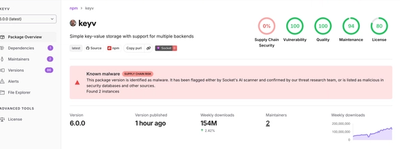
Popular npm packages keyv and cacheable compromised.

Security News
A misconfiguration gave three Anthropic models internet access, and one, believing it was in a simulation, shipped a credential-stealing package to PyPI.