

Research
/Security News
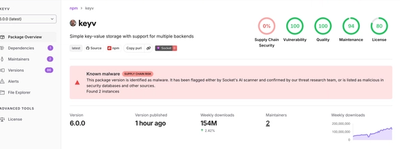
Popular npm Packages in the keyv and Cacheable Namespaces Compromised in Active Supply Chain Attack
Popular npm packages keyv and cacheable compromised.
By Socket Research Team - Aug 04, 2026
Local-first hierarchical memory brain for AI coding agents — auto-capture, LLM consolidation into beliefs, hybrid retrieval, per-prompt injection, a living Neural Universe monitor, and a daily self-improvement loop. Works with Claude Code, Codex, and any


Local-first, hierarchical, self-improving memory for Claude Code, Codex, and any MCP client.
Your AI forgets everything between sessions. Peon doesn't. It records your sessions, uses an LLM to consolidate them into typed beliefs, and injects the relevant ones back into every prompt. It runs as a daemon on your machine, and nothing leaves it.
PEON GLOBAL BRAIN ← user-level facts & preferences, inherited everywhere
/ | \
project A project B project C ← rooted child brains (.peon/ in each project)
⚠ MOST RELEVANT headline) into every prompt.
You never have to remember to save anything.localhost:3737/monitor renders every belief as
a star. Projects are galaxies, search makes matches flare, and autonomous curation pulses. The live monitor: 18k real beliefs rendered as stars. Type to make matching beliefs flare; click one to inspect it.
 Ask the field: typing "wulver cluster" makes 400+ matching beliefs flare while the rest dim, and the camera flies to them.
The name comes from Indian offices. Every office had a peon, the person who walked desk to desk all day: collect a file from this table, note who needs what, carry it to the next table, remember where everything is. He wasn't the boss or the star, but the whole office quietly ran on him. Nothing moved without him, and he never forgot where anything was.
That's this framework, with AI. Peon walks between your sessions and your projects. It collects what happened at one desk (a session), files it in the right cabinet (a project brain), carries the relevant papers to the next desk before you ask (injection), and keeps the master ledger upstairs (the global brain). Quiet clerk. Perfect memory. The office runs on him.
| Peon | mem0 | Letta/MemGPT | Zep/Graphiti | flat memory files (MEMORY.md) | |
|---|---|---|---|---|---|
| Runs | 100% local daemon | cloud or self-host | server | cloud/server | local |
| Storage | human-readable JSONL you can cat | vector DB | DB | graph DB | markdown |
| Memory model | beliefs + verbatim episodic layer | extracted facts | self-edited blocks | temporal knowledge graph | prose |
| Hierarchy | global parent brain → per-project child brains, inherited on every prompt | user/agent/session scopes | per-agent | per-user | per-project file |
| Capture | automatic via hooks (zero effort) | SDK calls you write | agent-managed | SDK calls | agent must remember to write |
| Conflict handling | supersede/merge, recoverable — never hard-deletes | LLM may DELETE | self-edit | invalidation | overwrite |
| Exact recall | episodic layer regression-tested (61% vs 17% belief-only, LongMemEval) | gist only | gist only | graph facts | whatever was written |
| Observability | live Neural Universe monitor + daily self-audit (STL) + serve telemetry | dashboard | — | — | — |
| Verification | committed eval ledger; negative results kept | vendor benchmarks | — | vendor benchmarks | — |
The short version: mem0 and Zep are memory platforms for products you build. Peon is memory for the coding agents you already use. It plugs into Claude Code or Codex in about five minutes, and you can watch it think and audit every number it claims.
Requirements: Node 20+, macOS or Linux. An OpenRouter API key is recommended (consolidation + semantic embeddings); without one Peon still works lexical-only.
One line:
npm install -g peon-mem && peon-mem install
(no Node? curl -fsSL https://raw.githubusercontent.com/VineetV2/peon-mem/main/install.sh | bash)
The guided setup asks four things:
~/Library/Application Support/Peon).peon-backup.That builds the package, starts the daemon as a service, wires your Claude Code hooks + MCP
server (with a backup of your settings), and writes a config template. Then add your key to
~/Library/Application Support/Peon/.env and open the monitor. peon-mem install --dry-run
shows every action first; peon-mem uninstall reverses it (memory data is never touched).
Or manually:
git clone https://github.com/VineetV2/peon-mem && cd peon-mem
npm install && npm run build
node bin/peon-mem.mjs install --dry-run   # inspect, then run without --dry-run
Create .env in the repo root:
OPENROUTER_API_KEY=sk-or-...
PEON_PROCESSING_MODEL=google/gemini-2.5-flash-lite   # cheap + good enough (measured)
PEON_EMBEDDING_MODEL=openai/text-embedding-3-small
Start the daemon (the installer prints a launchd/systemd recipe, or just):
node dist/daemon-cli.js # serves 127.0.0.1:3737
Then wire your agent (the installer prints these filled in for your paths):
~/.claude/settings.json (SessionStart / UserPromptSubmit /
SessionEnd → scripts/claude-peon-hook.mjs) and the MCP server (dist/index.js).dist/index.js as a stdio MCP server; 16 tools
(start_session, get_context, search_memory, record_message, process_memory, …).Open http://127.0.0.1:3737/monitor and watch your brain grow.
<project>/.peon/raw/
(append-only)..peon/brain/memories.jsonl (importance/confidence scores, entities, provenance
pointers), reconciling against existing beliefs: supersede, merge, conflict-flag.
Recoverable, never deleted.node scripts/install-peon.mjs # prints everything below filled in for YOUR paths
Or manually — ~/Library/LaunchAgents/com.peon.daemon.plist:
<?xml version="1.0" encoding="UTF-8"?>
<!DOCTYPE plist PUBLIC "-//Apple//DTD PLIST 1.0//EN" "http://www.apple.com/DTDs/PropertyList-1.0.dtd">
<plist version="1.0"><dict>
  <key>Label</key><string>com.peon.daemon</string>
  <key>ProgramArguments</key><array>
    <string>/opt/homebrew/bin/node</string>
    <string>/ABSOLUTE/PATH/TO/peon/dist/daemon-cli.js</string>
  </array>
  <key>RunAtLoad</key><true/>
  <key>KeepAlive</key><true/>
</dict></plist>
launchctl load ~/Library/LaunchAgents/com.peon.daemon.plist
curl http://127.0.0.1:3737/health        # → {"ok":true}
Linux: the installer writes ~/.config/systemd/user/peon-mem.service and enables it. Manual
equivalent: systemctl --user enable --now peon-mem.service, plus loginctl enable-linger $USER
so it survives logout. (Linux support is young — issue #1 tracks real-machine reports.)
Merge into ~/.claude/settings.json (replace the path):
{
  "hooks": {
    "SessionStart": [{ "hooks": [{ "type": "command",
      "command": "node /ABSOLUTE/PATH/TO/peon/scripts/claude-peon-hook.mjs" }] }],
    "UserPromptSubmit": [{ "hooks": [{ "type": "command",
      "command": "node /ABSOLUTE/PATH/TO/peon/scripts/claude-peon-hook.mjs" }] }],
    "SessionEnd": [{ "hooks": [{ "type": "command",
      "command": "node /ABSOLUTE/PATH/TO/peon/scripts/claude-peon-hook.mjs" }] }]
  }
}
claude mcp add peon -- node /ABSOLUTE/PATH/TO/peon/dist/index.js
~/.codex/config.toml:
[mcp_servers.peon]
command = "node"
args = ["/ABSOLUTE/PATH/TO/peon/dist/index.js"]
[mcp_servers.peon.env]
PEON_DAEMON_URL = "http://127.0.0.1:3737"
Codex has no hooks, so add usage rules to ~/.codex/AGENTS.md telling it to call
start_session + get_context at session start and record_message for durable facts
(example block in docs/).
curl "http://127.0.0.1:3737/context?projectPath=$PWD&query=test"   # JSON context
open http://127.0.0.1:3737/monitor                                  # the Neural Universe
Start a Claude Code session in any project, say something decision-shaped, and end the session. Within a minute the monitor shows the belief. The next session injects it.
start_session · record_message · record_event · end_session · get_context ·
search_memory · inspect_brain · build_injection · query_projects (cross-project search) ·
quality_report · remember_global · search_global_memory · import_global_memory ·
evaluate_project · process_memory · maybe_process_memory
launchctl unload ~/Library/LaunchAgents/com.peon.daemon.plist
# remove the hook entries + MCP server from your agent config
# your memory stays in <project>/.peon/ and ~/Library/Application\ Support/Peon/ — plain files, delete when ready
curl http://127.0.0.1:3737/health; check the hook is registered
(run any prompt in claude, then look at the monitor's Systems page for the request).PEON_EMBEDDING_MODE=ollama works too..peon/ if you want
memory to travel (redact first: the raw layer contains session text).| Var | Default | Purpose |
|---|---|---|
OPENROUTER_API_KEY | — | consolidation + embeddings |
PEON_PROCESSING_MODEL | google/gemini-2.5-flash-lite | consolidation model |
PEON_EMBEDDING_MODE | auto | api / ollama / local / off |
PEON_EMBEDDING_MODEL | — | e.g. openai/text-embedding-3-small or an Ollama model |
PEON_OLLAMA_URL | http://127.0.0.1:11434 | local embedding server |
PEON_AI_MODE | gated | off disables all LLM calls |
PEON_FLUSH_MIN_CHARS | 6000 | consolidation cost gate |
PEON_MEMORY_DIR | .peon | per-project brain dir name |
PEON_DAEMON_URL | http://127.0.0.1:3737 | daemon address |
PEON_CONSOLIDATION_MAX_DELTA_CHARS | 60000 | anti truncation-stall chunking |
PEON_DISABLED | — | hard off-switch for A/B testing |
<project>/.peon/ as human-readable JSONL and markdown. Commit it or
ignore it; your choice (.gitignore ships ignoring it)..peon/root marks a brain boundary. New brains are born rooted, so a parent directory can
never swallow a project's memory.~/Library/Application Support/Peon/global/ (macOS).Some people want a memory system that never calls a model: no API keys, no local LLM, no
embeddings. Peon supports that. Pick skip in the install wizard, or set two env vars in
<memory-home>/.env:
PEON_AI_MODE=off
PEON_EMBEDDING_MODE=off
The pipeline looks like this without a model. Hooks still capture everything you do into
<project>/.peon/raw/ as plain JSONL. As each event arrives, rule-based extraction files it
into readable brain files: a line that starts with "we decided" or "always use" lands in
decisions.md, preferences land in preferences.md, file paths land in artifacts.md. No
model reads it; it's pattern matching, and you can open the files to see exactly what it
caught. At your next session start, the hook asks the daemon for context, the daemon ranks
those records by keyword match, recency, and importance, and injects the best ones into your
prompt. The only step that disappears entirely is consolidation, the nightly LLM pass that
compresses raw history into deduplicated beliefs. Without it your memory is a well-indexed
journal instead of a distilled one. Search still finds things; nothing summarizes them.
What still works (all of it deterministic code, no model anywhere):
<project>/.peon/raw/..md files by rule-based extraction as events arrive.What you give up: consolidation (raw events are never distilled into deduplicated beliefs, so memory grows as an append-only journal), semantic search (paraphrased queries need shared keywords), automatic entity extraction, and stale-shadow demotion (it compares embeddings).
Two escape hatches if you want curation without external AI:
process_memory accepts a pre-built aiResult. The coding agent you already run (Claude
Code, Codex) can do the distillation itself in-session and hand Peon the structured result.
Memory stays curated, and Peon itself never spends a token.A/B test with real claude -p sessions: one question per session, same repo, same model.
ON means Peon hooks active (memory injected at session start). OFF means PEON_DISABLED=1,
so the agent falls back to reading files. 20 questions across procedures, past results,
decisions, and current-state facts; 15 clean ON/OFF pairs survived tooling issues. Token
counts come from Claude Code's own session transcripts.
| paired, n=15/arm | ON (Peon) | OFF | delta |
|---|---|---|---|
| avg tokens (in+out) | 511 | 878 | −42% |
| median tokens | 225 | 1,048 | −79% |
| cache-read tokens | 81.6k | 110.5k | 1.35× less |
| cheaper arm | ON wins 12/15 |
Answer quality, graded against repo ground truth: 8 ties, 1 clear Peon win, 5 baseline wins, 1 where both were weak. The Peon win is the interesting one. A rule that was only ever stated in a conversation (a professor's citation policy, from an email) got "no such rule found" from the baseline; Peon recited it exactly. Conversation-borne knowledge has no file to grep.
Honest caveats: the test repo has unusually good docs (a maintained research log), which makes the baseline strong, and most repos aren't like that. n=15 is small. Questions were picked to have known answers, not sampled from real usage. The test also exposed two real bugs in Peon itself: a stale superseded belief outranking the newer truth, and token rows getting lost when consolidation outlived the hook timeout. Both are fixed (stale-shadow demotion at retrieval; usage logged before consolidation).
Peon's development is eval-gated and keeps its negative results. An associative entity graph
was built, measured (−2.9% Recall@10), and turned OFF by default. Consolidation is lossy by
design; that's why the episodic layer exists and is regression-tested. The eval harness and
committed ledger (npm run eval) let you verify retrieval changes on your own brain.
127.0.0.1 only and rejects non-loopback Host/Origin headers
(DNS-rebinding defense).MIT © Vineet Vora
Peon is built and maintained by one person, and I'm open to help making it better. Issues, PRs, ideas, criticism of the architecture, or just telling me where it broke on your machine: all of it is useful.
Where help would matter most right now:
npm run eval) makes experiments cheap: better
consolidation prompts, smarter staleness handling, local embedding models worth defaulting
to.Open an issue at github.com/VineetV2/peon-mem/issues or send a PR directly.
Rules of the house: every retrieval/quality change ships with a test and an eval-ledger run
(npm run eval); negative results get documented, not deleted; nothing may hard-delete user
memory. npm test must stay green.
FAQs
Local-first hierarchical memory brain for AI coding agents — auto-capture, LLM consolidation into beliefs, hybrid retrieval, per-prompt injection, a living Neural Universe monitor, and a daily self-improvement loop. Works with Claude Code, Codex, and any
We found that peon-mem demonstrated a healthy version release cadence and project activity because the last version was released less than a year ago. It has 1 open source maintainer collaborating on the project.
Did you know?

Socket for GitHub automatically highlights issues in each pull request and monitors the health of all your open source dependencies. Discover the contents of your packages and block harmful activity before you install or update your dependencies.
Research
/Security News
Popular npm packages keyv and cacheable compromised.

Security News
A misconfiguration gave three Anthropic models internet access, and one, believing it was in a simulation, shipped a credential-stealing package to PyPI.

Security News
/Company News
Socket has joined the new Composer and Packagist sponsorship program as a launch sponsor, supporting the team that keeps PHP's package ecosystem secure.