
Product
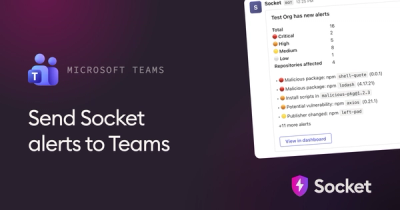
Microsoft Teams Notifications Are Now Available in Socket
Socket can now send alerts and supply chain attack notifications to Microsoft Teams, with filters that route the right updates to each channel.
By Jeppe Hasseriis - Sep 01, 2026
Multi-agent collaboration extension for pi — task decomposition, dependency management, parallel execution, TUI panel
Multi-agent collaboration extension for pi. Decomposes complex tasks into subtasks, assigns specialist agents, manages dependencies, runs them in parallel with automatic QA rework loops — all with a live TUI widget, overlay panel, and slash commands.
# From npm
pi install npm:pi-squad
# From git
pi install git:github.com/picassio/pi-squad
# Or symlink for development
ln -sf /path/to/pi-squad/src ~/.pi/agent/extensions/squad
Pi auto-discovers extensions on startup. No build step required.
Ask pi to do something complex. It calls the squad tool automatically:
> Build a REST API with authentication, tests, and documentation
The planner agent reads your codebase and creates a task breakdown automatically. Or define tasks explicitly:
> Use squad: goal="Build task API", tasks=[
    {id: "api", title: "Build CRUD endpoints", agent: "backend"},
    {id: "tests", title: "Write tests", agent: "qa", depends: ["api"]},
    {id: "docs", title: "Write README", agent: "docs", depends: ["api"]}
  ]
review, not done; main Pi receives every complete task output as untrusted review inputsquad_reviewSquad agents—including QA/reviewer agents—produce candidate work and evidence claims. They cannot mark a squad accepted. After all tasks finish:
review, never directly done.<squad_review_required> system reminder tells main Pi to re-read the original conversation contract, inspect the actual diff/source, rerun verification independently, and run integration/E2E where applicable.squad_review with requirement-by-requirement contract checks, diff review, actual command/result evidence, integration/E2E evidence, and issues.pass or pass_with_issues changes the squad to done; fail leaves it review-blocked and cannot be overwritten by another verdict.squad_modify with that squadId and add_task or resume_task (or resume when interrupted work exists). These operations reconstruct the scheduler after restart. /squad resume <squad-id> provides the same resume path.reviewHistory, the squad returns to running, and its evidence remains auditable. After every rework task settles, a fresh pending review becomes the active gate and squad_review is required again.◆ REVIEW PENDING · independent review required means no verdict exists yet; ✗ REVIEW FAILED · awaiting same-squad rework means the candidate was rejected. A truthful 3/3 task count never means a failed candidate was accepted.The completion report is explicitly labeled untrusted and not yet accepted. Main Pi must never merely relay it or ask whether verification should be run.
Task messages, task outputs, dependency/rework handoffs, QA feedback, advisor handoffs, completion reports, failure diagnostics, and planner errors are persisted and forwarded in full. There is no character or task-count limit on report data. TUI widgets may show width/height-limited views to fit the terminal, but the underlying data and agent/main-session handoffs remain complete.
Large-squad review reports spill to a durable file, not into the main context. When the assembled review-required report exceeds the inline limit (default 24,000 chars; PI_SQUAD_REVIEW_INLINE_LIMIT overrides), the complete report — every task handoff, working-tree snapshot, and the full review gate — is written untruncated to ~/.pi/squad/<squad-id>/review-report.md, and the main session receives a bounded digest: task counts/costs, a per-task index with output sizes, a compact review gate whose plan lines point at each durable task.json, and a mandate to read the entire report file (in Read offset/limit slices) before reviewing. An 89-task squad therefore cannot blow the main session's context window, and nothing is ever shortened — only relocated. Review gates with oversized delegated plans (over ~8,000 chars) likewise auto-compact to durable task.json pointer lines everywhere they are injected (report, per-turn gate reminder, restart restoration, squad_status).
Tasks define dependencies. The scheduler resolves the DAG, spawns ready tasks up to maxConcurrency, and auto-unblocks dependents when tasks complete.
architect → backend ──→ qa
              ↑
architect → frontend ─┘
Architect runs first. Backend and frontend run in parallel after architect completes. QA waits for both.
Suspension is an explicit pause, not a retry signal. If every remaining non-cancelled task is suspended or transitively blocked by suspended work, pi-squad durably wakes the main orchestrator once for that exact stall state. The widget shows ⚠ SUSPENDED — explicit resume required; squad_status and the detail panel list every exact suspended task ID and blocked descendant.
Nothing resumes automatically. Choose each task intentionally with an exact squad and task ID:
squad_modify({ action: "resume_task", squadId: "<exact-squad-id>", taskId: "<exact-task-id>" })
Repeated reconciliation and restart do not create notification storms. A delivered stall remains visible until explicit resumption changes the state; a different suspended/blocked set is a new actionable episode.
/squad disable persists a global master switch in ~/.pi/squad/settings.json. It first saves the disabled state, then stops schedulers, durably suspends in-progress tasks, kills child processes, clears focus, and hides the widget. On later Pi restarts, disabled mode does not reconstruct schedulers, recover mail, resume sessions, normalize tasks, or select a squad.
While disabled, all five squad tools and every /squad operation fail closed with /squad enable guidance; only exact /squad enable and the idempotent exact /squad disable control commands run. Tool schemas remain registered. Mandatory pending/failed review gates and suspended-stall reminders remain injected because they are durable safety obligations, but they do not authorize squad work while disabled.
/squad enable persists the enabled state and restores widget availability without selecting a squad or resuming anything. Suspended work remains suspended until an explicit exact-task resume or /squad resume <squad-id>.
When a QA agent outputs ## Verdict: FAIL, the scheduler automatically:
maxRetries (default: 2), then escalatesapi (backend) ✓ → qa (qa) ✗ found bug
→ api-fix-1 (backend) ✓ → qa-retest-1 (qa) ✓ all passing
9 skills ship with the extension. Every squad agent automatically loads them:
| Skill | Purpose |
|---|---|
squad-architecture | API contract definition, shared types, project structure, decision documentation |
squad-backend-dev | REST conventions, database patterns, auth implementation, error handling, security |
squad-frontend-dev | React patterns, state management, Tailwind CSS, accessibility, API integration |
squad-qa-testing | Test strategy, checklist, evidence requirements, verdict format, rework flow |
squad-security-audit | Vulnerability checklist, common patterns, reporting format |
squad-verification | Verify before claiming done, evidence-based completion |
squad-collaboration | Building on others' work, asking questions, sharing knowledge |
squad-protocol | Communication rules, @mention syntax, completion format |
squad-supervisor | Squad management guidance for the main pi agent |
Skills are prefixed with squad- to avoid conflicts with user or project skills. Squad agents also inherit all skills from the main pi session (user skills, package skills, project skills).
Bundled agent definitions are copied to ~/.pi/squad/agents/ on first run. Edit them freely — the extension never overwrites existing files.
| Agent | Role | Tags |
|---|---|---|
architect | Software Architect | architecture, design, patterns |
backend | Backend Engineer | api, server, database, auth |
frontend | Frontend Engineer | react, ui, css, tailwind, accessibility |
fullstack | Fullstack Developer | general, coding, implementation |
qa | QA Engineer | testing, verification, e2e |
reviewer | Code Reviewer (read-only) | review, code-quality, over-engineering |
security | Security Engineer | audit, vulnerability, threat-modeling |
debugger | Debugger & Root Cause Analyst | debugging, investigation, bugs |
devops | DevOps Engineer | ci-cd, docker, deployment |
docs | Technical Writer | documentation, readme, api-docs |
researcher | Research Analyst | research, analysis, exploration |
planner | Project Planner | planning, architecture, coordination |
Chain context: When task A completes, its complete output is injected into downstream prompts across the full dependency-ancestor closure (ancestors first, diamond dependencies deduplicated), not only the final direct edge. Integration and QA tasks therefore receive the original contracts their inputs were built from.
Completed-agent replies: An @agent request aimed at an agent whose task already finished is answered immediately from that agent's durable task output. It is never queued for a nonexistent future spawn, and a blocker resolved this way does not escalate to the human.
Report-only work: Planning/review agents may complete with a substantive assistant artifact even when they needed no tool call. Their output still passes through mandatory independent orchestrator review.
Shared filesystem: All agents work in the same project directory. Upstream agents create files, downstream agents read and modify them.
Sibling awareness: Parallel agents see each other's status and modified files, with warnings about shared file edits.
Worktree isolation: When other agents are concurrently writing to the same repository, each editing agent is instructed to work in its own git worktree on a squad/<task-id> branch (git worktree add ../<repo>.wt-<task-id> -b squad/<task-id>), hand off the branch name, and leave merging to the integration/final task — which merges all squad/* branches and cleans up every worktree (git worktree remove + branch delete). The planner adds these instructions to task descriptions whenever two or more tasks modify the same repo in parallel; read-only tasks stay in the main tree. Review-time check: git worktree list shows only the main tree.
@mention routing: Agents write @frontend what token format? in their output. The router delivers it in real-time via RPC steer().
Main-session request/reply: squad_message addresses one exact task ID. An agent name is accepted only as shorthand for exactly one currently live task, so two tasks assigned to the same role never share or steal messages. Requests are written first to the task's durable mailbox, then delivered with correlated Pi RPC. A completed task is reopened and resumed with pi --session <its-original-session-file>; only a task without a session binding receives a new session. This also works after scheduler/main-process reconstruction. By default (expectReply: true), the next substantive response is durably marked as the reply, pushed into main Pi, and wakes it; use expectReply: false for fire-and-forget steering. pi-squad waits for Pi's final agent_settled event before marking the task done or closing the child; low-level agent_end never kills queued continuations.
The planner creates task breakdowns with proper dependency ordering:
When the main agent provides tasks directly (via the tasks parameter), unknown agent names are automatically remapped to fullstack instead of failing.
Shows live execution progress plus a distinct acceptance/attention state. Truncation is viewport-only: no wrapping, deterministic height, with complete IDs and evidence retained for detail/status output.
◆ squad Build task API 3/3 · ◆ REVIEW PENDING · independent review required
✗ squad Build task API 3/3 · ✗ REVIEW FAILED · awaiting same-squad rework
⚠ SUSPENDED — explicit resume required · ^q detail

⏳ squad Build task API 2/3 $0.58 3m12s  ^q detail · /squad msg
  ✓ api (backend) 2m12s Created CRUD REST API with validation
  ⏳ tests (qa) 45s → bash npm test
  ◻ docs (docs) ← api
⏳ squad 2/3 $0.58
Full overlay with task list, live activity preview, and scrollable message view. The view opens at the live tail but can scroll back through the complete durable history, including acknowledged and older orchestrator/human messages; multiline bodies are not shortened. Main-Pi requests are labeled ORCHESTRATOR and panel/user input is labeled YOU.
| Key | Action |
|---|---|
↑↓ / jk | Navigate tasks / scroll messages |
Enter | View task messages |
Esc | Back to task list |
m | Send message to agent |
p | Pause/resume task |
x | Cancel task |
Ctrl+Q / q | Close panel |
| Command | Description |
|---|---|
/squad select | Pick a squad to view |
/squad resume [squad-id] | Reconstruct and resume an exact paused/failed/failed-review squad |
/squad list | List project squads |
/squad all | List all squads |
/squad agents | Manage agent definitions |
/squad msg [task-id|running-agent] text | Message an exact task, or use an agent name only when it has one live task |
/squad widget | Toggle widget |
/squad panel | Toggle panel |
/squad cancel | Cancel the visibly focused squad; the notification names it and the focused widget/status clear |
/squad clear | Dismiss widget |
/squad cleanup | Delete squad data |
/squad enable/disable | Persistently enable/disable all squad execution; enabling never auto-resumes work |
| Tool | Description |
|---|---|
squad | Start a squad with goal + optional tasks/config |
squad_status | Check progress, costs, task states |
squad_review | Record the main orchestrator's independent acceptance review |
squad_message | Durably message an exact task; completed tasks reopen on their original session |
squad_modify | Add/cancel/complete/pause/resume tasks or squads, or replace a task's dependencies with set_dependencies; exact squadId is required for destructive whole-squad cancel and recommended for all task actions |
Tool-level whole-squad cancellation never infers a target: squad_modify({ action: "cancel", squadId: "<exact-squad-id>" }) affects only that persisted squad and names it in the result. Omitting squadId is rejected without changing any squad. Interactive /squad cancel instead uses the squad visibly focused in the current UI and names the affected squad.
Dependency repair uses top-level taskId and depends, for example squad_modify({ action: "set_dependencies", taskId: "publish", depends: ["build"] }). The replacement is validated atomically (known IDs, no self-reference, duplicates, or cycles) and is allowed only while the task is not running or done.
cancel_task is refused while any non-cancelled task directly depends on the target. Update every listed dependent explicitly with set_dependencies, then retry cancellation. Cancellation never cascades to dependents and never rewrites their dependency lists automatically; cancelled tasks remain visible in squad history and can be revived only with explicit resume_task.
The main agent sees available agents in its system prompt and squad state when a squad is active.
squad({
  goal: "Build the app",
  config: {
    maxConcurrency: 3,  // parallel agents (default: 2)
    maxRetries: 2,      // QA rework attempts before escalation (default: 2)
  },
  agents: {
    backend: { model: "claude-sonnet-4-20250514" },   // per-agent model override
    architect: { thinking: "high" },                   // per-agent thinking level
  },
})
Agents normally start fresh with only their task description, dependency outputs, and squad protocol. Set inheritContext: true on a task to fork the main pi session (via pi --fork) so that agent inherits the full conversation context:
squad({
  goal: "Implement the design we discussed",
  tasks: [
    { id: "impl", title: "Implement agreed design", agent: "backend",
      description: "Goal: implement the API design agreed in this conversation. Verify: npm test",
      inheritContext: true },
  ],
})
Caveats:
debug.log)--no-session)~/.pi/squad/<squad-id>/<task-id>/session/, not in your project's session list--sessioninheritContext only when that's impracticalforkFromTask)Follow-up and review-rework tasks can fork an existing task's durable session instead of starting fresh: squad_modify { action: "add_task", task: { id: "impl-fix-1", agent: "backend", forkFromTask: "impl", ... } }. The new agent continues with the source task's complete conversation context — nothing is re-explored or redone. The source must have run at least once (it needs a durable session); the same 50%-of-context-window guard as inheritContext applies, and forkFromTask is mutually exclusive with inheritContext. This is the recommended shape for rework after a failed independent review.
Create ~/.pi/squad/agents/my-agent.json (global) or {project}/.pi/squad/agents/my-agent.json (project override):
{
  "name": "my-agent",
  "role": "ML Engineer",
  "description": "Machine learning, PyTorch, data pipelines",
  "model": null,
  "thinking": null,
  "tools": null,
  "tags": ["ml", "pytorch", "data"],
  "prompt": "You are an ML engineer specializing in PyTorch..."
}
model: null = squad default (see below). Override per agent or per squad.thinking: null = squad default. One of off, minimal, low, medium, high, xhigh, max (passed via pi's --thinking flag). Override per agent or per squad. Also editable via /squad agents → "Change thinking"./squad defaults)Agents without an explicit model/thinking follow the squad default policy (stored in ~/.pi/squad/settings.json):
| Policy | Behavior |
|---|---|
main (default) | Follow the main pi session's current model and thinking level — switch models mid-session and new agents follow |
pi-default | Legacy behavior: the child pi process resolves its own configured default |
| explicit value | A fixed model id (e.g. openai-codex/gpt-5.6-terra) or thinking level |
Change interactively with /squad defaults. The planner agent follows the same policy. Resolution order: agent def → per-squad override → squad default policy.
tools: null = all tools. Restrict with ["bash", "read", "write", "edit"].tags: Used by the planner to match agents to tasks automatically./squad advisor)Modeled on the advisor tool pattern (pi-advisor / Anthropic's advisor strategy): when the health monitor flags an agent as stuck, the squad consults a stronger advisor model in-process (via pi-ai, no subprocess) with a curated digest — task, recent messages, recent tool activity — before interrupting you.
The advisor returns a verdict (Course-correct / Push through / Needs human input) plus ≤5 action items:
maxCallsPerTask), or failed → normal escalation to youConfigure with /squad advisor (on/off, model, max calls per task, reasoning effort). Defaults: enabled, model = main session's model, 2 calls/task, medium reasoning. Settings persist in ~/.pi/squad/settings.json under advisor. All consultations are recorded in the task's message log (from: "advisor").
Agents must complete at least one LLM turn and produce either a tool call or a substantive assistant artifact before they can be marked done. This permits legitimate report-only planning/review work while rejecting empty exits. A child that exits before final agent_settled (typically a provider/API outage) is resumed on the same task session with backoff — 2s, 10s, 30s, 60s, 120s (override the attempt count with PI_SQUAD_SPAWN_RETRIES) — and only fails after the budget is exhausted. Successful completion or an explicit resume_task/resume grants a fresh budget, so an outage-failed task is always retriggerable once the provider recovers: squad_modify { action: "resume_task", taskId: "..." } reopens the same durable session and no work is redone.
in_progress state through reconciliation, and startup reconstructs project squads with pending mailbox entries—including review or already accepted done squads—to resume delivery. Disabled startup performs none of this recovery.in_progress while its agent is live, and requires a fresh orchestrator review after the final agent_settled. Every transitive descendant is re-blocked and reruns in dependency order, so results derived from the reopened dependency cannot remain falsely complete.resume recovers failed squads (failed tasks reset to pending), complete_task marks recovered work done and schedules dependents, and a 60s reconcile loop re-derives scheduling from persisted state so out-of-band store edits can't strand ready tasks.~/.pi/squad/debug.log (always for errors, PI_SQUAD_DEBUG=1 for verbose)The monitor never kills or blocks work on its own — its strongest action is notifying the main Pi session so you (or the main agent) can decide.
| Check | Threshold | Action |
|---|---|---|
| Idle warning | 3 minutes no output | Steer agent with nudge |
| Stuck detection | 5 minutes no output | Steer, then escalate to main session |
| Loop detection | Same tool call 5x | Steer with warning |
| Long-running check-in | Every 30 minutes total (PI_SQUAD_CEILING_MS) | Notify main session — work continues |
All state in ~/.pi/squad/. No database, no daemon. Writes are atomic. JSONL reads skip corrupt lines.
~/.pi/squad/
├── settings.json        — persistent master switch, defaults, and advisor settings
├── agents/              — agent definitions (user-editable)
├── debug.log            — error and debug logging
└── {squad-id}/
    ├── squad.json       — goal, status, config, cwd
    ├── context.json     — live state snapshot
    └── {task-id}/
        ├── task.json      — status, output, usage, immutable session binding, retry metadata
        ├── messages.jsonl — append-only conversation history
        ├── mailbox.json   — task-addressed inbound mail, including delivery acknowledgements
        └── session/       — this task's durable Pi session JSONL
src/
├── index.ts          — extension entry: tools, commands, widget, panel, lifecycle
├── types.ts          — type definitions
├── store.ts          — JSON/JSONL file I/O, atomic writes
├── scheduler.ts      — dependency DAG, concurrency, rework loop, task lifecycle
├── agent-pool.ts     — pi RPC process management, activity tracking
├── protocol.ts       — system prompt builder (chain context, sibling awareness, knowledge)
├── router.ts         — @mention parsing, cross-agent messaging
├── monitor.ts        — health checks (idle, stuck, loop, long-run notify)
├── planner.ts        — one-shot goal decomposition via LLM
├── logger.ts         — file-based logging (never writes to stderr)
├── panel/            — TUI overlay panel and widget
├── skills/           — 9 bundled skills for agents
└── agents/_defaults/ — 11 bundled agent definitions
MIT
Large contracts may be started without inlining them: squad({ specFile, specSha256 }). The strict v1 JSON contract, size/artifact policy, canonical-byte publication, child-only squad_spec_read protocol, tool guard, durable task attestation, and legacy compatibility are specified in docs/file-spec-and-full-read-attestation-contract.md. The SHA-256 must be lowercase and match the exact file bytes; malformed, oversized, or artifact-integrity failures are rejected before scheduling.
FAQs
Multi-agent collaboration extension for pi — task decomposition, dependency management, parallel execution, TUI panel
The npm package pi-squad receives a total of 74 weekly downloads. As such, pi-squad popularity was classified as not popular.
We found that pi-squad demonstrated a healthy version release cadence and project activity because the last version was released less than a year ago. It has 1 open source maintainer collaborating on the project.
Product
Socket can now send alerts and supply chain attack notifications to Microsoft Teams, with filters that route the right updates to each channel.

Security News
pnpm 12 rewrites the package manager in Rust, cutting install times by up to 90% while preserving pnpm 11 workflows and lockfiles.
Security News
Socket CTO Ahmad Nassri joins AppSec leaders at Black Hat to discuss active malware, package manager risks, and software supply chain defense.