


Company News
AWS Security Hub Adds Socket for Supply Chain Security
Socket is now in the AWS Security Hub Extended plan. Adopt it through AWS, apply committed spend, and block malicious open source packages.
By Feross Aboukhadijeh - Aug 04, 2026
pmll-memory-mcp
Advanced tools
PMLL Memory MCP Server v2 — persistent memory logic loop with short-term KV cache (peek pattern), Q-promise deduplication, Context+ long-term semantic memory graph, and solution engine. Four-way benchmarked: Combined Context+ + PMLL/peek delivers 36ms (TS
Persistent memory logic loop with short-term KV cache (peek pattern), Q-promise deduplication, and Context+ long-term semantic memory graph for 99% accuracy in Claude Sonnet/Opus agent tasks.
v2.0.0 — Four-way benchmarked, agent_instructions workflow, combined Context+ + PMLL/peek.





combined-speed.test.ts (14 tests) and test_combined_speed.py (14 tests) proving both layers work togethercontextplus-speed.test.ts (27 tests) and test_contextplus_speed.py (27 tests) benchmarking pure graph operationspeek() pattern, tool priority, and Context+ tool reference for all 15 toolsFour-way speed comparison across both languages. Full details in benchmarks/three-way-speed-comparison.md (updated from 3-way to 4-way in v2.0.0).
| Configuration | Avg Test Time | Tests | Per-test |
|---|---|---|---|
| Baseline (full suite) | 302ms | 197 | 1.53ms |
| Context+ only (no peek) | 63ms | 27 | 2.33ms |
| PMLL/peek only | 26ms | 32 | 0.81ms |
| ⭐ Combined (Context+ + PMLL/peek) | 36ms | 14 | 2.57ms |
| Configuration | Avg Duration | Tests | Per-test |
|---|---|---|---|
| Baseline (full suite) | 250ms | 104 | 2.40ms |
| Context+ only (no peek) | 142ms | 27 | 5.26ms |
| PMLL/peek only | 92ms | 32 | 2.88ms |
| ⭐ Combined (Context+ + PMLL/peek) | 78ms | 14 | 5.57ms |
| Operation | TypeScript | Python | Layer |
|---|---|---|---|
peek cache hit | 0ms | <1ms | PMLL/KV |
set + peek round-trip | ≤2ms | ≤3ms | PMLL/KV |
upsert_memory_node (100 nodes) | 6–7ms | ~8ms | Context+ graph |
search_memory_graph (100 nodes, depth-2) | 7–8ms | ~10ms | Context+ graph |
| ⭐ Graph search + cache + 50 peeks | ≤8ms total | ≤10ms total | Combined |
agent_instructions.md)Every agent using this server must follow the workflow defined in agent_instructions.md. Key requirements:
peek() Pattern (Mandatory)init once at task start to set up the session silopeek before every expensive MCP tool call — if hit, use cached valueset after a cache miss to populate the siloresolve to check Q-promise continuationsflush at task end to clear session slotsAgents MUST use Context+ tools instead of native equivalents:
| Instead of… | MUST use… | Why |
|---|---|---|
grep, rg | semantic_code_search | Finds by meaning, not string match |
find, ls | get_context_tree | Structure with symbols + line ranges |
cat, read file | get_file_skeleton first | Signatures without wasting context |
| manual symbol tracing | get_blast_radius | Traces all usages across codebase |
get_context_tree or get_file_skeletonget_blast_radius BEFORE modifying or deleting any symbolsearch_memory_graph at task start, upsert_memory_node after completing workSee the full agent_instructions.md for the complete 15-tool reference and anti-patterns.
pmll-memory-mcp is a Model Context Protocol (MCP) server that gives Claude Sonnet/Opus agents a persistent memory logic loop with two complementary memory layers:
PMLL.c::memory_silo_t.The server is designed to be the 3rd initializer alongside Playwright and other MCP tools — loaded once at the start of every agent task. Agents call init once at task start, then use peek before any expensive MCP tool invocation to avoid redundant calls. Frequently accessed entries are promoted to the long-term memory graph for persistent semantic retrieval.
The server exposes 15 tools total across four categories.
Modern Claude agent tasks routinely call Playwright, file-system tools, and other MCP servers. Without a shared memory layer, every subtask re-initializes the same context from scratch. pmll-memory-mcp eliminates this overhead with two complementary memory layers:
Agent task start
  ├── 1st init: Playwright MCP
  ├── 2nd init: Unstoppable Domains MCP  (see unstoppable-domains/)
  └── 3rd init: pmll-memory-mcp   ← this server
        ├── Short-term: all tool calls go through peek() first
        └── Long-term: frequently accessed entries auto-promote to graph
peek() patternBefore every expensive MCP tool invocation, agents call peek to check the cache:
// Pseudocode — what the agent does automatically via MCP tool calls

// 1. Check cache before navigating
const result = mcp.call("pmll-memory-mcp", "peek", { session_id: sid, key: "https://example.com" });
if (result.hit) {
    const pageContent = result.value;          // ← served from PMLL silo, no browser needed
} else {
    // 2. Cache miss — do the real work
    const pageContent = mcp.call("playwright", "navigate", { url: "https://example.com" });
    // 3. Populate the cache for future agents / subtasks
    mcp.call("pmll-memory-mcp", "set", {
        session_id: sid,
        key: "https://example.com",
        value: pageContent,
    });
}
| Tool | Input | Output | Description |
|---|---|---|---|
init | session_id: str, silo_size: int = 256 | {status, session_id, silo_size} | Set up PMLL silo + Q-promise chain for session |
peek | session_id: str, key: str | {hit, value?, index?} or {hit, status, promise_id} | Non-destructive cache + promise check |
set | session_id: str, key: str, value: str | {status: "stored", index} | Store KV pair in the silo |
resolve | session_id: str, promise_id: str | {status: "resolved"|"pending", payload?} | Check/resolve a Q-promise continuation |
flush | session_id: str | {status: "flushed", cleared_count} | Clear all silo slots at task completion |
| Tool | Input | Output | Description |
|---|---|---|---|
graphql | query: str, variables?: object, operationName?: str | {data} or {errors} | Execute GraphQL queries/mutations against the memory store |
These tools are adapted from Context+ by @ForLoopCodes, providing persistent semantic memory with graph traversal, decay scoring, and cosine similarity search.
| Tool | Input | Output | Description |
|---|---|---|---|
upsert_memory_node | session_id, type, label, content, metadata? | {node} | Create or update a memory node with auto-generated TF-IDF embeddings |
create_relation | session_id, source_id, target_id, relation, weight?, metadata? | {edge} | Create typed edges (relates_to, depends_on, implements, references, similar_to, contains) |
search_memory_graph | session_id, query, max_depth?, top_k?, edge_filter? | {direct, neighbors, totalNodes, totalEdges} | Semantic search with graph traversal — direct matches + neighbor walk |
prune_stale_links | session_id, threshold? | {removed, remaining} | Remove decayed edges (e^(-λt) below threshold) and orphan nodes with low access |
add_interlinked_context | session_id, items[], auto_link? | {nodes, edges} | Bulk-add nodes with auto-similarity linking (cosine ≥ 0.72 creates edges) |
retrieve_with_traversal | session_id, start_node_id, max_depth?, edge_filter? | [{node, depth, pathRelations, relevanceScore}] | Walk outward from a node — returns reachable neighbors scored by decay & depth |
| Tool | Input | Output | Description |
|---|---|---|---|
resolve_context | session_id, key | {source, value, score} | Unified context lookup: short-term KV → long-term graph → miss |
promote_to_long_term | session_id, key, value, node_type?, metadata? | {promoted, nodeId} | Promote a short-term KV entry to the long-term memory graph |
memory_status | session_id | {shortTerm, longTerm, promotionThreshold} | Unified view of short-term KV and long-term graph memory status |
npx (recommended — no install needed)npx pmll-memory-mcp
npm install -g pmll-memory-mcp
pmll-memory-mcp          # starts the stdio MCP server
claude_desktop_config.json){
"mcpServers": {
"pmll-memory-mcp": {
"command": "npx",
"args": ["pmll-memory-mcp"]
}
}
}
{
  "mcpServers": {
    "pmll-memory-mcp": {
      "command": "docker",
      "args": [
        "run", "-i",
        "-v", "pmll_data:/app/data",
        "-e", "MEMORY_FILE_PATH=/app/data/memory.jsonl",
        "--rm", "pmll-memory-mcp"
      ]
    }
  }
}
The MCP server ships as a multi-stage Docker image modelled on the
upstream memory server
Dockerfile.
# From the repository root
docker build -f mcp/Dockerfile -t pmll-memory-mcp .
docker run --rm -i pmll-memory-mcp:latest
docker run --rm -i \
  -v pmll_data:/app/data \
  -e MEMORY_FILE_PATH=/app/data/memory.jsonl \
  pmll-memory-mcp:latest
Add to .vscode/mcp.json (or open MCP: Open User Configuration from the Command Palette):
{
  "servers": {
    "pmll-memory-mcp": {
      "command": "npx",
      "args": ["-y", "pmll-memory-mcp"]
    }
  }
}
{
  "servers": {
    "pmll-memory-mcp": {
      "command": "docker",
      "args": [
        "run", "-i",
        "-v", "pmll_data:/app/data",
        "-e", "MEMORY_FILE_PATH=/app/data/memory.jsonl",
        "--rm", "pmll-memory-mcp"
      ]
    }
  }
}
memory DockerfileUpstream src/memory | This mcp/ | |
|---|---|---|
| Build source | COPY src/memory /app + COPY tsconfig.json | COPY mcp /app only |
| tsconfig.json | Extends root via ../../tsconfig.json | Self-contained standalone |
| Build command | npm install + npm ci --omit-dev in builder | npm install + npm run build |
| Persistence volume | ❌ | ✅ VOLUME ["/app/data"] |
| Entry point | node dist/index.js | node dist/index.js ✓ |
┌─────────────────────────────────────────────────────┐
│                pmll-memory-mcp v2.0.0               │
│                                                     │
│  ┌────────── Short-term (5 tools) ────────────┐    │
│  │ index.ts  ──► peekContext()  ──► kv-store.ts│    │
│  │                    │                        │    │
│  │                    └────────► q-promise-bridge│   │
│  └─────────────────────────────────────────────┘    │
│                                                     │
│  ┌──── Long-term — Context+ (6 tools) ────────┐    │
│  │ memory-graph.ts ──► embeddings.ts           │    │
│  │ (nodes, edges, decay scoring, similarity)   │    │
│  └─────────────────────────────────────────────┘    │
│                                                     │
│  ┌──── Solution Engine (3 tools) ─────────────┐    │
│  │ solution-engine.ts                          │    │
│  │ (resolve_context, promote, memory_status)   │    │
│  └─────────────────────────────────────────────┘    │
│                                                     │
│  ┌──── GraphQL (1 tool) ─────────────────────┐     │
│  │ graphql.ts                                 │     │
│  └────────────────────────────────────────────┘     │
└─────────────────────────────────────────────────────┘
         │                    │
         ▼                    ▼
   PMLL.c / PMLL.h      Q_promise_lib/
   (memory_silo_t)       (QMemNode chain)
The server is pure TypeScript — no C compilation is required at runtime. The KV store (kv-store.ts) mirrors the semantics of PMLL.c::init_silo() and update_silo() in TypeScript, and the promise registry (q-promise-bridge.ts) mirrors the QMemNode chain from Q_promise_lib/Q_promises.h.
The long-term memory graph (memory-graph.ts) is adapted from Context+ by @ForLoopCodes, providing an in-memory property graph with typed nodes, weighted edges, temporal decay scoring (e^(-λt)), and semantic search via TF-IDF embeddings. The solution engine (solution-engine.ts) bridges both layers, enabling unified context resolution and auto-promotion of frequently accessed short-term entries to the long-term graph.
| TypeScript module | Mirrors / Adapted from | Key primitives |
|---|---|---|
kv-store.PMMemoryStore | PMLL.h::memory_silo_t | init_silo(), update_silo() |
q-promise-bridge | Q_promises.h::QMemNode | q_mem_create_chain(), q_then() |
peek.peekContext() | Recursive conflict check in PMLL | check_conflict(), pml_refine() |
memory-graph.ts | Context+ memory graph | Nodes, edges, decay, traversal |
embeddings.ts | Context+ embeddings | TF-IDF, cosine similarity |
solution-engine.ts | Bridges short-term KV + Context+ long-term | resolveContext(), promoteToLongTerm() |
This server is structured for submission to the Anthropic official MCP registry. See mcp_manifest.json for the registry manifest.
| Server / Integration | Directory / Source | Transport | Description |
|---|---|---|---|
| Unstoppable Domains | unstoppable-domains/ | HTTP (remote) | Search, purchase, and manage Web3 domain names via natural conversation. |
| Context+ | github.com/ForLoopCodes/contextplus | Integrated | Long-term semantic memory graph, adapted into memory-graph.ts and solution-engine.ts. By @ForLoopCodes. |
Use all integrations together for the best agent experience: Unstoppable Domains handles domain operations, Context+ provides long-term semantic memory, and pmll-memory-mcp caches API responses to eliminate redundant network calls. See unstoppable-domains/claude_desktop_config.json for a combined Claude Desktop config.
FAQs
PMLL Memory MCP Server v2 — persistent memory logic loop with short-term KV cache (peek pattern), Q-promise deduplication, Context+ long-term semantic memory graph, and solution engine. Four-way benchmarked: Combined Context+ + PMLL/peek delivers 36ms (TS
We found that pmll-memory-mcp demonstrated a healthy version release cadence and project activity because the last version was released less than a year ago. It has 1 open source maintainer collaborating on the project.
Did you know?

Socket for GitHub automatically highlights issues in each pull request and monitors the health of all your open source dependencies. Discover the contents of your packages and block harmful activity before you install or update your dependencies.
Company News
Socket is now in the AWS Security Hub Extended plan. Adopt it through AWS, apply committed spend, and block malicious open source packages.
Research
/Security News
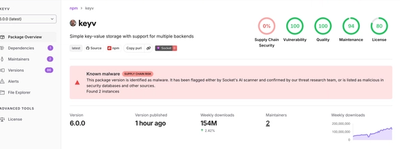
Popular npm packages keyv and cacheable compromised.

Security News
A misconfiguration gave three Anthropic models internet access, and one, believing it was in a simulation, shipped a credential-stealing package to PyPI.