

Company News
AWS Security Hub Adds Socket for Supply Chain Security
Socket is now in the AWS Security Hub Extended plan. Adopt it through AWS, apply committed spend, and block malicious open source packages.
By Feross Aboukhadijeh - Aug 04, 2026
Control a Q-SYS audio/video system from an AI agent over QSC's QRC protocol — against a real Core or Q-SYS Designer in Emulate mode. Open-source, cross-platform, zero QSC code.
Let an AI agent inspect and control a Q-SYS audio/video system over QSC's published QRC protocol — against a real Core or Q-SYS Designer's built-in emulator.


MCP Registry name: io.github.reowens/qsys-mcp
qsys-mcp is an MCP server. It speaks QSC's QRC external-control protocol (JSON-RPC 2.0 over TCP) — the same interface third-party control systems like Crestron and AMX use — and exposes it to an LLM agent as a set of tools. Point it at a physical Q-SYS Core or at Q-SYS Designer running in Emulate mode and the agent can read meters, flip mutes, ramp gains, and watch controls for changes.
It's a pure wire-protocol client: zero QSC code, no SDK, no hardware required for development. That makes it a clean, sanctioned layer QSC ships on no platform — AI-native control — and it runs anywhere Node does.
localhost.node:net only; CI proves it on Linux + macOS × Node 22 & 24.filter / names_only / type so large designs don't flood the agent's context.qsys_connect { allow_live_writes: true }; permitted live writes still carry a ⚠ warning, every tool declares MCP read-only/destructive annotations, and a 30 s NoOp keepalive holds the socket open through QRC's 60 s idle close.qsys_connect. Opt out with reconnect: false.Run it straight from npm (no install):
npx -y qsys-mcp # MCP server on stdio
Registry-aware clients can also discover it in the MCP Registry as
io.github.reowens/qsys-mcp.
Formerly published as
q-sys-mcp(now unpublished) — as of 0.3.0 the package name matches the command:qsys-mcp. Update any existing MCP configs.
Or from source:
git clone https://github.com/reowens/qsys-tools.git
cd qsys-tools
corepack enable
pnpm install
pnpm -r build                        # compiles every package to dist/
node packages/qsys-mcp/dist/index.js
Add it to your MCP client config (Claude Desktop, etc.):
{
  "mcpServers": {
    "q-sys": {
      "command": "npx",
      "args": ["-y", "qsys-mcp"]
    }
  }
}
From a local checkout instead, use "command": "node" with "args": ["/absolute/path/to/qsys-tools/packages/qsys-mcp/dist/index.js"].
Always call qsys_connect first (host 127.0.0.1, port 1710 for a local emulator) before any other tool.
Once connected, just ask in natural language — the agent picks the tools.
You: "Connect to my Q-SYS emulator and bring the main gain down to −20 dB over 2 seconds."
The agent runs:
qsys_connect → { host: "127.0.0.1", port: 1710 }qsys_list_components → { type: "gain" } — finds the Levels gain blockqsys_set_component → { name: "Levels", controls: [{ name: "gain", value: -20, ramp: 2 }] }Or, if you've exposed that fader as a Named Control in Designer:
qsys_set_control → { name: "MainGain", value: -20, ramp: 2 }
To watch a control live (meters, button states), create a change group and poll it:
qsys_create_change_group → { id: "meters", controls: ["MainGain"] }
qsys_poll_change_group    → { id: "meters" }   // returns only what changed since the last poll
| Tool | QRC method | Purpose |
|---|---|---|
qsys_connect | (socket) + Logon/StatusGet | Connect to a Core/emulator |
qsys_status | StatusGet | Engine status (platform, design, run state) |
qsys_list_components | Component.GetComponents | List named components |
qsys_get_component_controls | Component.GetControls | A component's controls + values |
qsys_get_control | Control.Get | Get Named Control values |
qsys_get_component | Component.Get | Get specific component control values |
qsys_set_control | Control.Set | Set a Named Control (with optional ramp) |
qsys_set_component | Component.Set | Set component controls (with optional ramps) |
qsys_load_snapshot | Snapshot.Load | Recall a saved snapshot (with optional ramp) |
qsys_save_snapshot | Snapshot.Save | Capture current settings into a snapshot |
qsys_mixer_set_crosspoint | Mixer.SetCrossPoint{Gain,Delay,Mute,Solo} | Set input×output crosspoints |
qsys_mixer_set_input | Mixer.SetInput{Gain,Mute,Solo} | Set mixer inputs |
qsys_mixer_set_output | Mixer.SetOutput{Gain,Mute} | Set mixer outputs |
qsys_mixer_set_cue | Mixer.SetCue{Gain,Mute} | Set mixer cues |
qsys_mixer_set_cue_input | Mixer.SetInputCue{Enable,Afl} | Route/monitor inputs to cues |
qsys_loop_player_start | LoopPlayer.Start | Play/queue files on a Loop Player's outputs |
qsys_loop_player_stop_cancel | LoopPlayer.Stop / LoopPlayer.Cancel | Stop playback / cancel a queued job |
qsys_create_change_group | ChangeGroup.AddControl | Watch Named Controls for changes |
qsys_change_group_add_component | ChangeGroup.AddComponentControl | Watch a component's controls |
qsys_poll_change_group | ChangeGroup.Poll | Get changes since last poll |
qsys_change_group_remove | ChangeGroup.Remove | Stop watching specific Named Controls |
qsys_change_group_clear | ChangeGroup.Clear | Remove all controls, keep the group |
qsys_change_group_invalidate | ChangeGroup.Invalidate | Force the next poll to resend everything |
qsys_destroy_change_group | ChangeGroup.Destroy | Free a change group's server-side state |
qsys_disconnect | (socket) | Close the connection |
qsys_list_components and qsys_get_component_controls accept optional filter (case-insensitive name substring), names_only, and — for components — type, to trim large designs before they reach the agent's context.
Q-SYS exposes controls two ways, and the tools mirror that split:
qsys_get_control / qsys_set_control) reach a control only if it's been explicitly exposed — dragged into the Named Controls pane in Designer with a unique name. Flat namespace, addressed by that one name.qsys_get_component_controls / qsys_get_component / qsys_set_component, plus the Mixer and Loop Player tools) reach any control on a component that has a Code Name and a QRC-reachable Script Access setting — no per-control naming needed.If qsys_get_control can't find a name, it almost always means the control hasn't been added to the Named Controls pane.
QRC can only see or move a component whose Script Access allows external control. This is a per-component property set in Designer, and its values are (Q-SYS Help):
| Script Access | Reachable by these tools (QRC)? |
|---|---|
| None (default) | ❌ Invisible to QRC — and to scripts/plugins too |
| Script | ❌ On-Core scripts/plugins only, not QRC |
| External | ✅ QRC only |
| All | ✅ QRC + scripts + plugins |
Because None is the default, a component is invisible to these tools until someone sets it to External or All in Designer and gives it a Code Name. So if qsys_list_components omits a component you can see in the schematic, or a qsys_set_component / Mixer / Loop Player write silently no-ops on a real Core, the first thing to check is that component's Code Name + Script Access. (Designer's Script Programmer Mode shows the setting on each component without disconnecting.) Note the development mock/emulator behind this repo's tests does not model Script Access — every component is reachable there — so a design that drives fine in tests can still be gated on a real target. Always confirm Script Access on the actual Core before blaming the tools.
127.0.0.1:1710.QRC is fully functional in Emulate mode, so you can build and test without any hardware.
Writes mutate the running/emulated system. On an emulator, nothing persists unless you save the design in Designer.
pnpm test                               # offline: QRC integration + MCP-over-mock (no hardware)
pnpm run smoke -- 127.0.0.1 1710        # read-only smoke against a live emulator/Core
pnpm run smoke:mcp -- 127.0.0.1 1710    # full MCP-over-stdio smoke against a live target
pnpm run smoke:write -- 127.0.0.1 1710  # live WRITE round-trip: set a gain, verify, restore
pnpm run smoke:named -- MainGain        # live Named-Control read/set + change-group poll
pnpm run smoke:keepalive                # idle >60s, prove the socket survives QRC's idle close
pnpm test needs no hardware; every smoke:* script needs a live target (a real Core, or Designer in Emulate mode, on port 1710).
CI runs pnpm install --frozen-lockfile && pnpm -r build && pnpm run typecheck && pnpm test on Linux + macOS × Node 22 & 24 (.github/workflows/ci.yml). The whole suite is hardware-free — the in-repo qsys-mock-core QRC server plus an in-memory MCP transport — so the full matrix runs without a Core.
@q-sys/qrwc — a convenience adapter for real Cores. Raw QRC is the primary transport today; the lib is still beta.1.0.0..qsys files) — out of scope: .qsys is a compressed .NET BinaryFormatter graph type-coupled to QSC's assemblies.See CHANGELOG.md for release notes, or the monorepo GitHub releases page.
MIT — see LICENSE. Q-SYS and QRC are trademarks/protocols of QSC, LLC; this project is an independent client and is not affiliated with or endorsed by QSC.
FAQs
Control a Q-SYS audio/video system from an AI agent over QSC's QRC protocol — against a real Core or Q-SYS Designer in Emulate mode. Open-source, cross-platform, zero QSC code.
The npm package qsys-mcp receives a total of 29 weekly downloads. As such, qsys-mcp popularity was classified as not popular.
We found that qsys-mcp demonstrated a healthy version release cadence and project activity because the last version was released less than a year ago. It has 1 open source maintainer collaborating on the project.
Did you know?

Socket for GitHub automatically highlights issues in each pull request and monitors the health of all your open source dependencies. Discover the contents of your packages and block harmful activity before you install or update your dependencies.
Company News
Socket is now in the AWS Security Hub Extended plan. Adopt it through AWS, apply committed spend, and block malicious open source packages.
Research
/Security News
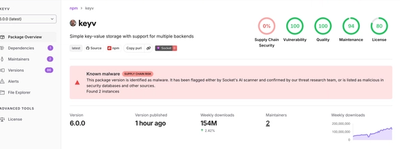
Popular npm packages keyv and cacheable compromised.

Security News
A misconfiguration gave three Anthropic models internet access, and one, believing it was in a simulation, shipped a credential-stealing package to PyPI.