
Research
/Security News
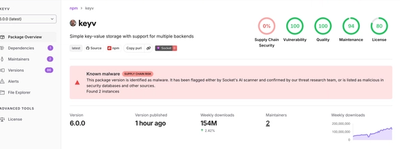
Popular npm Packages in the keyv and Cacheable Namespaces Compromised in Active Supply Chain Attack
Popular npm packages keyv and cacheable compromised.
By Socket Research Team - Aug 04, 2026
react-native-worktree
Advanced tools
Metro port switcher with mutex for multi-agent React Native development
A mutex tool for react-native/Expo that allows multiple agents to write code at the same time in worktrees.
They can then use the ios simulator or the android emulator to test and the tool queues them up automatically.
Each worktree runs its own Metro server on a unique port. Only one can use the device/simulator at a time per platform. This tool handles switching which Metro server the app connects to and coordinates access via per-platform cooperative locks.
npm install -g react-native-worktree
Install the skill so agents know how to use it:
# Claude Code
mkdir -p ~/.claude/skills/react-native-worktree && curl -fsSL https://raw.githubusercontent.com/aleqsio/react-native-worktree/main/skill/SKILL.md -o ~/.claude/skills/react-native-worktree/SKILL.md

# Codex
mkdir -p ~/.agents/skills/react-native-worktree && curl -fsSL https://raw.githubusercontent.com/aleqsio/react-native-worktree/main/skill/SKILL.md -o ~/.agents/skills/react-native-worktree/SKILL.md
Start multiple Claude Code sessions. Each agent works in a worktree:
> Add a user authentication feature, take screenshots on ios and android simulators, use react-native-worktree
The agent will (guided by the skill):
add (auto-detects bundle ID and platform on first run)react-native-worktree switch --platform ios to acquire the device and previewMeanwhile, another agent in a separate session:
> Fix the navigation bug on the settings screen, take screenshots on ios and android simulators, use react-native-worktree
This agent creates its own worktree. When it needs the device, it calls switch — if the first agent still holds the lock for that platform, it waits automatically until the device is free.
iOS Simulator — writes RCT_jsLocation to the app's NSUserDefaults, then terminates and relaunches:
xcrun simctl spawn booted defaults write <bundleId> RCT_jsLocation "localhost:<port>"
xcrun simctl terminate booted <bundleId>
xcrun simctl launch booted <bundleId>
Android Emulator — writes debug_http_host to the app's default SharedPreferences, sets up adb reverse for the actual port, then force-stops and relaunches:
echo '...localhost:<port>...' | adb shell run-as <packageName> sh -c 'cat > .../<packageName>_preferences.xml'
adb reverse tcp:<port> tcp:<port>
adb shell am force-stop <packageName>
adb shell monkey -p <packageName> -c android.intent.category.LAUNCHER 1
No proxy, no native module, no app changes required.
File-based cooperative lock at ~/.rnwt/lock.json, keyed by platform. iOS and Android locks are independent — two agents can hold different platform locks simultaneously.
switch <name> --platform ios — acquire the iOS lock (or heartbeat if already held). If another agent holds it, blocks until released or stale.release --platform ios — free the iOS lock immediately.The lock has a heartbeat/staleness model: each switch call updates a timestamp. If the holder stops calling (crashed, moved on), the timestamp goes stale after the inactivity timeout (default 60s) and another agent can take over. The --timeout flag on switch controls this inactivity threshold.
When adding a worktree without --port, the tool probes all existing ports for running Metro servers. If any port has Metro stopped (the worktree's server was killed), it's reused. Otherwise, a new port is assigned as max(all ports) + 1.
react-native-worktree add <name>Register a worktree. On first run, auto-detects bundle ID and platforms from app.json / app.config.js and creates the config. Port auto-assigned (reuses dead ports, or increments from max).
react-native-worktree add feat-auth --path ../feat-auth
react-native-worktree add feat-auth --path ../feat-auth --port 9000
react-native-worktree add feat-auth --app com.myapp          # explicit app (multi-app)
react-native-worktree switch <name>Acquire the lock and switch the device to the worktree's Metro port.
react-native-worktree switch feat-auth                       # first configured platform
react-native-worktree switch feat-auth --platform ios        # explicit platform
react-native-worktree switch feat-auth --platform android    # independent Android lock
react-native-worktree switch feat-auth --timeout 120000      # 2min inactivity threshold
react-native-worktree switch feat-auth --app com.myapp       # explicit app
react-native-worktree releaseRelease the lock for a platform so other agents can use the device.
react-native-worktree release                                # default: ios
react-native-worktree release --platform android
react-native-worktree statusShow who holds the lock and for how long.
[ios] Runtime held by 'feat-auth' (port 8082), last active 5s ago
[android] Runtime held by 'fix-nav' (port 8083), last active 12s ago
react-native-worktree status                                 # all platforms
react-native-worktree status --platform ios                  # single platform
react-native-worktree listShow all registered worktrees with Metro running status, grouped by app.
com.myapp (ios, android)
  Name                Port    Metro     Lock
  -------------------------------------------------------
  main                8081    running
  feat-auth           8082    running   ios
  fix-nav             8083    stopped
react-native-worktree list                                   # all apps
react-native-worktree list --app com.myapp                   # single app
Stored at ~/.rnwt/config.json:
{
  "apps": {
    "com.example.myapp": {
      "platforms": ["ios", "android"],
      "worktrees": {
        "main": { "path": "/path/to/project", "port": 8081 },
        "feat-auth": { "path": "/path/to/feat-auth", "port": 8082 }
      }
    }
  }
}
Old single-app configs ({ bundleId, platform, worktrees, nextPort }) are auto-migrated on first load.
~/.rnwt/lock.json — keyed by platform:
{
  "ios": { "holder": "feat-auth", "app": "com.example.myapp", "pid": 123, "updatedAt": "..." },
  "android": { "holder": "fix-nav", "app": "com.example.myapp", "pid": 456, "updatedAt": "..." }
}
MIT
FAQs
Metro port switcher with mutex for multi-agent React Native development
We found that react-native-worktree demonstrated a healthy version release cadence and project activity because the last version was released less than a year ago. It has 1 open source maintainer collaborating on the project.
Did you know?

Socket for GitHub automatically highlights issues in each pull request and monitors the health of all your open source dependencies. Discover the contents of your packages and block harmful activity before you install or update your dependencies.
Research
/Security News
Popular npm packages keyv and cacheable compromised.

Security News
A misconfiguration gave three Anthropic models internet access, and one, believing it was in a simulation, shipped a credential-stealing package to PyPI.

Security News
/Company News
Socket has joined the new Composer and Packagist sponsorship program as a launch sponsor, supporting the team that keeps PHP's package ecosystem secure.