

Company News
AWS Security Hub Adds Socket for Supply Chain Security
Socket is now in the AWS Security Hub Extended plan. Adopt it through AWS, apply committed spend, and block malicious open source packages.
By Feross Aboukhadijeh - Aug 04, 2026
recourse-cli
Advanced tools
MCP server for AI agents to evaluate consequences before destructive actions. Analyzes Terraform plans, shell commands, and MCP tool calls.

Consequence layer for AI agents
Check recoverability before destructive actions


 [](https://safeskill.dev/scan/recourseos-recourse)
[](https://safeskill.dev/scan/recourseos-recourse)
Website · MCP Setup · Console · Coverage
Recourse is an MCP server that evaluates Terraform plans, shell commands, and tool calls before execution. It returns structured facts — recoverability tier, evidence assessment, and risk level — so callers can make context-aware decisions. Agents call Recourse before they act; humans see what the agent checked.
One config block. Works with Claude Desktop, Claude Code, Cursor, and any MCP-compatible client.
{
"mcpServers": {
"recourseos": {
"command": "npx",
"args": ["-y", "recourse-cli@latest", "mcp", "serve"]
}
}
}
The server exposes five tools:
| Tool | Purpose |
|---|---|
recourse_evaluate_terraform | Check Terraform plans before terraform apply |
recourse_evaluate_shell | Check shell commands before execution |
recourse_evaluate_mcp_call | Check other MCP tool calls before invocation |
recourse_evaluate_with_evidence | Re-evaluate with verification evidence |
recourse_supported_resources | List resources with deterministic rules |
Plus a resource agents can read:
| Resource | Purpose |
|---|---|
recourse://instructions | Safety protocol — when to call, how to interpret results |
Each tool returns:
allow, warn, escalate, or blockThe engine emits facts. Callers interpret them in context — a block assessment in staging might be acceptable; in production it might require approval.
Terraform plan says:
- aws_db_instance.main will be destroyed
Recourse tells the agent what that means:
aws_db_instance.main
recoverability: unrecoverable
reason: skip_final_snapshot=true, backup_retention_period=0, deletion_protection=false
riskAssessment: block
The agent can interpret these facts: "Recourse assessed this as block-level risk — deletes the database with no backup. Should I proceed?"
That's different from "I deleted your production database."
Agents can read the built-in safety protocol from recourse://instructions. Or use this prompt:
Before executing destructive operations, call RecourseOS:
- Shell commands → recourse_evaluate_shell
- Terraform plans → recourse_evaluate_terraform
- Other MCP tools → recourse_evaluate_mcp_call

Interpret the riskAssessment:
- allow: proceed
- warn: proceed with caution, inform user
- escalate: stop and ask user for approval
- block: do not proceed without human review

If escalate/block includes verificationSuggestions, run those commands
and call recourse_evaluate_with_evidence to potentially upgrade the assessment.
For humans running preflight checks directly:
npm install -g recourse-cli@latest
recourse --version
Run a preflight check:
recourse preflight shell 'aws s3 rm s3://prod-audit-logs --recursive'
Or run without installing:
npx -y recourse-cli@latest preflight shell 'aws s3 rm s3://prod-audit-logs --recursive'
terraform plan -out=plan.bin
terraform show -json plan.bin > plan.json

recourse plan plan.json
Open the interactive terminal UI:
recourse tui
recourse tui --source shell --input 'aws s3 rm s3://prod-audit-logs --recursive'
Fail CI if a plan contains unrecoverable changes:
recourse plan plan.json --fail-on unrecoverable
BLAST RADIUS REPORT
===================

DIRECT CHANGES

  X DELETE aws_db_instance.main
    Recoverability: unrecoverable
    skip_final_snapshot=true, no backup retention; data will be lost

  X DELETE google_storage_bucket.audit
    Recoverability: recoverable-from-backup
    GCS bucket versioning is enabled; object generations may be recoverable

  ~ DELETE azurerm_role_assignment.reader
    Recoverability: reversible
    Azure role assignment/definition is config-only and can be reapplied

SUMMARY
  Unrecoverable:         1 resource
  Recoverable (backup):  1 resource
  Reversible:            1 resource
| Tier | Label | Meaning |
|---|---|---|
| 1 | reversible | Can be undone with another apply or API call. |
| 2 | recoverable-with-effort | Can be recreated, but requires coordinated work. |
| 3 | recoverable-from-backup | Requires a backup, snapshot, version, or retention window. |
| 4 | unrecoverable | Data, identity, key material, or recovery points may be permanently lost. |
| 5 | needs-review | Evidence is insufficient to classify safely. |
Known resources use hand-written deterministic rules and remain authoritative.
AWS: RDS, DynamoDB, S3, EBS, EFS, EC2, Lambda, AMIs, VPCs, security groups, EIPs, load balancers, Route53, IAM, KMS, Secrets Manager, SNS/SQS, CloudWatch logs, ElastiCache, Neptune.
GCP: Cloud Storage (versioning), Cloud SQL (protection, backups), BigQuery, Secret Manager, IAM, service accounts, DNS, persistent disks, snapshots, KMS, GKE.
Azure: Storage accounts (soft delete), Azure SQL/MSSQL, PostgreSQL/MySQL Flexible Server, MariaDB, Cosmos DB, Key Vault, role assignments, Azure AD, DNS, managed disks, AKS.
For unknown resource types, Recourse uses a three-layer classification system:
Production accuracy is 90.5% on a held-out test set. Low-confidence classifications return needs-review rather than false approval.
recourse plan plan.json
recourse plan plan.json --state terraform.tfstate
recourse plan plan.json --format json
recourse plan plan.json --classifier
recourse explain plan.json aws_db_instance.main
recourse explain plan.json aws_db_instance.main --format json
recourse evaluate terraform plan.json --classifier
recourse evaluate shell 'aws s3 rm s3://prod-audit-logs --recursive'
recourse evaluate mcp '{"server":"aws","tool":"s3.delete_bucket","arguments":{"bucket":"prod-audit-logs"}}'
recourse preflight terraform plan.json --classifier
recourse preflight shell 'kubectl delete namespace payments'
recourse preflight mcp mcp-call.json
recourse tui
recourse tui --source shell --input 'aws s3 rm s3://prod-audit-logs --recursive'
recourse tui --source terraform --input plan.json --classifier
recourse mcp serve
See docs/mcp-setup.md for full setup and docs/agent-interface.md for the schema reference.
The agent proposes. The gateway enforces. RecourseOS verifies consequences.
For production use with AI agents, the Enforcement Gateway provides in-line enforcement that agents cannot bypass.
The agent does NOT receive raw Terraform, Kubernetes, shell, or cloud credentials.
The agent receives ONLY gateway tools.
The gateway owns execution credentials and applies policy, consequence evaluation,
approval checks, and audit logging before any mutation is executed.
| Agent-Callable (via MCP) | Human-Only (control plane) |
|---|---|
gateway_request_approval | approve |
gateway_check_approval | reject |
gateway_terraform_plan | break_glass |
gateway_terraform_apply | policy_override |
The agent can request and check approvals. Only humans can grant them.
# Start the gateway
recourse gateway serve -e prod

# Verify enforcement configuration
recourse gateway doctor -e prod
Configure Claude Code/Cursor:
{
  "mcpServers": {
    "recourse-gateway": {
      "command": "npx",
      "args": ["-y", "recourse-cli@latest", "gateway", "serve", "-e", "prod"]
    }
  }
}
| Guarantee | Mechanism |
|---|---|
| No credential leakage | Agent never sees raw credentials |
| Plan integrity | Apply only works with verified plan hash |
| Temporal bounds | Plans and approvals expire (1h / 24h) |
| Audit completeness | All attempts recorded, including blocks |
| Approval isolation | Agents cannot approve their own requests |
See docs/enforcement-gateway.md for the full architecture.
Automatically check RecourseOS before dangerous shell commands execute. Add to your shell profile:
eval "$(recourse wrap)"
Now rm, aws, kubectl, and terraform commands check RecourseOS first:
rm -rf /tmp/important
# recourse: escalate - Recoverability needs human review
# Proceed? [y/N]
Or execute with explicit checking:
recourse exec "rm -rf /tmp/test"
Every evaluation response includes a cryptographic attestation (Ed25519 signature). Verify with:
recourse verify attestation.json
Or pipe from stdin:
cat response.json | jq '.attestation' | recourse verify -
recourse evidence aws-s3 prod-audit-logs --region us-east-1 > s3-evidence.json
recourse evidence aws-rds prod-db --region us-east-1 > rds-evidence.json

recourse evaluate shell 'aws s3 rb s3://prod-audit-logs --force' \
  --aws-s3-evidence s3-evidence.json
Supported: aws-s3, aws-rds, aws-dynamodb, aws-iam-role, aws-kms-key.
recourse resources
npm install
npm run build
npm test
npm run test:all
Regenerate docs after changing resource handlers:
npm run docs:all
Recourse analyzes the plan, state, command, and evidence you provide. It cannot:
The safety posture is conservative: when evidence is incomplete, Recourse returns higher-risk assessments (escalate or block) rather than understating risk.
MIT
FAQs
MCP server for AI agents to evaluate consequences before destructive actions. Analyzes Terraform plans, shell commands, and MCP tool calls.
We found that recourse-cli demonstrated a healthy version release cadence and project activity because the last version was released less than a year ago. It has 1 open source maintainer collaborating on the project.
Did you know?

Socket for GitHub automatically highlights issues in each pull request and monitors the health of all your open source dependencies. Discover the contents of your packages and block harmful activity before you install or update your dependencies.
Company News
Socket is now in the AWS Security Hub Extended plan. Adopt it through AWS, apply committed spend, and block malicious open source packages.
Research
/Security News
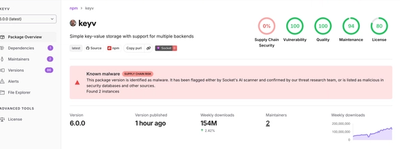
Popular npm packages keyv and cacheable compromised.

Security News
A misconfiguration gave three Anthropic models internet access, and one, believing it was in a simulation, shipped a credential-stealing package to PyPI.