Retroix 🕹️
A tiny, dependency-free retro game engine in a single file. Drop it in with a <script> tag — no build step, no npm required — and everything a small canvas game needs is there.





Retroix is a general-purpose 2D game engine for the browser. It bundles the
plumbing every small game re-implements — a DPI-aware canvas, a crash-safe game
loop, input, sound, physics, a camera, screens, leaderboards and more — so your
game is just its own update(dt) / render(ctx) and level data. It ships as one
UMD file (window.Retroix), works from a CDN or a bundler, and has zero
dependencies.
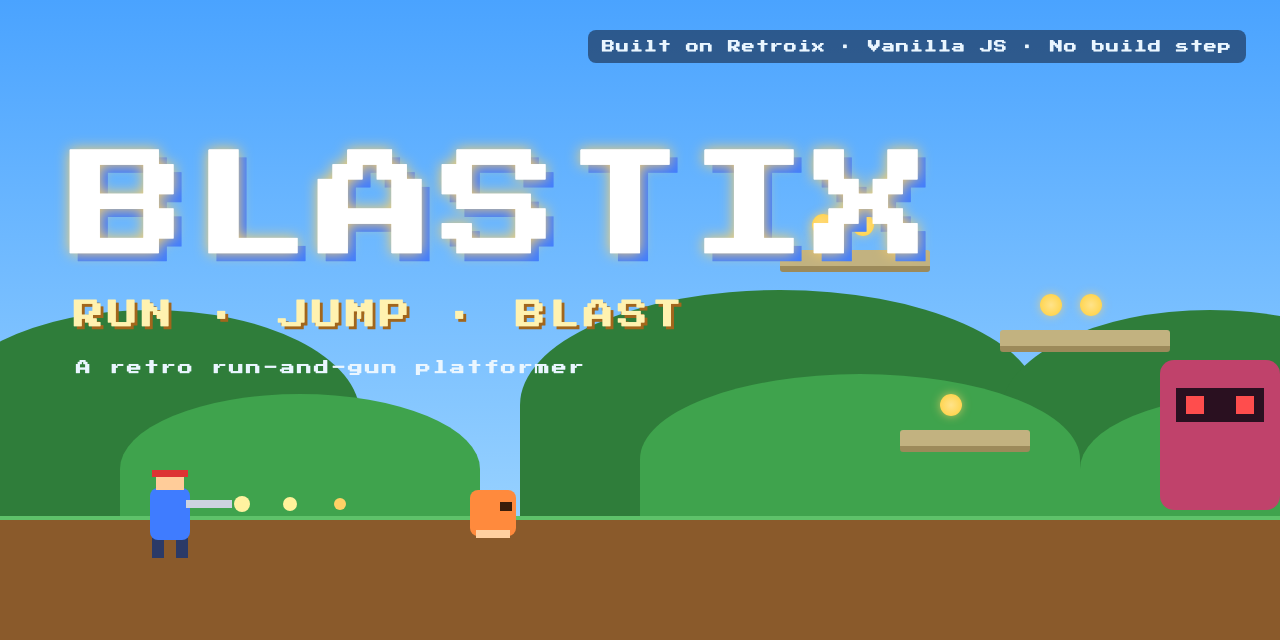
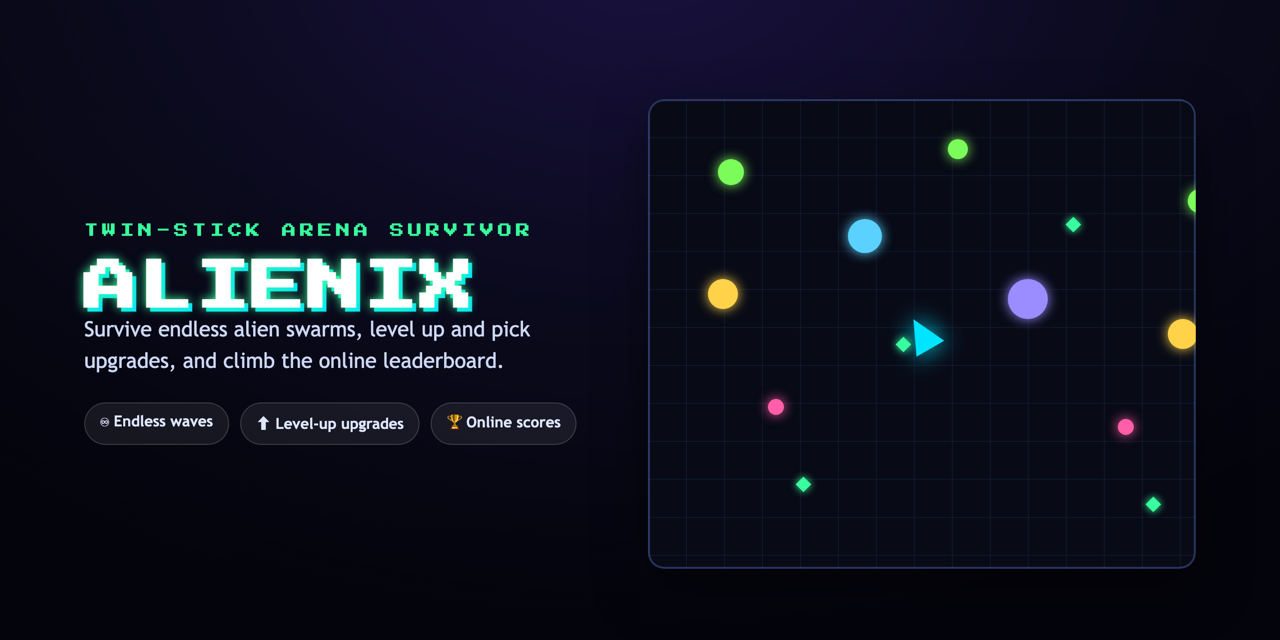
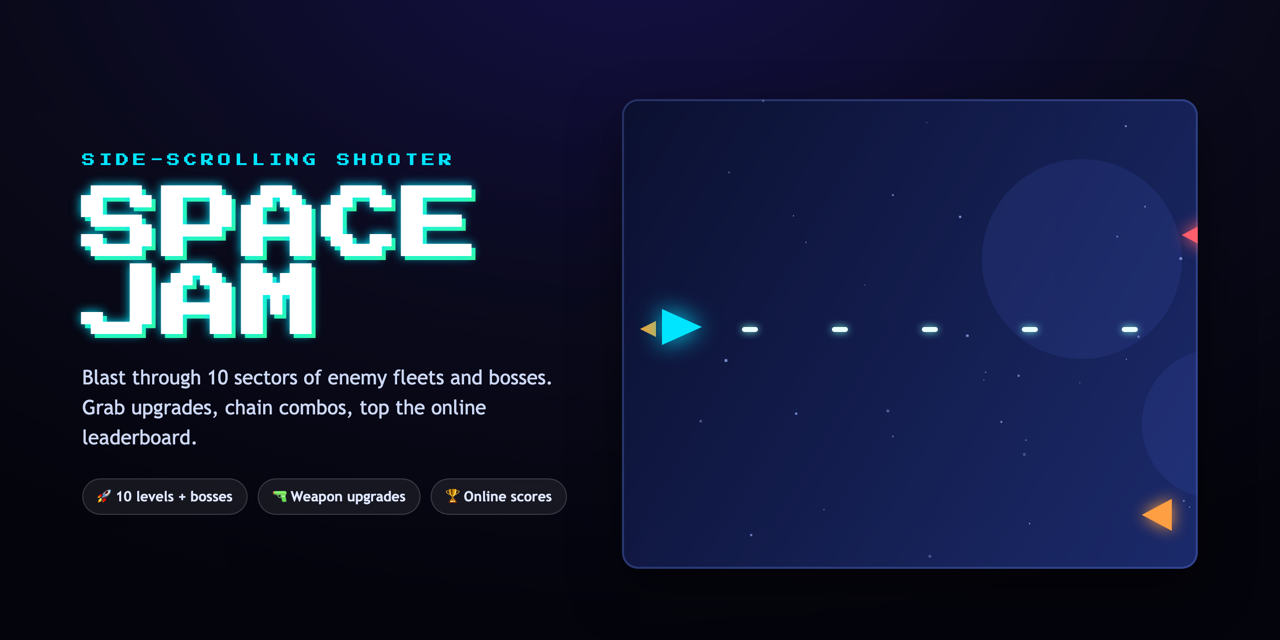
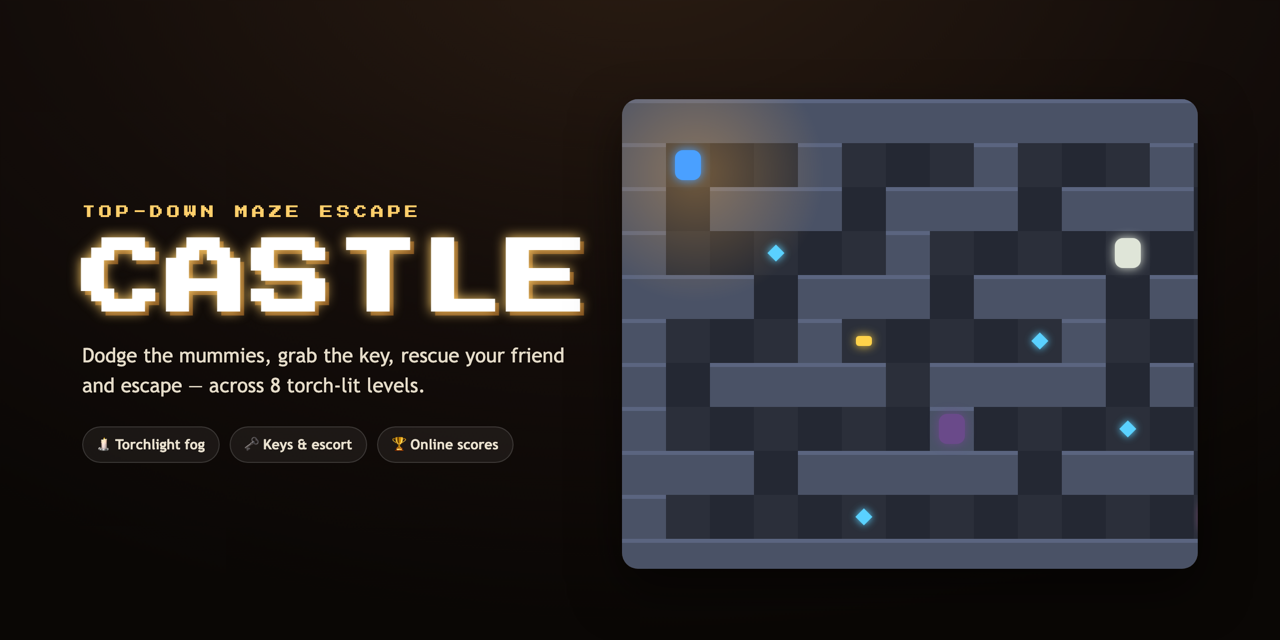
A whole gallery of games is built on it —
they're the showcase, not the point. It gives you:
- 🖥️ DPI-aware canvas — a fixed logical resolution scaled crisply to any size.
- 🔁 Render-safe game loop —
requestAnimationFrame with a clamped delta; can't die mid-frame.
- ⌨️ Input — keyboard (arrows + WASD → named actions), mouse and touch in logical coords.
- 🔊 8-bit audio — synthesized on the Web Audio API, zero sample files: SFX presets (coin, jump, laser, explosion, powerup, hit…), short jingles, and custom tones, with persistent mute/volume.
- 🎵 Chiptune music — looping, multi-voice background tracks defined as data (no files): per-level tunes with crossfade, pause/resume, ducking under loud SFX, and an independent music volume under one master mute.
- 💥 Game feel — screen shake, flash, and freeze-frame (hitstop) to make hits land.
- 🧲 Arcade physics — gravity/friction/max-vel integration + axis-separated AABB resolution with
onGround/blocked flags.
- 🗺️ Tile grid — cell↔world coords, and
solids() that feeds collision rects straight into physics.
- 🎥 Camera — follow a target, clamp to level bounds,
begin/end world transform.
- 🔀 State machine —
title / play / pause / over with enter/update/exit hooks.
- ⏱️ Timers & tweens —
after / every callbacks and eased property tweens.
- 📐 Collision — AABB / circle / circle-rect / point overlap tests.
- 💾 Storage — namespaced, JSON-friendly
localStorage for best scores and settings.
- 🤖 Autopilot — a secret-combo dev mode that turns a bot loose to play your game unattended: checks it's finishable, and surfaces crashes and soft-locks with an on-screen report.
- 🏆 Leaderboard — pluggable backend: a plain REST board (e.g. the free Cloudflare Worker + D1), Supabase, or per-browser localStorage — all with a localStorage fallback (
top / submit / qualifies).
- 🪟 Screens — overlay manager, retro 3-initial high-score entry, and a leaderboard table renderer.
- ✨ gfx —
roundRect, a particle-burst system, and a fading toast helper.
- 🎨
retroix.css — the neon-on-dark theme (HUD, buttons, screens, initials, leaderboard).
…so a game is just its own update(dt) / render(ctx) and level data.
Games built on Retroix
Seven full games run on the engine — each just a few hundred lines of game logic.
They're the proving ground (and the fun part). ▶ Play them all in the live gallery.
Install
No build step required. Load it straight from a CDN — it's a UMD file, so
window.Retroix is available globally:
<link href="https://fonts.googleapis.com/css2?family=Press+Start+2P&display=swap" rel="stylesheet">
<link rel="stylesheet" href="https://cdn.jsdelivr.net/npm/retroix@1.2.0/retroix.css">
<script src="https://cdn.jsdelivr.net/npm/retroix@1.2.0/retroix.js"></script>
Or from the GitHub repo (no npm needed):
<script src="https://cdn.jsdelivr.net/gh/DanMat/Retroix@v1.2.0/retroix.js"></script>
Or with a bundler:
npm install retroix
import Retroix from 'retroix';
import 'retroix/css';
Quick start
<canvas id="game" width="480" height="640"></canvas>
<script>
var view = Retroix.canvas('#game', 480, 640);
var input = Retroix.input(view);
var board = Retroix.leaderboard({ gameId: 'demo' });
var x = 240, y = 320;
Retroix.loop(function (dt) {
var a = input.axis();
x += a.x * 200 * dt; y += a.y * 200 * dt;
var ctx = view.ctx;
ctx.fillStyle = '#0a0a1c'; ctx.fillRect(0, 0, 480, 640);
ctx.fillStyle = '#00e5ff'; Retroix.gfx.roundRect(ctx, x - 15, y - 15, 30, 30, 6); ctx.fill();
}).start();
</script>
API
Retroix.canvas(el, w, h) | { ctx, width, height, dpr, resize(), toLogical(cx,cy) } |
Retroix.loop(step, opts) | { start(), stop(), isRunning() } — step(dt) in seconds |
Retroix.input(canvas, opts) | { actions, pointer, down(a), axis(), onKeyDown(fn) } |
Retroix.audio(opts) | { coin(), …, play(name), jingle(name), tone(spec), sequence(notes), music(track), stopMusic(), pauseMusic(), resumeMusic(), duck(), musicVolume(v), mute(v), volume(v), toggle() } |
Retroix.tracks | built-in chiptune loops: title, action, boss, calm |
Retroix.fx(dims, opts) | { shake(a), flash(color,s), freeze(dur), frozen(), update(dt), preRender(ctx), postRender(ctx) } |
Retroix.hit | rects(a,b), circles(a,b), circleRect(c,r), pointRect(px,py,r), pointCircle(px,py,c) |
Retroix.physics | body(opts), move(body, solids, dt) — arcade integration + AABB resolution |
Retroix.grid(cols, rows, tile) | { at, set, cellAt, rectOf, forEach, solids(isSolid, region) } |
Retroix.camera(view, opts) | { x, y, follow(t,l), clamp(), begin(ctx), end(ctx), worldToScreen, screenToWorld } |
Retroix.fsm(states, initial) | { set(name,…), update(dt), render(ctx), is(name), current() } |
Retroix.timer() | { after(s,fn), every(s,fn), tween(obj,props,dur,ease,done), cancel(t), update(dt) } |
Retroix.ease | linear, inQuad, outQuad, inOutQuad, inCubic, outCubic, outBack, outBounce |
Retroix.storage(ns) | { get(key,fallback), set(key,val), remove(key), keys(), clear() } |
Retroix.autopilot(cfg) | secret-combo test bot (finishability / chokepoints) — { start(), stop(), running() } |
Retroix.jumpReach(opts) | { maxDist, maxHeight, airtimeFrames, apexFrames } from jump physics |
Retroix.leaderboard(cfg) | { top(n), submit(initials,score,stage), qualifies(score), mode } |
Retroix.screens(root) | { show(id), hideAll(), current() } over [data-screen] elements |
Retroix.initials(el, {onEnter}) | 3-letter entry: { value(), reset(), handleKey(e), active } |
Retroix.renderLeaderboard(tbody, rows, opts) | fills a <tbody> with score rows |
Retroix.gfx | roundRect, particles() |
Retroix.toast(el) | returns toast(msg, ms) |
Retroix.util | clamp, rand, randInt, pick, hypot, dist2, lerp, shuffle, escapeHtml |
8-bit audio
No files — every sound is synthesized. The first key/tap unlocks audio
(browsers require a gesture); mute and volume persist across sessions.
var sfx = Retroix.audio();
sfx.coin();
sfx.explosion();
sfx.play('laser');
sfx.jingle('win');
sfx.tone({ wave: 'square', freq: 'C5', freqEnd: 'C6', dur: 0.15 });
sfx.sequence(['C5:0.08', 'E5', 'G5']);
sfx.toggle();
Autopilot (dev-mode test bot)
A secret key combo (the Konami code by default) turns a bot loose to play
your game unattended — to check it's finishable and to surface crashes,
soft-locks and impassable spots. The engine can't win your game, so supply
a bot(api) policy + closures over your state. The recommended model: give the
game infinite lives (respawn in place) and pass deaths() (a monotonic
failure counter) + location(). The bot keeps trying; if it dies
deathsPerSpot times within one spot, that's flagged an impassable
chokepoint — with the coordinate to fix. A stuck-watchdog, timeout,
isWin(), and crash capture round it out, and the report names the worst
death hotspot. (No bot → a generic masher smoke-tests boot→play.)
Retroix.autopilot({
start: function () { testMode = true; if (state === 'title') startGame(); },
stop: function () { testMode = false; },
bot: botDrive,
progress: function () { return levelIndex * 1e5 + player.x; },
location: function () { return levelIndex * 1e5 + deathX; },
deaths: function () { return deathCount; },
isWin: function () { return wonFlag; },
deathsPerSpot: 6
});
Pair it with a static reachability check so you catch impossible geometry
without even running the bot:
var reach = Retroix.jumpReach({ jump: JUMP, gravity: GRAV, run: RUN });
Chiptune background music
Tracks are data, not files — a tempo and a step grid per voice. Each token
is one step: a note (C4, F#3), - for a rest, or . to hold the previous
note one more step. Give each level its own tune; switching crossfades.
sfx.music('action');
sfx.music(level.track, { fade: 0.6 });
sfx.pauseMusic(); sfx.resumeMusic();
sfx.duck(0.4, 0.5);
sfx.musicVolume(0.4);
sfx.stopMusic(0.5);
var boss = {
tempo: 150, stepsPerBeat: 4,
voices: [
{ wave: 'square', vol: 0.26, notes: 'C5 C#5 C5 C#5 C5 - G5 - G#5 G5 G#5 G5 - - F5 -' },
{ wave: 'sawtooth', vol: 0.30, notes: 'C3 . C3 . C3 . C3 . G#2 . G#2 . G2 . G2 .' }
]
};
Game feel
var fx = Retroix.fx(view);
sfx.hit(); fx.shake(0.6); fx.flash('#fff', 0.4); fx.freeze(0.05);
fx.update(dt);
if (!fx.frozen()) { updateWorld(dt); }
fx.preRender(ctx);
drawWorld(ctx);
fx.postRender(ctx);
Arcade physics + tile grid
Bodies integrate gravity/friction and resolve against static rects. A grid turns
your level into those rects for free:
var grid = Retroix.grid(40, 30, 16);
grid.set(5, 20, 1);
var hero = Retroix.physics.body({ x: 80, y: 40, w: 12, h: 16, gravity: 0.6, friction: 0.2, maxVx: 4, maxVy: 12 });
Retroix.loop(function (dt) {
var a = input.axis();
hero.vx = a.x * 4;
if (input.down('up') && hero.onGround) { hero.vy = -11; sfx.jump(); }
var solids = grid.solids(null, { x: hero.x - 40, y: hero.y - 40, w: 120, h: 120 });
Retroix.physics.move(hero, solids, dt);
}).start();
Cap velocity (maxVx/maxVy) below your tile size — arcade physics steps
discretely, so an uncapped body can skip clean over a thin wall.
Camera, state machine & tweens
var cam = Retroix.camera(view, { bounds: { x: 0, y: 0, w: 640, h: 480 } });
cam.follow(hero, 0.1);
cam.begin(ctx); drawWorld(ctx); cam.end(ctx);
var game = Retroix.fsm({
title: { enter: function () { showScreen('title'); } },
play: { update: function (dt) { stepWorld(dt); } },
over: { enter: function () { sfx.jingle('gameover'); } }
}, 'title');
var tm = Retroix.timer();
tm.tween(hero, { y: hero.y - 20 }, 0.3, 'outBack');
tm.after(1.5, function () { game.set('over'); });
Leaderboard config
Three backends, in order of preference — set one, or none for a local board:
Retroix.leaderboard({
gameId: 'paddix',
apiUrl: 'https://retroix-leaderboard.danmat.workers.dev',
size: 10
});
Retroix.leaderboard({
supabaseUrl: 'https://YOUR-PROJECT.supabase.co',
supabaseAnonKey: 'sb_publishable_...',
gameId: 'paddix'
});
apiUrl expects a tiny REST service: GET /scores?game=&limit= returning
[{ initials, score, stage, created_at }], and POST /scores accepting
{ game, initials, score, stage }. A ready-made, free one (Cloudflare Worker + D1,
multi-tenant across all your games) lives at
retroix-leaderboard — it also validates
input and caps scores server-side. board.mode reports 'cloudflare' | 'supabase' | 'local'.
The Supabase board expects a scores table (game, initials, score, stage,
created_at) protected by row-level-security.
CSS
retroix.css styles .rx-* classes and reads CSS variables you can override
(--rx-accent, --rx-pixel, --rx-panel, …) to reskin per game. Load the
Press Start 2P font for the headings.
License
MIT © DanMat