
Product
PHP and Composer Support Is Now in Beta
Socket’s PHP and Composer support is now in Beta for all customers, with PHP reachability analysis generally available.
By Trevor Norris, Benjamin Barslev - Aug 21, 2026
riskrover-mcp-server
Advanced tools
Use any stdio MCP client to draft and review RiskRover product breakdowns and assess automated tests against product risks.
The portable local server for using RiskRover with any stdio-capable MCP client. It gives an AI agent two workflows:
System > Feature > Component Product Breakdown Structure (PBS);npm install riskrover-mcp-server downloads an executable into a Node.js project. It does not add the server to an AI client by itself. An MCP host must still start the executable over stdio and supply RISKROVER_API_TOKEN.
Most users should skip a separate install and configure their client to run:
npx -y riskrover-mcp-server@latest
This downloads and starts the current package when the MCP host needs it. Requirements are Node.js 20 or newer, an MCP-capable client, and a personal RiskRover API token.
Clients that use the common mcpServers format can start with:
{
  "mcpServers": {
    "riskrover": {
      "command": "npx",
      "args": ["-y", "riskrover-mcp-server@latest"],
      "env": {
        "RISKROVER_API_TOKEN": "PASTE_YOUR_PERSONAL_RISKROVER_API_TOKEN_HERE",
        "RISKROVER_PROJECT_ID": "12345"
      }
    }
  }
}
Keep literal tokens only in a private user configuration that is not committed. If the client supports secret storage or environment expansion, use that instead. RISKROVER_PROJECT_ID is optional; users can name a project ID in each request.
On native Windows, a client that cannot launch npx directly may need:
{
  "command": "cmd",
  "args": ["/c", "npx", "-y", "riskrover-mcp-server@latest"]
}
The RiskRover MCP for VS Code extension is the recommended route. It bundles the server, verifies and stores the token in SecretStorage, and registers the server dynamically without a separate Node.js installation.
For an npm-based VS Code setup, put this in the user MCP configuration opened by MCP: Open User Configuration, or in .vscode/mcp.json if the team deliberately shares the non-secret server definition:
{
  "servers": {
    "riskrover": {
      "type": "stdio",
      "command": "npx",
      "args": ["-y", "riskrover-mcp-server@latest"],
      "env": {
        "RISKROVER_API_TOKEN": "${env:RISKROVER_API_TOKEN}",
        "RISKROVER_PROJECT_ID": "12345"
      }
    }
  }
}
Set the environment variable before starting VS Code. Run MCP: List Servers to start, restart, or inspect RiskRover, then open a fresh Copilot Chat in Agent mode. MCP: Browse MCP Servers is the gallery, not the runtime list.
Copilot Business and Enterprise administrators must allow MCP servers in GitHub policy. Each user still supplies their own RiskRover token; a shared billing relationship does not share API credentials.
Codex CLI, the Codex IDE extension, and Codex on the same host share ~/.codex/config.toml:
[mcp_servers.riskrover]
command = "npx"
args = ["-y", "riskrover-mcp-server@latest"]
startup_timeout_sec = 60

[mcp_servers.riskrover.env]
RISKROVER_API_TOKEN = "PASTE_YOUR_PERSONAL_RISKROVER_API_TOKEN_HERE"
RISKROVER_PROJECT_ID = "12345"
Keep that user file private, restart Codex, start a new chat, and check the Codex MCP server list. The RiskRover VS Code extension's SecretStorage value is not automatically shared with Codex.
mcpServers entry to a project .mcp.json or user configuration, then check /mcp or claude mcp list.claude_desktop_config.json, fully quit, and reopen the application..cursor/mcp.json or the private global MCP configuration.npx arguments, and the required token environment variable.Environment expansion syntax differs between clients. Never commit a literal token merely to make an example work.
Create a token in RiskRover under Manage workspace > Configuration > API TOKENS. Read-only scope is enough for assessment and PBS drafting; importing a reviewed PBS requires read-and-write scope.
The executable supports --check-connection. With RISKROVER_API_TOKEN already supplied privately in the process environment, run the configured executable with that flag to receive a small JSON result. When RISKROVER_PROJECT_ID is set, it checks both authentication and project access.
Token-like data is redacted from diagnostics. A normal server shown as running proves MCP initialization, not necessarily API authentication; --check-connection or a RiskRover data request proves authentication.
Assess automated tests:
Use RiskRover MCP to assess the automated tests in the open workspace folders
against RiskRover project 12345. Keep it read-only and state the folders and
limitations included in the assessment.
Draft a product breakdown:
Use RiskRover MCP to draft a complete business-readable PBS for RiskRover
project 12345. Present it for review and do not import it yet.
Users do not need to call an API or name internal tools.
RiskRover project retrieval depends on the token and project ID, not the open repository. A full product repository, standalone application, automation repository, or test-only repository is valid scope.
The server itself cannot read files or run commands. The AI host inspects only the workspace folders it has been given. Add another folder explicitly when relevant code lives elsewhere; the assessment should identify omitted roots as a limitation rather than assuming the project is inaccessible.
RISKROVER_API_TOKEN: required personal API token.RISKROVER_PROJECT_ID: optional positive default project ID.RISKROVER_BASE_URL: optional; defaults to https://app.riskrover.io.RISKROVER_ALLOW_INSECURE_LOCALHOST: development only; permits an explicit localhost HTTP URL.The server uses stdout only for MCP protocol messages and writes diagnostics to stderr.
Support: contact@riskrover.io
FAQs
Use any stdio MCP client to draft and review RiskRover product breakdowns and assess automated tests against product risks.
We found that riskrover-mcp-server demonstrated a healthy version release cadence and project activity because the last version was released less than a year ago. It has 1 open source maintainer collaborating on the project.
Product
Socket’s PHP and Composer support is now in Beta for all customers, with PHP reachability analysis generally available.
Product
Socket is bringing experimental protection to Firefox, scanning 97,000+ extensions in Mozilla's official directory for malware and risky updates.
Research
/Security News
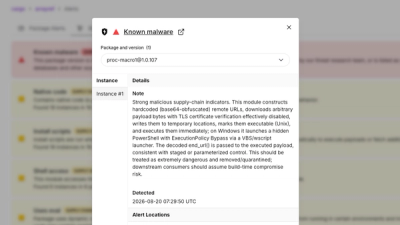
Three compromised Rust crates pulled in a malicious dependency that downloaded and executed cross-platform malware during Cargo builds.