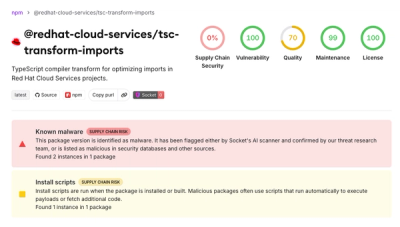
Serverless Module Registry Plugin
A Serverless Framework plugin that scans module registry files, discovers endpoints, and stores module feature mappings in DynamoDB for cross-module discovery and access control.
🎯 Purpose
This plugin enables:
- Module Discovery: Automatically catalog all modules and their features
- Endpoint Mapping: Track which API endpoints belong to which features
- Access Control: Store IAM policies for cross-module permission management
- Service Registry: Provide a central registry for module-to-module communication
📦 Installation
npm install --save-dev serverless-plugin-module-registry
🚀 Usage
Basic Configuration
Add the plugin to your serverless.yml:
plugins:
- '@hyperdrive.bot/serverless-composer'
- 'serverless-plugin-module-registry'
custom:
moduleRegistry:
tableName: ModuleRegistry
region: us-east-1
skipDynamoDB: false
Module Registry Structure
Each module should have a registry/ folder:
serverless/modules/my-module/
├── functions/                  # Existing serverless functions
├── resources/                  # Existing serverless resources
└── registry/                   # NEW: Registry definitions
    ├── module.yml              # Module metadata
    └── features/               # Feature definitions
        ├── user-management.yml
        └── notification-system.yml
Module Metadata (registry/module.yml)
name: "My Module"
version: "1.0.0"
description: "Sample module for testing"
maintainer: "DevSquad Team"
tags:
  - "sample"
  - "testing"
Feature Definition (registry/features/user-management.yml)
name: "User Management"
description: "CRUD operations for user lifecycle management"
version: "1.2.0"

endpoints:
  - "POST/users"
  - "GET/users"
  - "GET/users/*"
  - "PUT/users/*"
  - "DELETE/users/*"

customPolicies:
  - Effect: Allow
    Action:
      - "execute-api:Invoke"
    Resource:
      - "arn:aws:execute-api:*:*:*/*/POST/users"
      - "arn:aws:execute-api:*:*:*/*/GET/users"
      - "arn:aws:execute-api:*:*:*/*/GET/users/*"
  - Effect: Allow
    Action:
      - "dynamodb:PutItem"
      - "dynamodb:GetItem"
      - "dynamodb:Query"
    Resource:
      - "arn:aws:dynamodb:*:*:table/Users"
🗄️ DynamoDB Table Schema
The plugin creates an intermodular ModuleRegistry table using AWS SDK v3 (not CloudFormation) with the following structure:
🔄 Why SDK v3 Instead of CloudFormation?
✅ Intermodular Independence: The table exists independently of any specific module's deployment lifecycle
✅ Cross-Module Sharing: Multiple modules can write to the same registry without ownership conflicts
✅ Deployment Flexibility: The table persists even if individual modules are removed or redeployed
✅ No Stack Dependencies: No CloudFormation stack owns the table, preventing accidental deletion
📋 Table Management
- Creation: Automatic during first deployment with registry data
- Naming:
{service}-{stage}-module-registry (e.g., ds-api-live-module-registry)
- Compliance: Follows @dynamodb-tables.md standards (point-in-time recovery, tags)
- Lifecycle: Independent of individual module deployments
Primary Key
- PK:
MODULE#{moduleName} (e.g., MODULE#sign)
- SK:
FEATURE#{featureName} (e.g., FEATURE#user-management)
Global Secondary Index (GSI1)
- GSI1PK:
MODULES (for listing all modules)
- GSI1SK:
MODULE#{moduleName} (for grouping by module)
Global Secondary Index (GSI2)
- GSI2PK:
FEATURES (for listing all features)
- GSI2SK:
FEATURE#{featureId} (for direct feature lookup by ID)
Data Structure
{
  "PK": "MODULE#sign",
  "SK": "FEATURE#user-management",
  "GSI1PK": "MODULES",
  "GSI1SK": "MODULE#sign",
  "moduleName": "sign",
  "featureName": "user-management",
  "description": "CRUD operations for user lifecycle",
  "version": "1.2.0",
  "endpoints": [
    "POST/users",
    "GET/users",
    "GET/users/*"
  ],
  "customPolicies": [...],
  "lastUpdated": "2025-01-01T00:00:00Z"
}
🔄 How It Works
- After Composer: Plugin hooks after composer processes modules
- Registry Scanning: Scans each module's
registry/ folder
- Feature Processing: Reads and validates feature definitions
- Table Management: Creates intermodular DynamoDB table via AWS SDK v3 (if doesn't exist)
- Standards Compliance: Enables point-in-time recovery and applies compliance tags
- Data Storage: Batch writes registry data to DynamoDB with optimized structure
📋 Access Patterns
The stored data supports these query patterns:
List All Modules
const modules = await dynamoClient.query({
IndexName: 'GSI1',
KeyConditionExpression: 'GSI1PK = :pk',
ExpressionAttributeValues: {
':pk': 'MODULES'
}
})
Get Module Features
const features = await dynamoClient.query({
KeyConditionExpression: 'PK = :pk',
ExpressionAttributeValues: {
':pk': `MODULE#${moduleName}`
}
})
Get Specific Feature
const feature = await dynamoClient.getItem({
Key: {
PK: `MODULE#${moduleName}`,
SK: `FEATURE#${featureName}`
}
})
Get Feature by ID (GSI2)
const feature = await dynamoClient.query({
IndexName: 'GSI2',
KeyConditionExpression: 'GSI2PK = :pk AND GSI2SK = :sk',
ExpressionAttributeValues: {
':pk': 'FEATURES',
':sk': `FEATURE#${featureId}`
}
})
⚙️ Configuration Options
tableName | string | {service}-{stage}-module-registry | DynamoDB table name |
region | string | provider.region | AWS region for DynamoDB |
skipDynamoDB | boolean | false | Skip DynamoDB operations |
strict | boolean | false | Enforce registry folders on all modules |
🔒 Strict Mode (strict: true)
Controls whether the plugin should enforce registry compliance:
strict: false (Default - Graceful Mode)
custom:
moduleRegistry:
strict: false
- ✅ Graceful Migration: Modules without registry folders are silently skipped
- ✅ Backwards Compatible: Existing modules continue to work unchanged
- ✅ Gradual Adoption: Teams can add registry folders at their own pace
- ✅ Production Safe: No deployment failures
strict: true (Enforcement Mode)
custom:
moduleRegistry:
strict: true
- 🚨 Enforces Compliance: Deployment fails if modules don't have registry folders
- 🔒 Quality Gate: Ensures all modules participate in the registry
- 📋 Documentation Requirement: Forces teams to document their module features
- ⚡ Use After Migration: Enable once all modules have been updated
🎯 When to Use Each Mode
Use strict: false when:
- 🚀 Initial Rollout: Adding the plugin to existing systems
- 🔄 Migration Phase: Teams are gradually adding registry folders
- 🧪 Testing Phase: Experimenting with the registry system
- 🏗️ Development: Working with modules that aren't fully documented yet
Use strict: true when:
- ✅ Full Adoption: All modules have been migrated to use registry folders
- 🔒 Governance: You want to enforce registry compliance as a quality gate
- 📋 Documentation Standards: Registry definitions are required for all modules
- 🚀 Production Systems: Where complete module documentation is mandatory
🐛 Debugging
The plugin provides detailed logging with [module-registry] prefix:
serverless deploy --verbose
Example output:
[module-registry] 🔍 Scanning modules for registry definitions...
[module-registry] Found 3 modules: sample, sign, agents
[module-registry] 📋 Processing registry for module: sample
[module-registry]    Found 2 feature definitions
[module-registry]    ✓ user-management: 5 endpoints
[module-registry]    ✓ notification-system: 9 endpoints
[module-registry] ✅ Registry processing complete. Found 4 features across 3 modules
🤝 Integration with Handlers - Direct Import Pattern
No need for separate service files! Import service functions directly from the plugin:
TypeScript/ES6 Imports
import {
listAllModules,
getModuleFeatures,
getFeatureDetails,
createModuleRegistryLogger,
type ModuleInfo,
type FeatureInfo
} from 'module-registry'
const logger = createModuleRegistryLogger('my-handler')
export const myHandler = async (event: any) => {
const modules = await listAllModules()
logger.info(`Found ${modules.length} modules`)
return { modules }
}
export const getFeatureHandler = async (event: any) => {
const { featureId } = event.pathParameters
const feature = await getFeatureById(featureId)
if (!feature) {
return { statusCode: 404, body: { error: 'Feature not found' } }
}
return { statusCode: 200, body: feature }
}
CommonJS/Node.js Require
const {
listAllModules,
getModuleFeatures,
createModuleRegistryLogger
} = require('module-registry')
const logger = createModuleRegistryLogger('my-handler')
exports.myHandler = async (event) => {
const modules = await listAllModules()
logger.info(`Found ${modules.length} modules`)
return { modules }
}
Available Service Functions
listAllModules() | List all deployed modules | Promise<ModuleInfo[]> |
getModuleFeatures(moduleName) | Get features for a module | Promise<FeatureInfo[]> |
getFeatureDetails(moduleName, featureName) | Get feature details | Promise<FeatureDetails | null> |
getFeatureById(featureId) | Get feature by ID only (uses GSI2) | Promise<FeatureDetails | null> |
getModuleMetadata(moduleName) | Get module metadata only | Promise<ModuleInfo | null> |
getAllEndpoints() | Get all endpoints across modules | Promise<EndpointInfo[]> |
createModuleRegistryLogger(context) | Create logger for service functions | Logger |
Example Handler Implementation
const { http } = require('../../middlewares/http')
const { listAllModules, createModuleRegistryLogger } = require('serverless-plugin-module-registry')
const logger = createModuleRegistryLogger('list-modules-handler')
export const listModules = http(async (event) => {
logger.info('Listing all deployed modules', {
userSub: event.requestContext.authorizer?.claims?.sub
})
try {
const modules = await listAllModules()
logger.info(`Successfully retrieved ${modules.length} modules`)
return {
statusCode: 200,
body: {
modules,
count: modules.length,
timestamp: new Date().toISOString()
}
}
} catch (error) {
logger.error('Error listing modules:', error.message)
return {
statusCode: 500,
body: {
error: 'Failed to list modules',
message: error.message
}
}
}
})
🚀 CLI Commands
The plugin provides powerful CLI commands for managing module registries:
Generate Registry with AI (registryGenerate)
Automatically generate registry files for a module using AI analysis:
serverless registryGenerate --module workforce
serverless registryGenerate --module workforce --force
Prerequisites:
- Set
OPENROUTER_API_KEY environment variable for AI generation
- Module must have function descriptions in serverless function definitions
- Only functions with
aws_iam authorizer are included in registry
What it does:
- Analyzes module structure (functions, resources, endpoints)
- Uses AI (Claude 3.5 Sonnet) to generate AWS-style feature groupings
- Creates
registry/module.yml and registry/features/*.yml files
- Follows AWS IAM naming conventions (e.g.,
EmployeeReadAccess, UserSelfService)
Generate Service Package (registryGeneratePackage)
Generate the virtual service package for importing registry functions:
serverless registryGeneratePackage
serverless registryGeneratePackage --force --verbose
What it creates:
node_modules/module-registry/service.js - Service functionsnode_modules/module-registry/service.d.ts - TypeScript definitionsnode_modules/module-registry/env.js - Environment configurationnode_modules/module-registry/package.json - Package manifest
🛠️ Development
Prerequisites
- Node.js ≥14.0.0
- TypeScript ≥5.0
- Serverless Framework ≥2.0.0
Setup
npm install
npm run build
npm run watch
npm run typecheck
npm run lint
Build Configuration
The project uses tsup for building:
- Entry:
src/index.ts (main plugin), src/service.ts (service functions)
- Output:
dist/ directory with CommonJS and TypeScript definitions
- Target: Node.js 14+ compatibility
- External: Serverless Framework excluded from bundle
Testing
Tests are currently disabled but the framework is set up with Jest:
npm test
🔧 Troubleshooting
Common Issues
Plugin not found
Error: Plugin "serverless-plugin-module-registry" not found
Solution: Ensure plugin is installed and listed in serverless.yml plugins section
Variable resolution errors
Module Registry: Unresolved variables in configuration
Solution: Check that all variables in custom.moduleRegistry section can be resolved
DynamoDB table creation fails
Failed to create table: AccessDenied
Solution: Ensure AWS credentials have DynamoDB permissions:
dynamodb:CreateTabledynamodb:DescribeTabledynamodb:UpdateContinuousBackupsdynamodb:TagResource
AI generation fails
OPENROUTER_API_KEY environment variable is required
Solution: Set OpenRouter API key: export OPENROUTER_API_KEY=your_key_here
Registry generation requires function descriptions
Function 'myFunction' is missing required 'description' field
Solution: Add descriptions to all functions in your serverless function definitions
Debug Mode
Enable detailed logging:
serverless deploy --verbose
Look for [module-registry] prefixed logs for plugin-specific information.
📊 Performance Considerations
DynamoDB Costs
- Plugin creates one table per service/stage combination
- Uses Pay-Per-Request billing mode
- Table persists across deployments (not recreated)
- Point-in-time recovery enabled by default
Batch Operations
- Registry updates use batch writes (25 items per batch)
- Automatic cleanup of stale entries during deployment
- Optimized for sparse access patterns
CloudFormation Policies
- IAM policies generated as CloudFormation resources
- Policy ARNs resolved at deployment time
- No runtime AWS API calls for policy management
🔐 Tenant Role Creation
The module registry provides a utility function to create IAM roles for tenant onboarding with ABAC (Attribute-Based Access Control) tags.
Usage
import { createTenantRoles } from 'serverless-plugin-module-registry/tenant'
const roleArns = await createTenantRoles({
tenantId: 'acme',
identityPoolId: 'us-east-1:12345678-1234-1234-1234-123456789012',
modules: ['sign', 'workforce'],
config: {
tableName: 'ModuleRegistry',
region: 'us-east-1',
policyPrefix: 'api'
},
logger: {
info: (msg, data) => console.log(msg, data),
warning: (msg, data) => console.warn(msg, data),
error: (msg, err) => console.error(msg, err)
}
})
console.log(roleArns)
What It Does
- Discovers Roles: Queries DynamoDB to find all role types (authenticated, unauthenticated, admin, etc.)
- Collects Features: For each role, gathers all module features and builds ABAC tags
- Creates IAM Roles: Creates roles with proper Cognito trust policies and ABAC tags
- Attaches Policies: Attaches module ManagedPolicies to roles
- Registers with Cognito: Attaches roles to the Cognito Identity Pool
Role Naming Convention
Roles follow the pattern: {policyPrefix}-{tenantId}-{roleType}
Examples:
api-acme-authenticatedapi-acme-unauthenticatedapi-acme-admin
ABAC Tags
Each role is tagged with module features in the format:
{moduleName}Features: "feature1:feature2:feature3"
Example tags:
signFeatures: "7tmARMbS:BRUBT2SN:F8d3wY_v"workforceFeatures: "abc123:def456:ghi789"
Idempotency
The function is idempotent - it can be called multiple times safely:
- Existing roles are updated with new tags and policies
- No duplicate roles are created
- Cognito attachment is updated if needed
🔒 Security Considerations
IAM Policies
- Generated policies follow least privilege principle
- Endpoint-specific resource ARNs (not wildcards)
- Custom policies allow fine-grained permission control
- Tenant roles use Cognito Identity Pool trust policies
Access Control
- Registry table access requires DynamoDB permissions
- Cross-module access controlled via IAM policy ARNs
- Service functions inherit Lambda execution role permissions
Best Practices
- Review generated policies before deployment
- Use strict mode (
strict: true) in production
- Regularly audit endpoint permissions
- Implement proper IAM role boundaries
🤝 Contributing
Development Workflow
- Fork the repository
- Create a feature branch:
git checkout -b feature/my-feature
- Make changes and test thoroughly
- Update documentation if needed
- Submit a pull request
Code Standards
- Follow TypeScript best practices
- Use provided ESLint configuration
- Add JSDoc comments for public APIs
- Maintain backward compatibility
Testing
When contributing:
- Add test cases for new features
- Ensure existing functionality isn't broken
- Test with multiple Serverless Framework versions
📋 Version Compatibility
Serverless Framework Features
- v2: Basic hook support, CloudFormation resources
- v3: Enhanced variable resolution, improved logging
- v4: Full ESM support, performance optimizations
📄 License
MIT License - see the LICENSE file for details.