

Company News
AWS Security Hub Adds Socket for Supply Chain Security
Socket is now in the AWS Security Hub Extended plan. Adopt it through AWS, apply committed spend, and block malicious open source packages.
By Feross Aboukhadijeh - Aug 04, 2026
settlemesh-sdk
Advanced tools
Add SettleMesh login, database and payments to any app — any framework, hosted anywhere.
Add SettleMesh login, database and payments to any app — any framework, hosted anywhere (your own server, Vercel, Cloudflare, Render, a Raspberry Pi). You write the routes and decide where the "Sign in with SettleMesh" entry point lives; the SDK does the protocol work.
It is not tied to SettleMesh hosting. Drop it into an Express/Hono/Fastify/Next/SvelteKit/plain-Node app and call three small APIs.
npm install settlemesh-sdk
Runs anywhere with the Web Crypto API: Node 18+, Cloudflare Workers, Deno, Bun, the browser. Zero dependencies. Ships with TypeScript types, and transparently retries transient gateway errors (502/503/504) on idempotent reads — never on writes/charges.
npx settlemesh apps register \
  --name "My App" \
  --redirect-uri https://myapp.com/auth/callback \
  --with-database --with-payment
This prints (and never needs a SettleMesh-hosted deploy):
| Pillar | You receive | Use it for |
|---|---|---|
| Login | clientId | OAuth — auth.* |
| Database | projectId, serverKey | SQL — db.* (server-side only) |
| Payments | merchantKey, webhookSecret | Checkout — payments.* (server-side only) |
import { createClient } from "settlemesh-sdk";

const settle = createClient({
  clientId: process.env.SETTLEMESH_CLIENT_ID,
  projectId: process.env.SETTLEMESH_PROJECT_ID,
  serverKey: process.env.SETTLEMESH_SERVER_KEY,
  merchantKey: process.env.SETTLEMESH_MERCHANT_KEY,
  webhookSecret: process.env.SETTLEMESH_WEBHOOK_SECRET,
  sessionSecret: process.env.SESSION_SECRET, // for durable login cookies
});
Pass only the credentials for the pillars you use.
The SDK gives you a URL and the identity; you own the two routes. Example with plain Node, but the same two calls work in any framework:
// 1) Your "Sign in" route — wherever you want it
const { url, state, codeVerifier } = await settle.auth.createAuthorizationUrl({
  redirectUri: "https://myapp.com/auth/callback",
});
// stash { state, codeVerifier } in a short-lived signed/HttpOnly cookie, then redirect:
res.writeHead(302, { Location: url });

// 2) Your callback route — path is your choice, just match the redirectUri
const { user, idToken } = await settle.auth.handleCallback({
  code, redirectUri: "https://myapp.com/auth/callback", codeVerifier,
});
// user = { sub, email, name, ... }
Keep users signed in with your own durable cookie (decoupled from the 15‑minute OAuth token):
const sessionCookie = await settle.auth.createSession(user, { maxAgeSec: 60 * 60 * 24 * 7 });
// later, on any request:
const me = await settle.auth.readSession(cookieValue); // null if absent/expired/tampered
Helpers parseCookies(header) and serializeCookie(name, value, opts) are exported so you never hand-roll cookie strings.
await settle.db.migrate("init", `
  create table if not exists notes (id integer primary key, user_id text, body text)
`);
await settle.db.query("insert into notes (user_id, body) values (?, ?)", [user.sub, "hi"]);
const { rows } = await settle.db.query("select * from notes where user_id = ?", [user.sub]);
const one = await settle.db.queryOne("select count(*) as n from notes");
Server-side only — never expose serverKey to the browser. Params are positional (? for SQLite/D1, $1 for Postgres/Neon).
// Start a checkout, redirect the user to `url`
const checkout = await settle.payments.createCheckout({
  amount: 50,                 // credits
  description: "Pro plan",
  externalId: order.id,
  returnUrl: "https://myapp.com/billing/return",
  cancelUrl: "https://myapp.com/billing",
  idempotencyKey: order.id,
});
res.writeHead(302, { Location: checkout.url });
Confirm completion either way:
// (a) On your return route — poll:
const c = await settle.payments.retrieveCheckout(checkoutId);
if (c.paid) { /* fulfil */ }

// (b) Via webhook (recommended) — verify the signature against the RAW body:
const event = await settle.payments.verifyWebhook({
  payload: rawBody,                                  // the raw string, do NOT re-serialize
  signature: req.headers["x-settlemesh-signature"],
});
if (event.event === "checkout.completed") { /* fulfil event.data.external_id */ }
For a deployed app's backend: call official capabilities (LLM, search, scrape, video) and object
storage with the app's runtime key (SETTLEMESH_APP_API_KEY, injected for you). By default these bill the
developer who owns the key. To bill the logged-in user for their own usage instead, pass that user's
token as payer — extractPayerToken(req) pulls it off the incoming request in one line:
import { createClient, extractPayerToken } from "settlemesh-sdk";

const settle = createClient({}); // apiKey defaults to process.env.SETTLEMESH_APP_API_KEY

app.post("/ai/summarize", async (req, res) => {
  const payer = extractPayerToken(req); // the logged-in user's token (Bearer or __settle_session cookie)
  const out = await settle.runtime.invokeCapability("llm.generate",
    { prompt: req.body.text }, { payer }); // ← the USER pays for their own call, not you
  res.json(out);
});
No payer? The key owner (you) pays — never a surprise charge to the wrong account. Read your app's own
non-secret config (storage / capability / database URLs, app id) at runtime instead of baking it in:
const cfg = await settle.runtime.config(); // { base_url, storage_api, capabilities_invoke, app_id, ... }
createClient(cfg) → { auth, db, payments, runtime, baseUrl }createAuthorizationUrl, handleCallback, getUser, decodeIdToken, createSession, readSessionquery, queryOne, migratecreateCheckout, retrieveCheckout, verifyWebhookinvokeCapability(id, input, { payer }), storagePut/storageGet(key, { payer }), config() — plus extractPayerToken(req)All errors are SettleMeshError with .status, .code, .details.
createClient({ baseUrl: "https://settlemesh.example.com", /* ... */ });
Defaults to https://www.settlemesh.io.
FAQs
Add SettleMesh login, database and payments to any app — any framework, hosted anywhere.
We found that settlemesh-sdk demonstrated a healthy version release cadence and project activity because the last version was released less than a year ago. It has 1 open source maintainer collaborating on the project.
Did you know?

Socket for GitHub automatically highlights issues in each pull request and monitors the health of all your open source dependencies. Discover the contents of your packages and block harmful activity before you install or update your dependencies.
Company News
Socket is now in the AWS Security Hub Extended plan. Adopt it through AWS, apply committed spend, and block malicious open source packages.
Research
/Security News
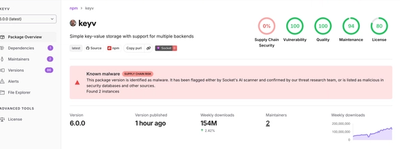
Popular npm packages keyv and cacheable compromised.

Security News
A misconfiguration gave three Anthropic models internet access, and one, believing it was in a simulation, shipped a credential-stealing package to PyPI.