simframe


Eyes, hands and memory for a coding agent driving the iOS Simulator or an
Android emulator. The agent reads the screen as text with tap points, runs a
whole flow in one call, and remembers screens it has seen — so it stops paying
a screenshot, a model round trip and a re-read for every single step.
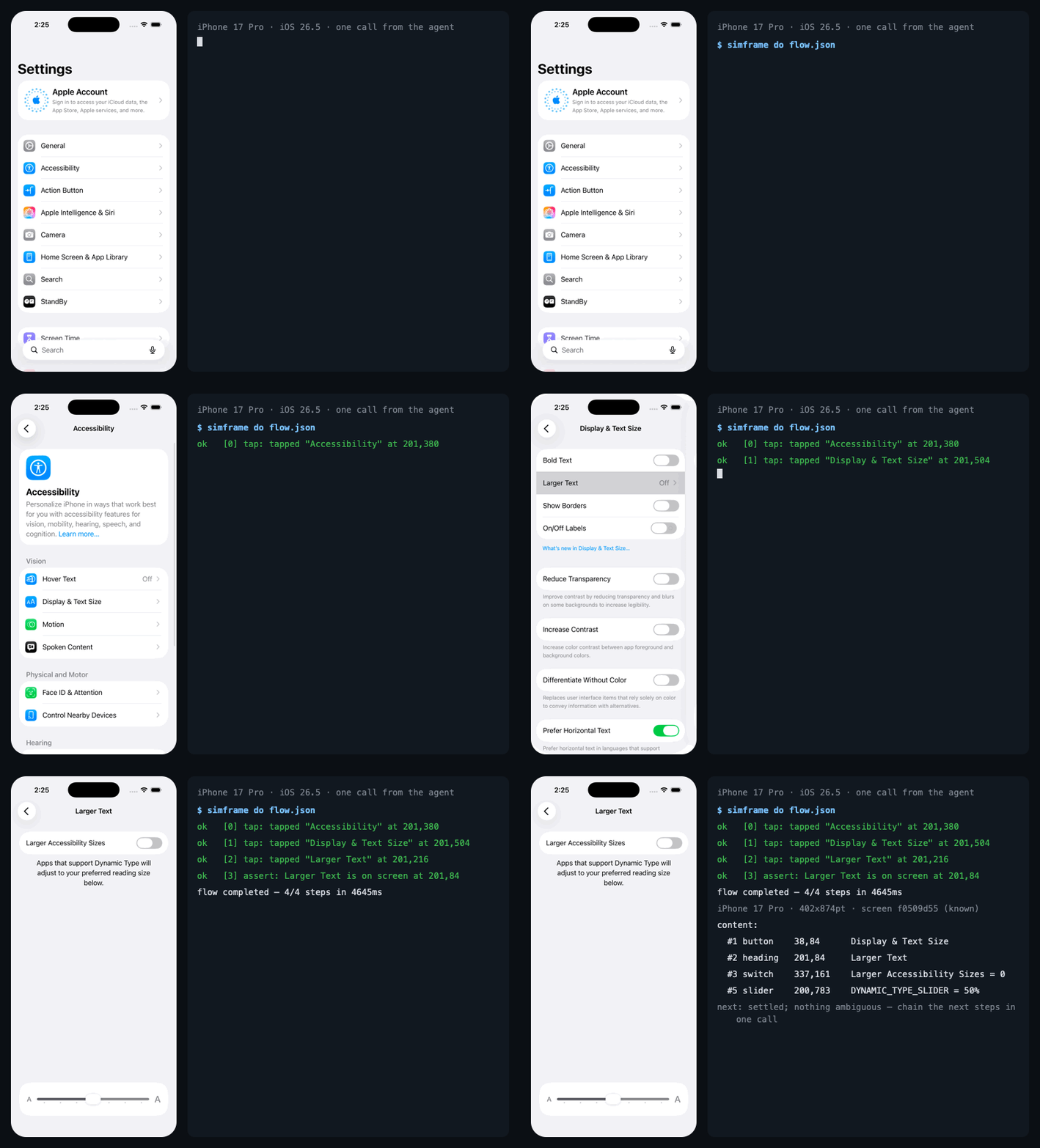
Install in ten seconds
You need a Mac with Xcode (you have one if you have a simulator) and Node 18+.
Nothing else — no idb, no Appium, no Python.
Claude Code
claude mcp add --scope user simframe -- npx -y simframe mcp
Claude Desktop — Settings → Developer → Edit Config, then add:
{
  "mcpServers": {
    "simframe": { "command": "npx", "args": ["-y", "simframe", "mcp"] }
  }
}
Cursor —  or add the same
 simframe block to ~/.cursor/mcp.json.
Codex, Windsurf, Zed, VS Code, anything else that speaks MCP — the same
JSON block, wherever that client keeps its mcpServers.
Then boot a simulator and ask the agent for something: "open my app and tap
through the signup flow", "is the list on the Orders tab loading?", "why
does the Save button do nothing?". The first call builds a small Swift daemon
from source — about 15 seconds, once.
The CLI is the same thing without an agent in the loop, and the cheapest way
to check the install:
npm install -g simframe
simframe doctor
simframe ui
If more than one simulator is booted, name the one you mean with
--device=<udid> or export SIMFRAME_DEVICE=<udid>; simframe refuses to guess,
because the command that would act on the wrong one is a tap.
What it changes
An agent driving a simulator is slow for three reasons, and only the first is
obvious. Every look is a wait (simctl io screenshot costs ~130 ms, paid on
every glance). Every step is a model round trip. And nothing is remembered, so
the same screen is re-read and re-reasoned about each time it appears. There
is a fourth that is pure waste: an image is the most expensive way to ask what
is on screen, and it still does not say what is tappable.
| Look at the screen | ~130–400 ms screenshot, blocking | ~20 ms, already captured |
| "Did anything change?" | a full image | ~2 ms, text only |
| Reading a screen | an image, ~1,600 tokens, no tap points | ~330 tokens of text, with tap points |
| A 10-step flow | 10 turns, 10 images | 1 turn, 0 images |
| Same flow, again | every run is the first | replayed from memory, every step verified, zero model calls |
Measured on an iPhone 17 Pro simulator, iOS 26.5, Apple Silicon, against a real
production app; the full tables with N, median and p95 are in
docs/BENCHMARKS.md.
This is what the agent gets back instead of a picture:
iPhone 17 Pro · 402x874pt · screen a1b2c3d4 "Inbox" (known, 3 known exits)
last action: [2] tap — ok: matches the outcome seen 5x before
nav-bar:
  #1 button    24,64      Back
  #2 text      201,64     Inbox
content:
  #3 cell      201,140    Weekly digest
  #4 field     201,196    Search = weekly ~ weekly|
  #5 switch    201,252    Notifications = 1
tab-bar:
  #6 text      62,835     Inbox
  #7 text      201,835    Settings
next: settled; nothing ambiguous — chain the next steps in one sim_do without looking again.
Region, type, label, contents, a tap point, and a number the next call can use
as a selector. = value is what the accessibility tree says the control
contains; ~ value is what OCR read off the pixels. Where they disagree, that
is the point.
The tools
sim_ui | Start here. The screen as the numbered text map above. |
sim_do | The main tool. A whole flow in one call — tap, type, scroll, wait, assert — each step settling before the next and verified against what it did last time. Fallback selectors, optional steps, and a bounded seek let a batch survive a surprise instead of handing it back. |
sim_state | Has anything changed since your last look, and which regions moved. |
sim_goto · sim_flow_run | Walk to a screen simframe has been to before; replay a saved flow with zero model calls. |
sim_find · sim_tap · sim_type_into · sim_scroll_to · sim_wait_for · sim_assert | Single actions, for when you genuinely only have one step. |
sim_launch · sim_open_url · sim_permission | Launch (confirmed to have reached the front), open a deep link, grant a privacy permission without tapping the alert. |
sim_look | The only tool that returns an image, capped at 1024 px — for layout, colour and spacing. |
sim_recall · sim_strip · sim_storage | What happened in the last minute, as text or as a contact sheet; what the app saved (UserDefaults, AsyncStorage), even on a device that is shut down. |
sim_wait · sim_capture · sim_devices | Wait for change then settle; manage capture; list simulators and emulators. |
Three ways to name a control, anywhere one is named: "Save" (resolved by
intent — verbs, typos, synonyms, icon-only controls by their common name),
#3 (the number the map gave it, valid for that screen only), or @120,400
(raw points, last resort). A label that matches the destructive vocabulary —
Delete, Pay, Send, Sign out — is never substituted for or guessed at.
A Claude Code skill ships in the package and
teaches the CLI path, which is cheaper still: a few lines of output instead of
a tool result, and no MCP schema in context until a tool is used.
Android
The second backend drives an Android emulator with the same commands, the same
screen map and the same memory. Frames arrive at ~41 ms through the emulator
console; tap, swipe, text, keys and the clipboard work; simframe devices
lists emulators next to simulators. What Android does not have is an
accessibility tree, so its screens are read by OCR and CV alone — and
simframe doctor says so rather than pretending. Details, costs and the
reasoning are in the guide.
How it works, briefly
One Swift daemon per device reads the simulator's framebuffer straight off its
IOSurface when the display reports damage, runs Apple's Vision OCR on the same
surface, reads the accessibility tree host-side, and sends taps as real
down/move/up sequences over the HID channel — no PNG, no file, no spawned
process. Frames land in ~/.simframe/<udid>/, input goes over a 0600 Unix
socket, and the MCP server and CLI are thin clients over both.
Screen memory keys a merged element map by a structural fingerprint, so a
screen seen before is a file read. A transition graph records which action led
from which screen to which, so sim_goto plans a route and a saved flow
replays with no model in the loop.
Every layer degrades rather than fails, and never quietly: simframe doctor
reports each one and --strict turns any downgrade into a non-zero exit. The
private frameworks the daemon links are documented, with evidence, in
docs/PRIVATE_API.md.
Read on
docs/GUIDE.md | the full guide: recovering without a round trip, screen memory and the two hashes, navigating by memory, the CLI, diagnosing a wedged simulator, keeping a session cheap, the roadmap |
docs/BENCHMARKS.md | every number, with N, median, p95, machine and the measurement traps |
docs/EXPERIMENTS.md | what we believed before measuring, and the fourteen times it was wrong |
docs/DECISIONS.md | the judgements that changed the plan, including a phase cancelled by its own measurement |
docs/DEFERRED.md | every known defect, open or closed, with the evidence |
docs/ARTICLE.md | Agents shouldn't blink — the argument the whole thing adds up to |
Almost everything here was decided by a measurement rather than an argument,
and several measurements reversed a decision that had already shipped. Two
headline results: a warm transition graph removes about 27% of an agent's
model round trips, and a one-line threshold on a number the daemon already
computes beat every local model tried as a step supervisor — 95% against
77–91%, at zero latency.
Limitations
- Simulators and emulators only; nothing here can reach a physical device.
- The daemon links private frameworks. They survived the iOS 26 transition,
but an Xcode upgrade can move a symbol;
doctor names the broken layer and
--engine=screenshot still works.
- Android has no accessibility tree, so screen identity there rests on OCR
geometry alone: thinner and noisier than iOS.
- Hardware buttons: only
home. The other codes are unverified and a wrong
one can crash the device, so they return an error rather than a guess.
- The confirm vocabulary (
OK, Save, Done…) is English.
- It speeds up confirming a fix, not locating one. A bug in a stale
closure is not visible in any frame.
The full list, with the measurements behind each item, is in
the guide.
Releasing
npm version is the only way to bump a version — its hook keeps server.json
in step — and git push --follow-tags runs a workflow that publishes to npm
and the official MCP Registry with no secrets. Why it is built that way, and
the release that once vanished for a week, is in
the guide.
License
MIT



