
Research
/Security News
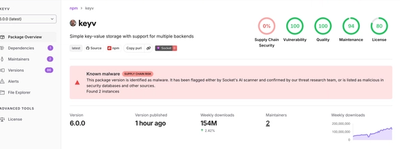
Popular npm Packages in the keyv and Cacheable Namespaces Compromised in Active Supply Chain Attack
Popular npm packages keyv and cacheable compromised.
By Socket Research Team - Aug 04, 2026
simplisafe-mcp
Advanced tools
SimpliSafe MCP server for Claude — developed and maintained by AI (Claude Code)
MCP server for SimpliSafe home security. Check whether the system is armed, review sensors and events, arm/disarm, and control smart locks — from Claude.
This server can disarm a home alarm and unlock doors. Every tool that changes physical state, plus the tool that reads alarm PINs, is gated behind an explicit
confirm: true. Without it, no request is sent at all and you get a dry-run preview of exactly what would happen. Install it only where you'd be comfortable with that capability.
Developed and maintained by AI (Claude Code).
| Tool | |
|---|---|
simplisafe_list_systems | Systems on the account with current alarm state |
simplisafe_get_system | One system's state, connectivity, base-station messages |
simplisafe_list_sensors | Sensors with battery / offline / triggered status, filterable |
simplisafe_list_locks | Smart locks with locked / unlocked / jammed state |
simplisafe_get_events | Recent base-station events (arm, disarm, opens, alarms) |
simplisafe_get_settings | Entry/exit delays, volumes, base-station health |
simplisafe_get_pins | Alarm PINs — cleartext, confirm-gated |
simplisafe_set_alarm_state | Arm home / arm away / disarm — confirm-gated |
simplisafe_set_lock_state | Lock / unlock a door — confirm-gated |
simplisafe_healthcheck | Auth + API reachability |
Supports SimpliSafe 3 systems. Legacy SS2 systems are rejected with an explanation rather than an opaque upstream 404.
npm install -g simplisafe-mcp
Or add to .mcp.json:
{
  "mcpServers": {
    "simplisafe": {
      "command": "npx",
      "args": ["-y", "simplisafe-mcp"],
      "env": { "SIMPLISAFE_REFRESH_TOKEN": "${SIMPLISAFE_REFRESH_TOKEN}" }
    }
  }
}
SimpliSafe issues no API keys. The credential is an OAuth2 refresh token, minted by a browser login you perform one time:
git clone https://github.com/chrischall/simplisafe-mcp && cd simplisafe-mcp
node scripts/bootstrap-auth.mjs             # prints an authorize URL
# sign in (MFA included), then copy the com.simplisafe.mobile:// URL
node scripts/bootstrap-auth.mjs "<that URL>"
The token is written to .env (mode 0600) after being verified against the live
API. SimpliSafe does not rotate refresh tokens, so it stays valid until you
sign out of all devices in the SimpliSafe app — which is how you revoke it.
Capturing the code: open DevTools → Network and tick Preserve log before
signing in; afterwards the browser fails to open a com.simplisafe.mobile://…
link, and that failed entry's link address is what you paste. The code is
single-use and expires in about two minutes.
Treat the resulting token like a house key: it grants full control of the alarm.
Calling a write tool without confirm: true sends nothing and returns a
preview, including a plain statement of the physical consequence:
{
  "dryRun": true,
  "action": "set alarm state to away",
  "method": "POST",
  "path": "/ss3/subscriptions/7858153/state/away",
  "currentState": "OFF",
  "warning": "Arms ALL sensors including interior motion. Starts an exit delay; anyone still moving inside when it expires can trigger the siren and a monitoring-center dispatch.",
  "note": "Nothing was sent. Re-run with confirm: true to execute."
}
With confirm: true, the tool executes and then re-reads the system to check
what actually happened, reporting confirmed, in_progress (the exit delay is
counting down), or unconfirmed. A 2xx is never treated as proof.
The same tools can run as a Cloudflare Worker so they're reachable from claude.ai on the web, desktop and phone. This archetype supports it because auth is a non-rotating refresh token — no browser bridge, no signed-in tab.
The connector runs the whole OAuth bootstrap itself, as a two-step login page, so it doesn't depend on a local install and you never paste a long-lived credential. See docs/DEPLOY-CONNECTOR.md.
For quick one-off queries there's a curl-based skill in
skills/simplisafe-api/ — same API, no MCP
process, sharing the same refresh token.
npm install
npm run build
npm test              # node suite
npm run worker:test   # Workers-runtime suite (connector)
Verified endpoint shapes live in docs/SIMPLISAFE-API.md, including several things that are easy to get backwards:
location.system.version, not the top-level
systemVersion;ss3/ prefix;numEvents has an undocumented hard ceiling of 50;settings.pins returns alarm codes in cleartext alongside harmless settings.Unofficial. Not affiliated with or endorsed by SimpliSafe. It uses the same private API the SimpliSafe mobile app uses, with your own account credentials. Use at your own discretion.
MIT
FAQs
SimpliSafe MCP server for Claude — developed and maintained by AI (Claude Code)
We found that simplisafe-mcp demonstrated a healthy version release cadence and project activity because the last version was released less than a year ago. It has 1 open source maintainer collaborating on the project.
Did you know?

Socket for GitHub automatically highlights issues in each pull request and monitors the health of all your open source dependencies. Discover the contents of your packages and block harmful activity before you install or update your dependencies.
Research
/Security News
Popular npm packages keyv and cacheable compromised.

Security News
A misconfiguration gave three Anthropic models internet access, and one, believing it was in a simulation, shipped a credential-stealing package to PyPI.

Security News
/Company News
Socket has joined the new Composer and Packagist sponsorship program as a launch sponsor, supporting the team that keeps PHP's package ecosystem secure.