

Security News
The Code You Didn't Write Is Still Yours to Defend
AI agents are pulling packages into environments no scanner is watching, creating exposure before security teams can see it.
By Brad Arkin - Jun 23, 2026
socket.io-as-promised
Advanced tools
Socket.IO middleware for supporting returning promises from handlers



Socket.IO middleware for supporting returning promises from handlers
Allows you to more easily respond to your user's events by employing promises instead of callbacks. Supports Node >= 16.
It also helps with error handling, which is important since Socket.IO does not serialize Error objects.
$ npm install --save socket.io-as-promised
// server.js
import { Server } from 'socket.io';
import asPromised from 'socket.io-as-promised';

const io = new Server(5000);

// on the main '/' namespare
io.use(socketAsPromised());

// on a custom namespace
io.of('/foo').use(socketAsPromised());

io.on('connection', socket => {
  // Client will get a response with the string 'returned a promise'
  socket.on('returns promise', () => Promise.resolve('returned a promise'));

  // Client will get a response with the string 'returned from async function'
  socket.on('returns from async', async () => 'returned from async function');

  // Handles errors
  socket.on('throws exception', () => Promise.reject({ error: 'thrown exception' }));
  socket.on('throws from async', async () => { throw { error: 'thrown exception' }; });

  // Error objects get turned into '{}' objects by socket io, so they need serializing
  // use the handleError option documented in the API to handle this case
  socket.on('throws error exception', () => Promise.reject(new Error('thrown exception')));
});
// client.js
const io = require('socket.io-client');
const client = io.connect('http://0.0.0.0:5000');

client.emit('returns promise', (err, res) => console.log(res)); // 'returned a promise'
client.emit('returns from async', (err, res) => console.log(res)); // 'returned from async'

client.emit('throws exception', err => console.log(err)); // { error: 'thrown exception' }
client.emit('throws from async', err => console.log(err)); // { error: 'thrown exception' }

client.emit('throws error exception', err => console.log(err)); // {}
Type: function
Returns Socket.IO middleware. Monkeypatches socket.on to wrap the handler function and support returned promises
Type: function, default: null
Optional argument, helps in case you want to ignore certain errors, or serialize other errors.
io.use(socketAsPromised({
  handleError(err, event) {
    return Promise.reject({ name: err.name, message: err.message });

    // or:
    throw { name: err.name, message: err.message };

    // more fancy usage, filter out certain errors, return a
    // generic error instead useful in case of errors like database
    // connectivity that you don't want to reach the end user
    const genericError = { name: 'GenericError', message: 'Something went wrong' };

    if (isKnownError(err.name)) {
      return Promise.reject({ name: err.name, message: err.message });
    }
    return Promise.reject(genericError);
  }
}))
npm test
You can customize the port under which the test server runs (by default 8090):
TEST_PORT=4444 npm test
See the LICENSE file for license rights and limitations (MIT).
FAQs
Socket.IO middleware for supporting returning promises from handlers
The npm package socket.io-as-promised receives a total of 46 weekly downloads. As such, socket.io-as-promised popularity was classified as not popular.
We found that socket.io-as-promised demonstrated a not healthy version release cadence and project activity because the last version was released a year ago. It has 2 open source maintainers collaborating on the project.
Did you know?

Socket for GitHub automatically highlights issues in each pull request and monitors the health of all your open source dependencies. Discover the contents of your packages and block harmful activity before you install or update your dependencies.
Security News
AI agents are pulling packages into environments no scanner is watching, creating exposure before security teams can see it.

Security News
GitHub Actions checkout now blocks risky pull_request_target checkouts by default to help prevent pwn request supply chain attacks.
Product
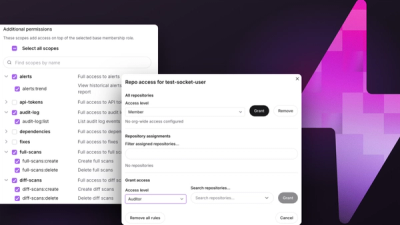
Socket now supports Custom Roles and Repository Access Permissions so organizations can control who can access specific repositories and actions.