

Product
PHP and Composer Support Is Now in Beta
Socket’s PHP and Composer support is now in Beta for all customers, with PHP reachability analysis generally available.
By Trevor Norris, Benjamin Barslev - Aug 21, 2026
statecore-mcp
Advanced tools
Zero-deploy MCP memory server backed by the StateCore engine — auditable facts with evidence chains
Auditable memory for coding agents, over the Model Context Protocol. One process, one SQLite file, no infrastructure, no API key required — remember a fact and why will show you the evidence and the full version chain, including what it superseded.
statecore-mcp is the MCP front end for StateCore, a self-hosted long-term memory runtime. This package runs the engine embedded (SQLite, in-process) by default, or as a thin client against a full StateCore deployment via --url.

Every result in the recording is live tool output — demo/driver.mjs drives a real server over stdio, and demo/statecore-demo.cast is the asciinema source.
npx -y statecore-mcp --data /tmp/statecore-demo
That starts the server over stdio with no configuration and no model key. Point any MCP client at it (see host configs below), or drive it directly with the SDK's client for a smoke test. It exposes five tools:
| Tool | Does |
|---|---|
remember | Store a fact. Default path is deterministic (no LLM) and immediate; consolidate: true queues it as a conversational event for background distillation |
recall | Retrieve memory relevant to a query, packed into a character budget |
facts | List everything currently believed, grouped, with fact ids |
why | A fact's evidence and its full version chain — the differentiator: not just what is believed, but why, and what it replaced |
forget | Retire a fact by key. The record is kept and marked retired, not deleted |
remember → facts → why → forget is the whole loop, and every step of it works with no model key configured.
| Capability | No key | With key (FEATURE_LLM=true + MODEL_API_KEY) |
|---|---|---|
remember (note path), facts, why, forget | Full — deterministic write, evidence id, audit chain | Same |
Conversational memory (remember with consolidate: true) | Event is stored; background distillation into stable facts never runs | Distilled into facts automatically once pending events cross a threshold (default 20), or on startup catch-up |
| Retrieval quality | Keyword matching, plus CJK bigram matching for Chinese/Japanese/Korean text — no semantic search | Same in embedded/lite mode — semantic (pgvector) search is a full-stack capability, only reachable via --url against a keyed StateCore deployment, not by holding a key alone |
Nothing behind a key is required for the audit trail to work. A key only turns on distillation of raw conversational events into stable facts, and it does that in the background — it is never on the critical path of a tool call.
Embedded (default). One SQLite file, one process, all five tools run in-process against @statecore/core. No infrastructure. Data lives at ~/.statecore/statecore.db, or wherever --data <dir> points.
Remote (--url <base>). Talks to a running StateCore deployment's frozen /v1 HTTP surface instead of an embedded database — see the API reference. Use this when several agents or machines need to share one memory store, or you already run the full stack (Postgres + pgvector + Redis) and want its retrieval quality. STATECORE_USER_ID sets the x-user-id sent on every request (default local).
Both modes resolve scope — the memory partition a project's facts live in — the same way: git rev-parse --show-toplevel if the working directory is a git repo, else the working directory itself; STATECORE_SCOPE overrides either.
dsh starts a configured command; it does not download or install MCP servers. Install the pinned executable first:
npm install --global statecore-mcp@<version>
# statecore.cordis.yml — a dsh --patch overlay, applied via:
#   dsh web --patch "$PWD/statecore.cordis.yml"
- insert:
    - id: memory-statecore
      name: '@deepseek-ai/dsh-mcp-client'
      config:
        serverName: statecore
        transport: stdio
        command: statecore-mcp
        args: []
        cwd: !!js process.cwd()
        env:
          FEATURE_LLM: 'true'
          # dsh strips ambient credential-shaped vars from the CHILD's
          # environment before spawning it; config.env with !!js reads dsh's
          # own process env explicitly instead, so this forwards the key
          # without the child-env stripping ever seeing it and without
          # writing the secret into this YAML file.
          MODEL_API_KEY: !!js process.env.MODEL_API_KEY
          MODEL_BASE_URL: 'https://api.deepseek.com/v1'
          MODEL_NAME: 'deepseek-chat'
Omitting MODEL_API_KEY (running dsh with it unset in its own environment) silently keeps the server keyless — note-path memory still works; distillation does not. The digest path never sends reasoning_effort unless MODEL_STRUCTURED_OUTPUT_REASONING_EFFORT is set explicitly, so a DeepSeek key (or any OpenAI-compatible endpoint that rejects the parameter) works with this config as written.
claude mcp add statecore -- npx -y statecore-mcp
Add a model key for automatic distillation by passing --env:
claude mcp add statecore --env FEATURE_LLM=true --env MODEL_API_KEY=<your-key> --env MODEL_BASE_URL=https://api.deepseek.com/v1 --env MODEL_NAME=deepseek-chat -- npx -y statecore-mcp
Add to .cursor/mcp.json (project) or your global MCP settings:
{
  "mcpServers": {
    "statecore": {
      "command": "npx",
      "args": ["-y", "statecore-mcp"],
      "env": {
        "FEATURE_LLM": "true",
        "MODEL_API_KEY": "<your-key>",
        "MODEL_BASE_URL": "https://api.deepseek.com/v1",
        "MODEL_NAME": "deepseek-chat"
      }
    }
  }
}
Drop the env block entirely to run keyless.
statecore-mcp/lib)For embedding the engine in-process instead of talking MCP over stdio — the surface dsh-statecore is built on:
createEmbeddedBackend / createHttpBackend — the two MemoryBackend implementations, with an injectable digestLlm (a DigestChatModel) replacing the env-derived model on the embedded pathresolveScopeName — the git-root/cwd project-scope rule, shared so co-installed front ends land in the same scoperunScopeDigest — one locked digest pass against an injected chat modelMemoryBackend.digestNow() — a caller-demanded, threshold-1 digest pass with an honest outcome ({ ran: true } or { ran: false, reason }), for moments when raw context is about to leave a model's view (a host compacting its conversation). Embedded mode waits out startup catch-up first; --url mode reports unsupported because the server deployment's worker owns digest scheduling.recall still returns a budgeted digest, believed facts, and matching events, but it will not find a paraphrase with no matching tokens the way the full stack's semantic search can.remember with consolidate: true stores the raw event, but it is never folded into stable facts — facts/why will not see it until a key is configured and the digest runs (threshold trigger, or startup catch-up).--data directory, not per project. Multiple projects on one machine share ~/.statecore/statecore.db by default, partitioned by scope; only concurrent writes to the same scope from multiple processes are guarded (WAL + a busy timeout + an in-database digest lock for concurrent distillation).--url mode's facts() output carries no fact-registry id per item (the frozen /v1 MemoryFactsOutput contract doesn't have one) — why() in that mode needs a factId sourced from a prior recall()'s factRegistry or a previous provenance response, not invented from facts() alone.docs/api.md — the frozen /v1 HTTP contract --url mode speaksSTABILITY.md — what "frozen" means for the /v1 surfaceFAQs
Zero-deploy MCP memory server backed by the StateCore engine — auditable facts with evidence chains
We found that statecore-mcp demonstrated a healthy version release cadence and project activity because the last version was released less than a year ago. It has 1 open source maintainer collaborating on the project.
Product
Socket’s PHP and Composer support is now in Beta for all customers, with PHP reachability analysis generally available.
Product
Socket is bringing experimental protection to Firefox, scanning 97,000+ extensions in Mozilla's official directory for malware and risky updates.
Research
/Security News
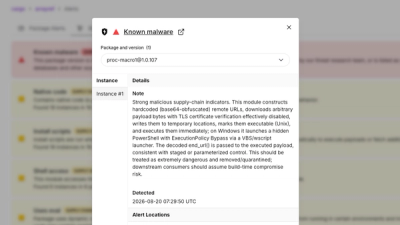
Three compromised Rust crates pulled in a malicious dependency that downloaded and executed cross-platform malware during Cargo builds.