
Research
/Security News
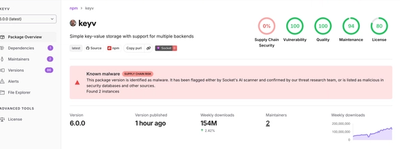
Popular npm Packages in the keyv and Cacheable Namespaces Compromised in Active Supply Chain Attack
Popular npm packages keyv and cacheable compromised.
By Socket Research Team - Aug 04, 2026
stellar-memory
Advanced tools
AI memory system using celestial mechanics metaphor - MCP server for persistent context across sessions
Persistent AI memory powered by celestial mechanics.
Important memories orbit close to the Sun. Forgotten ones drift to the Oort Cloud.




Stellar Memory is a local-first, persistent memory system for AI assistants. It uses orbital mechanics as a cognitive model -- memories with high importance orbit close to the Sun for instant recall, while stale knowledge naturally drifts outward through exponential decay. No cloud services, no API keys, no data leaving your machine.
@xenova/transformersnode:sqlite and local embeddings importance = 0.30 x recency
+ 0.20 x frequency
+ 0.30 x impact
+ 0.20 x relevance
distance = 0.1 + (1 - importance)^2 x 99.9
. * . . * . . * .
. * . . . .
. CORE (0.1-1 AU) .
. . instant recall . *
* . . . . . . . . . .
. NEAR (1-5 AU) . .
. recently used . * .
. . . . . . . . . . . *
. ACTIVE (5-15 AU) . .
in-context memories . . .
. . . . . . . . . . . . . * .
ARCHIVE (15-40 AU) . .
older knowledge . . .
. . . . . . . . . . . . . . . *
FADING (40-70 AU) . .
losing relevance . . .
. . . . . . . . . . . . . . . . . .
FORGOTTEN (70-100 AU) .
the Oort Cloud -- soft deleted .
When you recall a memory, it gets pulled closer to the Sun. When you stop using it, exponential decay pushes it outward. The half-life is 72 hours by default.
node:sqlite)git clone https://github.com/your-username/stellar-memory.git
cd stellar-memory
npm install
npm run build
Add to your Claude Code MCP settings (~/.claude/settings.json or project .claude/settings.json):
{
  "mcpServers": {
    "stellar-memory": {
      "command": "node",
      "args": ["/absolute/path/to/stellar-memory/dist/index.js"],
      "env": {
        "STELLAR_PROJECT": "my-project"
      }
    }
  }
}
Then in Claude Code, Stellar Memory automatically:
stellar://sun to restore working context at session startAdd this block to ~/.codex/config.toml:
[mcp_servers."stellar-memory"]
command = "node"
args = ["/absolute/path/to/stellar-memory/dist/index.js"]
Or use the setup helper:
npx stellar-memory init --codex
That command also installs a Stellar Memory workflow section into the project AGENTS.md so Codex restores context, recalls before guessing, and commits before ending work.
Codex does not support Claude-style session hooks. In Codex, the MCP server still works normally, and the first Stellar tool response can restore saved sun context.
Add to claude_desktop_config.json:
{
  "mcpServers": {
    "stellar-memory": {
      "command": "node",
      "args": ["/absolute/path/to/stellar-memory/dist/index.js"],
      "env": {
        "STELLAR_PROJECT": "my-project"
      }
    }
  }
}
# Start the API server
npm run api

# In another terminal, start the web dashboard
cd web && npm run dev
Open http://localhost:5175 to see your memories orbiting in 3D.
npm run daemon
The daemon runs scheduled tasks:
| Task | Interval |
|---|---|
| Orbit recalculation | 1 hour |
| Memory decay | 6 hours |
| Consolidation check | 24 hours |
| Requirement | Minimum |
|---|---|
| Node.js | 22.0.0+ (for node:sqlite) |
| npm | 9.0.0+ |
| Disk | ~100 MB (embedding model) + DB |
| RAM | ~200 MB (model + corona cache) |
| OS | Windows, macOS, Linux |
The embedding model (~90 MB) downloads automatically on first use and is cached in ~/.cache/huggingface.
All configuration is via environment variables:
| Variable | Default | Description |
|---|---|---|
STELLAR_DB_PATH | ~/.stellar-memory/stellar.db | SQLite database file location |
STELLAR_PROJECT | default | Active project name |
STELLAR_API_PORT | 21547 | REST API port |
STELLAR_SUN_TOKEN_BUDGET | 800 | Max tokens for sun context resource |
STELLAR_DECAY_HALF_LIFE | 72 | Hours for 50% recency decay |
STELLAR_WEIGHT_RECENCY | 0.30 | Weight for recency in importance formula |
STELLAR_WEIGHT_FREQUENCY | 0.20 | Weight for access frequency |
STELLAR_WEIGHT_IMPACT | 0.30 | Weight for memory type impact |
STELLAR_WEIGHT_RELEVANCE | 0.20 | Weight for contextual relevance |
src/
  engine/          Core: orbit, gravity, corona, embedding, quality, analytics
  storage/         database.ts, queries.ts, vec.ts (sqlite-vec)
  mcp/             MCP server + tools (memory-tools, ingestion-tools, daemon-tool)
  api/             Hono REST server + 12 route modules
  scanner/         Filesystem + git log scanners with file parsers
  service/         Background daemon + scheduler
  utils/           Config, logger, tokenizer, time helpers

web/src/
  components/      SolarSystem (Three.js), Layout, SearchBar, MemoryDetail, etc.
  api/client.ts    REST API client
  i18n/            EN/KO internationalization (React Context)

tests/             15 test files, 252 tests (Vitest)
electron/          Desktop app (Electron 40)
SQLite via Node.js built-in node:sqlite with three search layers:
Query
  |
  +---> FTS5 keyword search ----+
  |                              |---> Reciprocal Rank Fusion ---> Re-ranked results
  +---> sqlite-vec KNN search --+
The hybrid approach handles both exact matches ("JWT authentication error") and semantic matches ("login token expired").
An in-memory tier holding up to 200 core + near zone memories with a token index for O(1) keyword lookup. The corona mirrors how human System 1 thinking works -- your most important knowledge is always instantly available.
| Tool | Description |
|---|---|
status | View memory system state, grouped by orbital zone |
recall | Hybrid search -- finds memories and pulls them closer |
remember | Store a new memory with type, impact, and tags |
forget | Push a memory to the Oort Cloud or permanently delete it |
commit | Save session state to the Sun (working context) |
orbit | Force recalculation of all orbital positions |
scan | Ingest a local directory into memories (idempotent) |
daemon | Start/stop/status of the background scheduler |
constellation | Explore the knowledge graph between memories |
galaxy | Multi-project management (switch, list, universal memories) |
analytics | System insights: health, topics, survival curves, movements |
observe | Auto-extract memories from conversation text |
consolidate | Find and merge duplicate/similar memories |
resolve_conflict | View and resolve contradicting memories |
temporal | Point-in-time queries and memory evolution chains |
export | Backup memories as JSON or Markdown |
| URI | Description |
|---|---|
stellar://sun | Current working context (core + near memories within token budget) |
The API server runs on port 21547 (default) and exposes:
GET    /api/health                    Health check
GET    /api/memories                  List memories (with filters)
POST   /api/memories                  Create a memory
GET    /api/memories/:id              Get a single memory
PATCH  /api/memories/:id              Update a memory
DELETE /api/memories/:id              Delete a memory
GET    /api/sun                       Get sun state
POST   /api/sun/commit                Commit session state
POST   /api/orbit/recalculate         Trigger orbit recalculation
GET    /api/constellation/:id         Get knowledge graph
GET    /api/projects                  List projects
POST   /api/projects                  Create a project
GET    /api/analytics/:report         Get analytics report
GET    /api/temporal/at               Point-in-time query
GET    /api/conflicts                 List conflicts
POST   /api/scan                      Scan a directory
GET    /api/sources                   List data sources
POST   /api/observations              Submit conversation for observation
POST   /api/consolidation             Run consolidation
# Run MCP server in dev mode (stdio, watch)
npm run dev

# Run API server in dev mode (watch)
npm run api

# Run web dashboard (proxies /api to :21547)
cd web && npm run dev

# Run all tests
npm run test

# Run tests in watch mode
npm run test:watch

# Build everything
npm run build:all

# Build Electron desktop app
npm run electron:pack
You need Node.js 22 or later. The node:sqlite module is a built-in that was added in Node.js 22.
node --version # Must be >= 22.0.0
The all-MiniLM-L6-v2 model (~90 MB) downloads from Hugging Face on first use. If it hangs:
export HTTPS_PROXY=http://your-proxy:port~/.cache/huggingface -- delete that directory to force re-downloadThe sqlite-vec extension uses a native binary. If it fails to load:
npm install (the binary is fetched during install)Only one process should write to the database at a time. If you're running both the MCP server and API server, they share the same database file and SQLite handles locking. If you see this error:
ps aux | grep stellarcurl http://localhost:21547/api/healthweb/vite.config.ts)# Run the full test suite (252 tests)
npm run test
# Run with coverage
npx vitest run --coverage
# Run specific test file
npx vitest run tests/orbit.test.ts
# Web component tests
cd web && npm run test
The test suite uses a virtual module plugin in vitest.config.ts to bridge node:sqlite for Vite's module resolver. This is required because Vite does not natively recognize Node.js built-in modules with the node: prefix.
MIT
FAQs
AI memory system using celestial mechanics metaphor - MCP server for persistent context across sessions
We found that stellar-memory demonstrated a healthy version release cadence and project activity because the last version was released less than a year ago. It has 1 open source maintainer collaborating on the project.
Did you know?

Socket for GitHub automatically highlights issues in each pull request and monitors the health of all your open source dependencies. Discover the contents of your packages and block harmful activity before you install or update your dependencies.
Research
/Security News
Popular npm packages keyv and cacheable compromised.

Security News
A misconfiguration gave three Anthropic models internet access, and one, believing it was in a simulation, shipped a credential-stealing package to PyPI.

Security News
/Company News
Socket has joined the new Composer and Packagist sponsorship program as a launch sponsor, supporting the team that keeps PHP's package ecosystem secure.