
Product
PHP and Composer Support Is Now in Beta
Socket’s PHP and Composer support is now in Beta for all customers, with PHP reachability analysis generally available.
By Trevor Norris, Benjamin Barslev - Aug 21, 2026
The Taskpod developer CLI and MCP server — sync project context to your machine and AI, and manage teams, projects, and tasks from any MCP client.
The developer CLI and MCP server for Taskpod — the AI-native task tracker where humans and agents work the same board.
Your repo's central mind. Three commands take a bare clone to a fully wired workspace where you, your teammates, and every AI agent share one live picture of the project — tasks, sprint, dependencies, and the learnings everyone records as they work:
npx taskpod login # 1. authorize this machine (opens your browser)
npx taskpod init # 2. repo-first: creates/links the project from your git remote + pulls context
npx taskpod agent-setup # 3. connects Claude Code, Cursor, or any MCP client
Then, as you work:
npx taskpod sync # ↑ share new learnings · ↓ pull the latest board, learnings, wiki, sprint
This one package ships two things:
taskpod — a CLI that links a repo to a Taskpod project, syncs a live .taskpod/ context bundle to your machine and your local AI, and writes work back to the board.taskpod mcp — an MCP server (stdio) that exposes Taskpod's tools to any MCP client (Claude Code, Cursor, etc.).Both talk to the Taskpod REST API over HTTPS with your personal token — no database access, no secrets in your repo. No install needed (npx taskpod …), or install globally with npm i -g taskpod.
taskpod init — the repo is the project. Run inside a git repo and init reads your origin remote, asks the server to create (or find) the Taskpod project for that repo, links the repo (taskpod.json), and pulls the .taskpod/ context bundle — one command from clone to ready:
$ npx taskpod init
Detected git remote: acme/web
✓ Created web (WEB) from acme/web.

Workspace ready: WEB — 12 tasks, 3 learnings.
Run taskpod status, or taskpod agent-setup to connect your AI tools.
Run it in a teammate's clone of the same repo and it links to the same project (created: false) — the repo is the identity. --team "Name" files the project under a specific team (creating it if needed). Outside a git repo, or with an explicit --name "Project", the original flow still works: npx taskpod init --team "My Team" --name "My App" creates a named project non-interactively (agent-friendly).
At the end of a successful init on a terminal, it offers to finish the job — Connect your AI tools (Claude Code / Cursor) now? (Y/n) — and, on yes (the default), runs the same auto-detect, no-secrets code path as taskpod agent-setup. Pass --no-agents to skip the prompt; non-interactive runs (CI, agents) never prompt and just print the agent-setup hint.
taskpod agent-setup — one command connects every AI tool. Writes real MCP config for the tools it detects in your repo (flags for CI: --claude, --cursor, --codex, --all):
taskpod server entry into .mcp.json (never clobbers your other servers), adds a marker-guarded TaskPod section to CLAUDE.md, and installs a real Claude Code skill at .claude/skills/taskpod/SKILL.md (valid name/description frontmatter + the full agent protocol). The skill body is fetched live from <apiBase>/skill.md (5-second timeout, TASKPOD_API_URL-aware for self-hosted instances); on any failure it falls back to the copy bundled in this package, so the install works offline. Idempotent: the file is rewritten only when its content differs..cursor/mcp.json.npx -y taskpod mcp) + skill URL.By default no secret is written: taskpod mcp picks up your taskpod login token automatically on each machine. For CI or containers, --with-key [token] embeds env.TASKPOD_TOKEN in the config (don't commit that). Re-running updates everything in place — never duplicates.
agent-setup installs the TaskPod skill pack by default — a set of general engineering skills, shipped inside this package, that land in the repo's .claude/skills/<name>/ and load automatically in Claude Code:
| Skill | What it teaches |
|---|---|
clean-code | Write and review clean, readable code — names, functions, comments, errors, tests — with modern judgment on where the book overreaches |
design-patterns | Pick (or skip) OO design patterns by smell — KISS first, lightest form wins, patterns for likely change only |
pr-craft | How to ship — imperative one-line commit subjects, one logical change per commit, no AI attribution ever, small diffs, honest what/why/how-verified PR descriptions |
verify-your-work | Before claiming done — drive the affected flow end-to-end, verify acceptance criteria one by one, report failures and skipped steps faithfully |
decompose-to-plan | Decompose briefs into 3–6 epics × 2–6 tasks with explicit acceptance criteria, backward-only dependencies, and honest priorities |
uxloom-journeys (all) | Journey-first UI/UX validation — model journeys as state machines in a JourneyGraph, then run the bundled deterministic validator (validate.mjs, no network) to 0 errors |
java-annotations (all) | Choose official Java annotations with judgment — Lombok vs records, Micrometer/Powertools instrumentation, Jakarta Validation vs JSpecify, Dagger vs Guice vs Spring |
coverage-first-review (all) | When reviewing/grading — report every finding with confidence + severity and a concrete failure scenario; never self-filter |
Usage:
npx taskpod agent-setup                      # installed by default: core pack — clean-code, design-patterns, pr-craft, verify-your-work, decompose-to-plan
npx taskpod agent-setup --with-skills=all    # full pack: core + uxloom-journeys, java-annotations, coverage-first-review
npx taskpod agent-setup --no-skills          # skip the skill pack entirely
The core pack installs silently — no flag, no prompt, same as the taskpod skill itself. --no-skills opts out; --with-skills=all upgrades to the full pack (--with-skills[=core] is an explicit no-op alias for the default). The install is idempotent per file (each file written only when its content differs, reported as installed/updated/unchanged), and the CLAUDE.md TaskPod section lists the installed skills so agents know they're there.
taskpod sync — the bidirectional central mind. One command keeps you and the board in lockstep:
.taskpod/learnings.md (one per ## title heading, body below; optional kind prefix like ## [gotcha] title — learning | decision | convention | gotcha), plus anything passed as --note "...", are shared to the project's learnings. Pushed entries are fingerprinted in .taskpod/.synced, so sync is idempotent and never double-posts; the outbox is consumed after pushing..taskpod/ bundle, including LEARNINGS.md: the project's shared memory (everyone's decisions, conventions, and gotchas) rendered for your local AI to read.$ npx taskpod sync --note "prisma db push needed after schema changes"
✓ ↑ 2 learnings shared · ↓ context updated: 14 tasks, 5 learnings.
taskpod ingest — pre-load the central mind from an existing repo. One deterministic scan turns the knowledge already sitting in your repo into board state:
README.md becomes a "Project overview" page; each docs/**/*.md (up to 15 files, ≤50 KB each) becomes a page titled by its relative path.package.json deps), build/test commands (from scripts), the first lines of CONTRIBUTING.md, and any lint/format configs — plus a gotcha listing the variable names in .env.example (never values).TODO:/FIXME:/HACK: comments in source files (ts/tsx/js/py/go/rs/java/rb) become LOW-priority BACKLOG tasks with their file:line (default 20, --limit-tasks N to change).The scan skips node_modules/.git/dist/build/.next, and the whole command is idempotent: docs, learnings, and tasks whose titles already exist on the board are skipped, so re-running never duplicates. --dry-run prints the full plan without writing anything. After a real run it pulls, so .taskpod/ immediately reflects the new board.
When taskpod init creates a project (not links an existing one) and the repo has a README, docs, or TODOs, it offers to run ingest right away — Pre-load the board from this repo's README, docs, and TODOs? (Y/n), default yes. Pass --no-ingest to skip the prompt; non-interactive runs never prompt and just print the hint.
Auth & link
  login                       authorize this machine in the browser
  logout                      remove stored credentials
  whoami                      show the signed-in user
  init [--team T --name N]    create/link the project from this repo's git remote + pull
       [--no-agents]          skip the end-of-init "connect your AI tools" prompt
       [--no-ingest]          skip the end-of-init "pre-load the board" prompt
  link [KEY]                  connect this repo to a project (writes taskpod.json)
  agent-setup                 connect Claude Code / Cursor / any MCP client to this project
                               installed by default: the TaskPod skill pack into .claude/skills/
       [--no-skills]               skip the skill pack
       [--with-skills=all]         upgrade to the full pack (--with-skills[=core] is a no-op)

Context
  sync [--note "..."]         push new .taskpod/learnings.md entries ↑ + pull context ↓
  pull                        sync .taskpod/ (context, board, mine, deps, resources, learnings, skill)
  ingest [--dry-run]          pre-load the board from this repo: README + docs/ → wiki,
         [--limit-tasks N]     conventions → learnings, TODO/FIXME/HACK comments → tasks (default 20)
  status                      your tasks + board summary + sync age
  mine [--blocked]            just your tasks
  show <ticket>               full task detail
  resources [--json]          list this project's resources, grouped by type
  setup [--clone]             clone repos + list every resource to get you working
  doctor                      health check: local git vs board drift

Work
  start <ticket> [-m note]    → IN_PROGRESS + checkpoint comment
  done  <ticket> [-m report]  → IN_REVIEW + work-report comment
  comment <ticket> -m ".." [-t progress|decision|blocker|handoff|question]
  eta <ticket> <when> [--confidence low|med|high]
  assign <ticket> --to <name|email>          reassign to a human teammate
  handoff <ticket> --to-agent [name]         hand to an agent (needs acceptance criteria)
  handoff <ticket> --to-human --needs "..."  hand back to a human (Needs You)

Other
  skill --install             install the agent protocol into this repo
  mcp [--api-key <tok>]       run the MCP server on stdio (defaults to your login token)
Help is always safe. taskpod <cmd> --help (or -h) prints that command's usage lines and exits — it never executes the command, so taskpod sync --help won't sync and taskpod init --help won't create anything.
Config & credentials. A committed taskpod.json in the repo records { apiBase, projectId, projectKey }. Your token is stored separately in ~/.config/taskpod/credentials.json (mode 0600) — never in the repo. Override with TASKPOD_API_URL / TASKPOD_TOKEN.
The .taskpod/ bundle. taskpod pull/sync write context.md, board.json, mine.md, deps.md, resources.md, LEARNINGS.md (the project's shared memory), plus SKILL.md and AGENTS.md (the agent protocol) so your local AI has full, live project context. .taskpod/ is git-ignored automatically.
Resources. Each project carries a catalog of the links a human or agent needs to work on it — repos, docs, BRDs, designs, cloud consoles, dashboards, SOPs, and environments. taskpod resources lists them grouped by type; taskpod setup gets you ready to work by printing a git clone for every REPO resource (add --clone to actually run them, skipping repos already checked out) and listing the rest grouped. taskpod pull also materializes them into .taskpod/resources.md (grouped, with a clone command per repo) and a Resources section near the top of .taskpod/context.md, so an agent reading context immediately knows where everything lives.
taskpod agent-setup writes this config for you. To wire it by hand: if you've run taskpod login, no key is needed — taskpod mcp uses your stored login token automatically:
claude mcp add taskpod -- npx -y taskpod mcp
Or point any MCP client at the stdio server with an explicit token:
// .mcp.json (Claude Code) or your client's MCP config
{
  "mcpServers": {
    "taskpod": {
      "command": "npx",
      "args": ["-y", "taskpod", "mcp", "--api-key", "tp_live_xxx"]
    }
  }
}
Create a token in Taskpod under Settings → API Access. Auth precedence: --api-key > API_KEY env > TASKPOD_TOKEN env > ~/.config/taskpod/credentials.json (written by taskpod login).
The server exposes the full Taskpod toolset — teams, projects, folders, tasks, comments, subtasks, dependencies, lifecycle, and handoff — plus the workspace + resource tools below.
The three tools an agent needs to bootstrap and stay grounded in a repo:
init_workspace({ repoUrl? | repoFullName?, teamId?, name? }) — create (or find) the Taskpod project for a git repository. The repo is the project's identity: calling it twice for the same repo returns the same project (created: false).sync_context({ projectId }) — returns a compact digest ready to inject into working context: project, active sprint + goal, task counts, active tasks by status with owners, recent learnings, and wiki page titles.record_learning({ projectId, kind?, title, content }) — write a learning | decision | convention | gotcha to the project's shared memory, so every human (taskpod sync) and agent (sync_context) sees it on their next pull.There is deliberately no ingest_workspace MCP tool: the hosted MCP server has no access to your repo's files, so it can't scan them for you. taskpod ingest is the CLI's repo-side scanner; an agent working inside the repo achieves the same result with its own file access plus create_doc, record_learning, and create_task (the decompose-to-plan path).
list_project_resources({ projectId }) — list a project's repos, docs, BRDs, designs, consoles, dashboards, SOPs, and environments.add_project_resource({ projectId, type, label, url, description? }) — add a resource (type ∈ REPO|DOC|BRD|DESIGN|CLOUD|DASHBOARD|SOP|ENVIRONMENT|OTHER).remove_project_resource({ projectId, resourceId }) — remove one.create_task and update_task now also take storyPoints (integer 0–100), sprintId, and workflowStatusId (a custom board column — setting it also syncs the task's canonical status), so an agent can estimate, schedule, and move cards on a customized board.
list_sprints({ projectId }) (with story-point rollups), create_sprint({ projectId, name, startsAt, endsAt, goal? }), update_sprint, close_sprint, and delete_sprint. Assign a task to a sprint with update_task({ sprintId }).list_custom_fields({ projectId }) reveals each field's id, type, and SELECT options; create_custom_field({ projectId, name, type, options? }) defines one (type ∈ TEXT|NUMBER|SELECT|DATE). Set a task's values with set_task_fields({ taskId, values: [{ fieldId, value }] }) (pass null to clear).list_workflow_columns({ projectId }) lists the board columns (each column's id is the workflowStatusId to move a card to); create_workflow_column({ projectId, name, category, color?, isDefault? }) adds one.get_project_metrics({ projectId, from?, to? }) returns cycle/lead-time percentiles, weekly throughput, and a cumulative flow diagram (defaults to the last 90 days).Discover valid values first: call list_custom_fields before set_task_fields, and list_workflow_columns before setting a workflowStatusId.
The tools an agent needs to plan against the roadmap, pull context out of the wiki, and log its own time. update_task also takes initiativeId to file a task under a cross-project initiative.
list_initiatives({ teamId }) returns the team's initiatives with their linked project IDs and a task rollup; create_initiative({ teamId, name, status?, color?, startDate?, targetDate?, ownerId?, description? }) adds one (status ∈ PLANNED|ACTIVE|PAUSED|SHIPPED|CANCELLED). File a task under one with update_task({ initiativeId }) — the initiative must belong to the same team as the task's project.list_docs({ teamId, projectId? }) returns the page tree (titles only; omit projectId for the team-level wiki); get_doc({ docId }) reads a page's full markdown body; create_doc({ teamId, title?, projectId?, parentId?, icon? }) creates an empty page; update_doc({ docId, content?, title?, icon?, archived? }) writes it (any title/content change snapshots the prior revision).log_time({ taskId, minutes, description? }) records a manual time entry against a task, which rolls up into the task's logged minutes and the owner's weekly timesheet.Read before you write: list_docs to find a page ID, then get_doc for its content; list_initiatives to find an initiativeId before update_task.
Agent runs pause on approval gates; humans set the quarter's objectives — these tools let either side read and move both from any MCP client:
list_approvals({ projectId?, status? }) lists approval requests on projects you can see (status ∈ PENDING|APPROVED|DENIED|EXPIRED|ALL, default PENDING); decide_approval({ approvalId, decision: "approve"|"deny", note? }) records the verdict. Exactly one decision wins across every surface (web, email link, Slack, MCP) — a second decision returns a 409 naming who decided first. On success the orchestrator forwards the verdict into the suspended run.list_objectives({ teamId, period? }) returns the team's objectives with key results and derived progress (0..1); update_key_result({ objectiveId, keyResultId, currentValue }) is the check-in that moves the number. Find IDs with list_objectives first.The same board, two hands: everything a developer does at the terminal, an agent can do over MCP (and vice versa).
| Capability | CLI (human at the terminal) | MCP tool (agent) |
|---|---|---|
| Link a repo to its project | taskpod init / taskpod link <KEY> | init_workspace |
| Pull project context | taskpod sync / taskpod pull | sync_context |
| Share a learning | .taskpod/learnings.md + taskpod sync | record_learning |
| Pre-load a repo's knowledge | taskpod ingest (offered by init) | own repo access + create_doc / record_learning / create_task |
| Board overview | taskpod status | get_sprint_status |
| My tasks | taskpod mine | list_tasks (filtered) |
| Task detail | taskpod show <ticket> | get_task / resume_task |
| Start work | taskpod start <ticket> | checkpoint_task (→ IN_PROGRESS) |
| Finish work | taskpod done <ticket> | checkpoint_task (→ IN_REVIEW) |
| Typed comment | taskpod comment <ticket> -t … | add_comment |
| Set an ETA | taskpod eta <ticket> <when> | update_task (etaAt) |
| Reassign / hand off | taskpod assign / taskpod handoff | handoff_to_human / update_task |
| Project resources | taskpod resources / taskpod setup | list_project_resources / add_project_resource |
| Approvals inbox | Taskpod web / Slack buttons | list_approvals |
| Decide an approval | Taskpod web / email link / Slack | decide_approval |
| Read the OKRs | Taskpod web (OKR board) | list_objectives |
| Key-result check-in | Taskpod web (OKR board) | update_key_result |
| Connect AI tools | taskpod agent-setup (offered by init) | — (it's what wires the agent in) |
npm install
npm run build      # tsc → dist/
node dist/taskpod.js help
Publishing is automated by GitHub Actions (.github/workflows/publish.yml): push a version tag and CI builds and publishes to npm.
npm version patch          # bumps package.json + creates a git tag
git push --follow-tags     # CI publishes the new version
One-time setup: add an npm automation token as the NPM_TOKEN repository secret (GitHub → Settings → Secrets and variables → Actions).
MIT
FAQs
The Taskpod developer CLI and MCP server — sync project context to your machine and AI, and manage teams, projects, and tasks from any MCP client.
We found that taskpod demonstrated a healthy version release cadence and project activity because the last version was released less than a year ago. It has 1 open source maintainer collaborating on the project.
Product
Socket’s PHP and Composer support is now in Beta for all customers, with PHP reachability analysis generally available.
Product
Socket is bringing experimental protection to Firefox, scanning 97,000+ extensions in Mozilla's official directory for malware and risky updates.
Research
/Security News
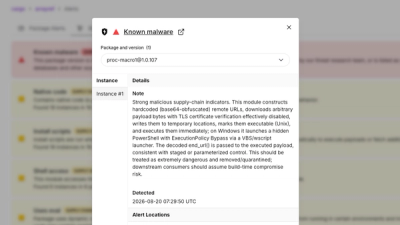
Three compromised Rust crates pulled in a malicious dependency that downloaded and executed cross-platform malware during Cargo builds.