
Research
/Security News
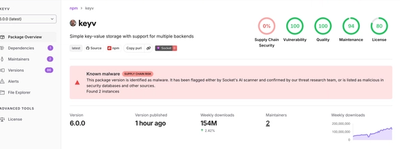
Popular npm Packages in the keyv and Cacheable Namespaces Compromised in Active Supply Chain Attack
Popular npm packages keyv and cacheable compromised.
By Socket Research Team - Aug 04, 2026
Unofficial MCP server for the TC39 specs (ECMA-262 + ECMA-402) — SHA-pinned clauses, AOID-aware search, in+out cross-references, edition diffs, history. Not affiliated with Ecma International or TC39.


📖 Docs: mcp.xyzzylabs.ai/tc39 — Get started · Tools · Cookbook · Editions · Architecture · Hosting
Independent project — not an official Ecma International or TC39 publication. Reads the publicly published ECMAScript specs (ECMA-262 + ECMA-402).
Give MCP-speaking AI agents structural access to the JS spec.
Any client that speaks the Model Context Protocol can call
clause.get sec-tonumber and get back parsed JSON (algorithm
steps as discrete arrays, cross-references as ids, signatures as
typed values) instead of being handed a 4 MB spec.html to grep
through. Tools cover ECMA-262
(the core language) and ECMA-402
(the Intl API): clauses, algorithm steps, cross-references both
ways, edition diffs, upstream git history, test262 search,
proposal lookup. Every response is SHA-pinned to a specific
upstream commit so anything an agent cites stays reproducible.
Snapshots resolve through a local cache → hosted Worker →
bundled fallback chain. The stdio transport (npx tc39-mcp)
fetches each snapshot from the hosted Cloudflare Worker on a cold
cache, writes it under ~/.cache/tc39-mcp/, and serves it from
disk thereafter — revalidating only when the local copy is older
than ~4 hours (a conditional If-None-Match request). The npm
package also bundles the latest stable + main editions of both
specs plus the test262 and proposals indexes; when the Worker is
unreachable, those are served straight from the package (the
offline fallback — not written to the cache). The hosted Worker
is also the HTTP alternative when you want a shared network
endpoint; its R2 data refreshes from upstream every ~4 hours.
Wire it into any MCP client — the stdio launch command is the same everywhere, only the config file differs:
{
  "mcpServers": {
    "tc39": { "command": "npx", "args": ["tc39-mcp"] }
  }
}
A global install works too — npm i -g tc39-mcp, then run tc39-mcp.
The first run downloads the npm package (latest stable + main editions plus the proposals and test262 indexes are bundled). The first call for a given snapshot fetches it from the hosted Worker and caches it locally; subsequent calls are served from disk, revalidated against the Worker only after the ~4-hour freshness window. If the Worker is unreachable, the bundled editions still answer offline. Then in your client:
use
clause.getto readsec-tonumberand show me the steps
You should see structured JSON back:
{
  "meta": {
    "id": "sec-tonumber",
    "aoid": "ToNumber",
    "title": "ToNumber ( argument )",
    "number": "7.1.4",
    "kind": "op"
  },
  "signatureRaw": "ToNumber ( _argument_: an ECMAScript language value, ): either a normal completion containing a Number or a throw completion",
  "algorithms": [
    { "steps": [
        { "text": "If _argument_ is a Number, return _argument_." },
        { "text": "If _argument_ is either *undefined* or a Symbol, throw a *TypeError* exception." },
        { "text": "If _argument_ is *null*, return *+0*<sub>𝔽</sub>." },
        "..."
    ]}
  ],
  "crossrefs": ["sec-tonumber-applied-to-the-string-type", "..."]
}
Five-minute walkthrough: docs/getting-started.md.
Point your client at the hosted Cloudflare Worker instead of running a local subprocess — same MCP protocol, no install:
{
  "mcpServers": {
    "tc39": {
      "type": "http",
      "url": "https://mcp.xyzzylabs.ai/tc39/mcp"
    }
  }
}
Traffic is rate-limited to 30 req/min per IP.
spec.search ranks
AOID-exact matches first; spec.symbol_resolve decodes
[[Prototype]] / %Object.prototype% / ~enumerate~.spec.crossrefs returns
what a clause cites AND who cites it. AOID-densified so bare
mentions in step text count, not just <emu-xref> hrefs.
include_cross_spec resolves 262 ↔ 402 hops.
(Cookbook recipe 1.)spec.diff
between any two editions back to ES2016; spec.history walks
the upstream git log via pickaxe search.
(Cookbook recipe 2.)test262.search
with prefix-matched esid: catches sec-tonumber AND
sec-tonumber-applied-to-the-string-type in one call.proposal.list /
proposal.get from a structured index of tc39/proposals,
covering both ECMA-262 and ECMA-402 (Intl) proposals — filter by
spec. Refreshed on the same 4-hour cadence as the specs.~/.cache/tc39-mcp/, tool calls are served from
disk and only revalidated against the hosted Worker after the
~4-hour freshness window (a conditional If-None-Match request
that carries the R2 object key, never a clause-id). Bundled
editions answer offline when the Worker is unreachable. The
hosted Worker is the HTTP alternative for shared / multi-tenant
use.| Goal | Tool(s) |
|---|---|
| Verify what's being served | spec.about · spec.snapshots |
| Read a specific clause | clause.get |
| Find a clause from a name / symptom | spec.search · spec.global_search |
Resolve [[X]] / %X% / ~X~ notation | spec.symbol_resolve |
| Browse / outline | clause.list · clause.outline |
| Compare editions / commit history | spec.diff · spec.history |
| Walk references (in + out) | spec.crossrefs |
| Read structured tables | spec.tables |
| Inspect the grammar | spec.grammar · spec.sdo_index |
| Enumerate well-known intrinsics | spec.well_known_intrinsics |
| Find conformance tests | test262.search · test262.get |
| Look up a proposal | proposal.list · proposal.get |
Full reference (input schemas, output types, example calls per
tool): docs/tools.md — auto-generated from
the schemas so it never drifts.
Every spec-reading tool accepts spec ("262" or "402", default
"262") and edition (default "latest").
es2016 – es2026, main. (ES5 / ES5.1 / ES6
have no upstream tags and aren't supported.)es2016 – es2026, main. (402 publishes each
annual edition as an esYYYY branch rather than a tag; the fetch
step resolves a branch or a tag the same way.)latest is spec-aware (each spec → its current
stable release, es2026 today). draft / next → main on both.Full table + how to add new releases: docs/editions.md.
The stdio server fetches snapshots from the public hosted Worker
at https://mcp.xyzzylabs.ai/tc39/r2/<key> (cache →
Worker → bundled fallback), so on a strict-egress network it falls
back to the bundled editions and can't reach the others. Override
the base URL via TC39_MCP_BASE_URL to point at a private mirror
— useful for strict-egress networks, air-gapped environments, or
running against a self-hosted Worker:
TC39_MCP_BASE_URL=https://my-mirror.example.com npx tc39-mcp
The endpoint just needs to serve the same key structure
(spec-<spec>-<edition>.json, test262-index.json,
proposals-index.json) — a plain static file server works. If it
returns ETags, the server revalidates with If-None-Match
(cheap 304s); without them it just refetches the full object
when a cached copy goes stale. To populate a mirror, run
npm run parse against a local checkout (see below) and upload
build/*.json to your bucket of choice.
The cache lives at $XDG_CACHE_HOME/tc39-mcp (or
~/.cache/tc39-mcp when XDG_CACHE_HOME is unset).
End users don't need this — the npm package and the hosted Worker are the supported surfaces above. This is for working on the server itself.
git clone https://github.com/xyzzylabs/tc39-mcp
cd tc39-mcp
npm install
npm run fetch-spec               # ~2 min, ~150 MB — both specs at every supported edition
npm run parse                    # spec.html → build/spec-<spec>-<edition>.json
npm run fetch-test262            # optional, enables test262.* (~300 MB)
npm run build-test262-index
npm run fetch-proposals          # optional, enables proposal.* (~50 MB)
npm run build-proposals-index
npm run mcp                      # start the stdio MCP server against your source
Point your MCP client at your local source instead of the published bin:
{
  "mcpServers": {
    "tc39": {
      "type": "stdio",
      "command": "npm",
      "args": ["run", "--silent", "mcp"],
      "cwd": "/abs/path/to/tc39-mcp"
    }
  }
}
--silentkeeps npm's lifecycle banner off stdout, so the MCP client receives a clean JSON-RPC stream.
Hosted at mcp.xyzzylabs.ai/tc39
— searchable, dark-mode-friendly, auto-rebuilt on every refresh so
/snapshots always reflects the live SHAs.
In-repo (also browseable on GitHub):
docs/getting-started.md — install →
wire → first call → verify. Five minutes.docs/tools.md — every tool, every field, every
example. Auto-generated from source.docs/cookbook.md — multi-tool recipes:
cross-spec lookups, prose-drift tracking, grammar/SDO
cross-references, test262 coverage, proposal-to-clause mapping.docs/editions.md — supported editions +
alias resolution.docs/architecture.md — data pipeline,
parser, cache, memory model.docs/deployment.md — local stdio, npm
CLI, hosted Cloudflare Worker, refresh model, observability.CONTRIBUTING.md — what kinds of changes
land easily, what won't.SECURITY.md — threat model + responsible
disclosure.CHANGELOG.md — version history + auto-refresh
convention.tc39-mcp is a read-only spec lookup service. The stdio transport
(npx tc39-mcp) sends no telemetry and never transmits your
queries — snapshots are fetched from the hosted Worker on a cold
or stale cache and served from local disk otherwise; those fetches
carry R2 object keys, never clause-ids or tool arguments. The hosted Cloudflare Worker collects only standard
request metadata (IP for rate limiting, timestamps, request
headers); it does not log request bodies, set cookies, or share
data with third parties.
Full policy: mcp.xyzzylabs.ai/tc39/privacy
For privacy questions, open an issue with the privacy label on
GitHub.
MIT
FAQs
Unofficial MCP server for the TC39 specs (ECMA-262 + ECMA-402) — SHA-pinned clauses, AOID-aware search, in+out cross-references, edition diffs, history. Not affiliated with Ecma International or TC39.
The npm package tc39-mcp receives a total of 36 weekly downloads. As such, tc39-mcp popularity was classified as not popular.
We found that tc39-mcp demonstrated a healthy version release cadence and project activity because the last version was released less than a year ago. It has 1 open source maintainer collaborating on the project.
Did you know?

Socket for GitHub automatically highlights issues in each pull request and monitors the health of all your open source dependencies. Discover the contents of your packages and block harmful activity before you install or update your dependencies.
Research
/Security News
Popular npm packages keyv and cacheable compromised.

Security News
A misconfiguration gave three Anthropic models internet access, and one, believing it was in a simulation, shipped a credential-stealing package to PyPI.

Security News
/Company News
Socket has joined the new Composer and Packagist sponsorship program as a launch sponsor, supporting the team that keeps PHP's package ecosystem secure.