

Company News
AWS Security Hub Adds Socket for Supply Chain Security
Socket is now in the AWS Security Hub Extended plan. Adopt it through AWS, apply committed spend, and block malicious open source packages.
By Feross Aboukhadijeh - Aug 04, 2026
vibeshare-live
Advanced tools
Share your live agent coding session by URL — spectate read-only or invite into the session. Local-first: runs on your machine, nothing readable leaves without consent. Part of the Vibe Suite.
Share your live agent coding session by URL — traces.com-style, open source, CLI-first. Spectators watch read-only; invite links let viewers request to join as collaborators (host approves, live).
Part of the Vibe Suite — companion tools for agentic coding CLIs (Claude Code, Codex, Gemini, Grok/pi, Kimi). Ships as CLI + npm package + MCP server, built on @pooriaarab/vibe-core (consent ledger, hooks bus, badges).
Local-first: the share runs on your machine. The consent ledger gates every share (share:session scope), the stream is served straight from your host, and nothing is stored on a server.
vibeshare shares a LIVE TERMINAL SESSION. It wraps a PTY, so the program inside is irrelevant — any agent CLI, shell, or TUI renders faithfully (colors, cursor, full-screen) via xterm.js in the browser.
Two ways to share a session:
vibeshare --public -- <harness> — vibeshare is the parent, PTY-captures. Examples: vibeshare --public -- claude, -- codex, -- gemini, -- aider, -- opencode, -- kimi, -- amp, or any shell/command.vibeshare attach <pane> taps it live. Harness-agnostic — it captures the terminal, not the app.Verified harnesses (all render the real TUI live): Claude Code (claude), OpenAI Codex (codex), Gemini CLI (gemini), aider (requires pip install aider-chat), opencode, Moonshot Kimi (kimi), pi (grok/glm), Sourcegraph amp (requires its own PATH setup). Others (Continue, Goose, Crush, Qwen, Cursor Agent, Warp, Zed, …) wrap identically — they're just terminal programs.
| Need | Command |
|---|---|
| Share a new claude session | vibeshare --public -- claude |
| Share a running session | Run it in tmux + vibeshare attach <pane> |
| Local-only sharing | vibeshare -- <cmd> |
Modes: --public (WebRTC P2P + e2e via getvibe.dev), --tunnel <provider> (12 providers, e2e), or local loopback/LAN. Presence + attributed chat included.
▶ Watch the launch video — claude is multiplayer now.
https://github.com/pooriaarab/vibeshare/raw/main/branding/launch-video.mp4
npm install
npm run build      # tsup → dist/ (cli.js, index.js, mcp.js + types)
npm run typecheck  # tsc --noEmit
npm test           # vitest
vibeshare                        # share your shell, spectate read-only
vibeshare --invite --expire 1h   # viewers may request to join; auto-expires
vibeshare --pass hunter2         # passphrase second factor
vibeshare -- npm test            # share a specific command
vibeshare --host 0.0.0.0         # share on your LAN (default: loopback only)

vibeshare viewers                # who's watching, pending join requests
vibeshare viewers --approve <id> # promote a viewer to collaborator
vibeshare viewers --kick <id>    # remove a viewer, live
vibeshare stop                   # end the share (works from another terminal)
Running vibeshare prints the link:
● local · no data out
  sharing:  npm test
  url:      http://127.0.0.1:50613/s/KKxzdjLpr_km
  access:   spectate (read-only)
  expires:  until you stop
  manage:   vibeshare viewers · vibeshare stop
Opening the URL shows a self-contained spectator page (no install for viewers) streaming the session live over SSE, with a "Request to join" button on invite links. First run asks for consent (--yes to skip); the grant is recorded locally in ~/.vibeshare/consent.json and can be revoked any time.
Read-only is real: there is no route that lets a viewer write — the host is the server of record, and promotion to collaborator goes only through a host-approved request (ViewerRegistry.canWrite() is the single gate).
import { createShare, grantConsent } from 'vibeshare';

grantConsent('share from my tool');              // once; local ledger
const { url, feed, viewers, revoke } = await createShare({
  session: 'npm test',
  access: 'spectate',                            // or 'invite'
  expiry: '1h',                                  // or 'stop'
});

feed.publish('tests starting…');
viewers.on('request', (v) => viewers.approve(v.id));
await revoke();
createShare throws ConsentRequiredError without a share:session grant. Bring your own plumbing with ShareManager, LocalHttpTransport, and FileConsentStore.
{
  "mcpServers": {
    "vibeshare": { "command": "vibeshare-mcp" }
  }
}
Tools: vibeshare_create, vibeshare_viewers, vibeshare_stop — so an agent can offer "share this session?". Your MCP client's tool-approval prompt is the consent act (recorded with that note). Approving join requests stays human-only, via the CLI.
vibeshare owns the link + gate; session content is an ordered feed served to spectators. The one deliberate seam is transport (src/transport.ts):
LocalHttpTransport (implemented, default): spectator page + SSE stream + loopback host-control API, served from your machine. Nothing stored on a server.RelayTransport (lands with vibelive): a dumb e2e relay / p2p mesh handing out public vibeshare.io URLs — same ShareTransport interface, swap-in only. Collaborator input routing is part of that seam and must pass ViewerRegistry.canWrite().Everything else — consent, access policy, passphrase gate, expiry teardown, viewer registry, revocation — is fully implemented and tested.
The original UX prototype (no build, no network): open docs/prototype.html. Spec: docs/spec.md.
FAQs
Did you know?

Socket for GitHub automatically highlights issues in each pull request and monitors the health of all your open source dependencies. Discover the contents of your packages and block harmful activity before you install or update your dependencies.
Company News
Socket is now in the AWS Security Hub Extended plan. Adopt it through AWS, apply committed spend, and block malicious open source packages.
Research
/Security News
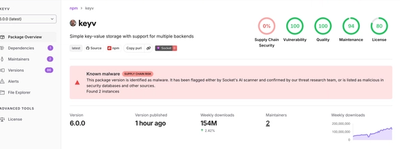
Popular npm packages keyv and cacheable compromised.

Security News
A misconfiguration gave three Anthropic models internet access, and one, believing it was in a simulation, shipped a credential-stealing package to PyPI.