WebCake Landing MCP
English · Tiếng Việt




Describe a landing page in plain words — your AI builds it, checks it, and ships it straight to WebCake.
⭐ If this saves you an afternoon of dragging boxes, give it a star — it's a one-dev project and every star keeps it alive.
"Build a landing page for my coffee shop — a hero with a sign-up button, a 3-feature section, and a lead form. Save it to my workspace."
…and a real, editable WebCake page appears in your account. No dragging boxes, no learning the schema, no hand-writing JSON.
🧩 How it works
This server is the bridge between your AI assistant and WebCake. The AI never guesses what a WebCake
page looks like — it asks this MCP, which knows the entire element model, validates the result, and saves it for you.
You AI assistant webcake-landing MCP WebCake
┌──────┐ prompt ┌────────────┐ tools ┌──────────────────────┐ API ┌──────────┐
│ idea │ ───────► │ Claude / │ ──────► │ • knows the element │ ────► │ a real │
│ │ │ Cursor / │ │ model + AI hints │ │ editable │
│ │ ◄─────── │ Windsurf │ ◄────── │ • builds + validates │ ◄──── │ page in │
└──────┘ page URL └────────────┘ result │ • saves to your acct │ │ WebCake │
└──────────────────────┘ └──────────┘
- You ask in plain language — goal, brand, sections, CTA, form fields.
- The AI learns the model from the MCP: the element catalog, the absolute-positioning canvas, the event vocabulary — so it builds a real WebCake page, not a guess.
- It assembles + validates the full
{ page, popup, settings, options } JSON. validate_page catches off-canvas boxes, dangling CTAs, and missing form fields before anything is saved.
- It persists to your WebCake account — dry-run preview first, then for real.
- You get an editor link — open it, tweak, publish. The AI did the heavy lifting.
Why it's reliable
| 📚 Knows the real model | Serves WebCake's actual element catalog (40+ types — hero, form, countdown, gallery, product list…), each with its exact specials and AI hints, drawn straight from the editor's renderers. |
| ✅ Validates before saving | Structural + semantic checks (unique ids, on-canvas layout, working CTAs, unique form fields) so the page isn't broken when it lands. |
| 🛡️ Safe by default | Every write is dry-run first (preview the request, token masked) — nothing touches your account until you confirm. |
| ✏️ Edits surgically | Ask for one change ("make the CTA green") and it edits only that element — every other id, coordinate, and block stays exactly as it was. |
💡 Lead-gen, events, invitations, app promos — or selling COD/online? It speaks WebCake's commerce model too (product lists, variations, cart).
✨ What you can build
One sentence to your AI → a finished, editable WebCake page. A taste of what people ship with it:
| 🧲 Lead-gen landing | "A SaaS waitlist page — hero, 3 benefits, an email-capture form." |
| 🛒 COD / online store | "A one-product page for my skincare serum — gallery, price, variations, an order form with cart." |
| 🎟️ Event / webinar | "A registration page for Saturday's webinar — countdown, agenda, sign-up form." |
| 💌 Invitation | "A wedding invite — names, date, a map, an RSVP form." |
| 📱 App promo | "A page for my fitness app — phone mockups, feature list, App Store + Google Play buttons." |
| ⚡ Flash sale | "A flash-sale page — big countdown, discounted product grid, a sticky Buy button." |
| 🔗 Link-in-bio | "A link-in-bio for my creator profile — avatar, short bio, 5 link buttons, socials." |
| 🎉 Product launch | "A launch page for v2 — hero, what's-new list, an early-access form." |
…then "make the CTA green" or "add a 4th feature" and it edits only that block — every other id and coordinate stays exactly where it was.
🤖 Works in Claude Desktop, Claude Code, Cursor, Windsurf, Augment, Codex, Antigravity, Gemini CLI, Cline, Kiro, OpenCode, or any MCP-capable client — and the reference + generation tools need zero setup, so you can try it before ever pasting a token.
Under the hood
MCP (Model Context Protocol) server that teaches AI agents how to build a complete
WebCake landing-page source JSON from a requirement — and persist it to a WebCake backend.
It exposes the element catalog, per-element usage hints + specials, the full page JSON Schema,
valid element/page skeletons, a page validator, and tools to create or edit pages on the backend.
The AI agent produces the full { page, popup, settings, options, cartConfigs } JSON; create_page
persists it and auto-publishes (build + publish_html) so the preview renders immediately (the edit
tools save source-only — re-publish via publish_page after edits).
| npx (local) — runs on your machine | Personal daily use, full control | browser login, a JWT, or none (reference tools) |
| Hosted URL — use our live server, nothing to install | No Node.js, teams, the claude.ai dialog | your personal ?jwt= link / x-webcake-jwt header |
The reference + generation tools (get_generation_guide, list_elements, validate_page, …) and the ingest tools (ingest_html, ingest_url — turn an existing HTML or URL into a layout anchor so the AI can recreate or adapt it) work with zero config; only the persistence tools (create_page, update_page, add_section, patch_page, publish_page, list_pages, find_pages, get_page, list_organizations) need a token. Credentials resolve in order: per-request header → env var → saved auth.json (login).
🚀 Get connected — the 2 main ways
Pick one. Both hand your AI tool (Claude, Cursor, …) the full Webcake landing toolkit. No coding.
① npx — runs on your machine (recommended for personal use)
Zero install, always the latest version, needs Node.js 18+. One line grabs your token and writes the IDE config:
npx -y webcake-landing-mcp install
npx -y webcake-landing-mcp install --ide all --env prod --jwt <your-jwt>
npx -y webcake-landing-mcp uninstall
It writes a webcake-landing entry into the right config file for each target: claude-desktop,
claude-code, cursor, windsurf, augment (VS Code), codex, antigravity, gemini (Gemini CLI),
cline, kiro, opencode, or all. Flags: --ide, --env, --jwt, --org-id,
--api-base/--app-base, --npx/--local, -y — see install --help.
Just want to run the server (configure by hand later)? npx -y webcake-landing-mcp
🛠️ Hand-written per-IDE config, shell-script installers (install.sh/install.ps1), or a cloned
local build → docs/manual-install.md.
② Remote URL …/mcp?jwt= — hosted, nothing to install
The server is already live at https://mcp.toolvn.io.vn/mcp — no Node.js, no machine to keep awake.
Grab your personal link (your token is baked in) and paste it into your client's Add custom connector / config:
https://mcp.toolvn.io.vn/mcp?jwt=<YOUR_TOKEN>
Two ways to get the link:
Optional extras: &env=prod, &org_id=…, &api_base=…. Hand each teammate a link with their own jwt →
per-user, no OAuth. Clients that support headers should send the token as x-webcake-jwt instead of
putting it in the URL — the full header ↔ env mapping is in docs/configuration.md.
✅ Best for: no Node.js, team/shared use, the claude.ai connector dialog (URL-only, no headers).
⚠️ The link contains your personal token — treat it like a password, always use HTTPS.
⚙️ Configuration
The quick version — only the persistence tools need any of this:
npx -y webcake-landing-mcp login
…or set WEBCAKE_ENV (local | staging | prod — fills in all base URLs) + WEBCAKE_JWT.
For publish_page to actually put a page live, a build host is needed (it renders the
app/app_css that the live publish_html route requires):
prod preset auto-configures https://build.webcake.io — no extra setup (the preset applies when the env resolves to prod: WEBCAKE_ENV=prod, --env prod, or x-webcake-env: prod).- For staging/local, set
WEBCAKE_BUILD_BASE=<url> or send the x-webcake-build-base header per request.
- Without it,
publish_page falls back to a legacy source-only save with rendered:false, live:false + a warning — nothing goes live.
- A page is only permanently live with a
custom_domain; without one the returned /preview/<page_id> link expires ~10 minutes after the publish.
Everything else — the full env-var table, environment presets, per-request headers for the hosted
server, the login browser flow (+ backend contract), and how to grab a JWT by hand — lives in
docs/configuration.md.
📚 Docs
🧰 The tools at a glance
23 tools in five groups — full descriptions in docs/tools.md:
| Reference | get_generation_guide · list_elements · get_element · get_page_schema | nothing |
| Generation | new_element · new_page_skeleton · validate_page · layout (exact centering/row/grid/stack coordinates, both breakpoints) | nothing |
| Media | search_images (real Pexels stock photos) · get_icon_svg (Material Symbols / Font Awesome icon names → inline SVG via Iconify) · upload_images (re-host external images, data: URIs, or local file paths from the user's machine — files into your media collection when Webcake creds and an org are available; the org is required and must match the page's, so settle it up front — 1 org auto-selects, 2+ with none chosen returns organization_required + the list; no JWT → the public CDN) · render_preview (screenshot a page/URL so the model can see + compare it) | nothing |
| Ingest | ingest_html · ingest_url (recreate an existing page) | nothing |
| Persistence | list_organizations · create_page · list_pages · find_pages · get_page · update_page · add_section · patch_page · publish_page | WEBCAKE_API_BASE + WEBCAKE_JWT |
Every write defaults to dry_run=true — it previews the exact request (token masked) and only
touches your account when you re-run with dry_run=false.
Suggested prompt
Build me a WebCake landing page for <brand/offer>. Use the webcake-landing MCP:
call get_generation_guide, new_page_skeleton, then get_element for each element type you use,
assemble the { page, popup, settings, options } JSON, validate_page until zero errors,
then create_page (dry-run first).
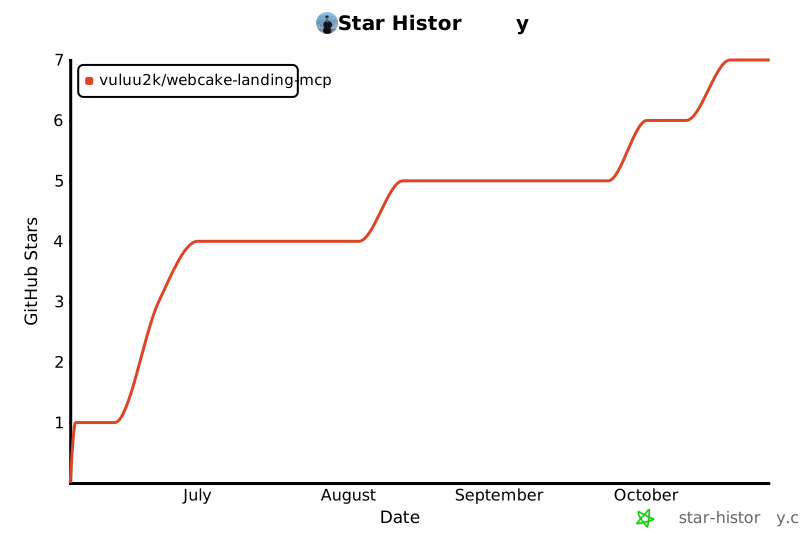
⭐ Like the idea? Drop a star
This is a solo, open-source project — every ⭐ genuinely keeps it moving and helps other builders discover it.
- ⭐ Star the repo — 2 seconds, huge motivation.
- 🐛 Open an issue — a bug, a missing element type, or just an idea.
- 🔁 Share it with anyone still building landing pages box by box.
Built with ❤️ for the WebCake community. Thanks for being here.