XR Blocks

)
)


JavaScript library for rapid AI + XR prototyping
Site —
Manual —
Templates —
Demos —
Gem —
YouTube —
arXiv —
Blog
Description
XR Blocks is a lightweight, cross-platform library for rapidly prototyping
advanced XR and AI experiences. Built upon three.js, it
targets Chrome v136+ with WebXR support on Android XR (e.g.,
Galaxy XR) and also
includes a powerful desktop simulator for development. The framework emphasizes
a user-centric, developer-friendly SDK designed to simplify the creation of
immersive applications with features like:
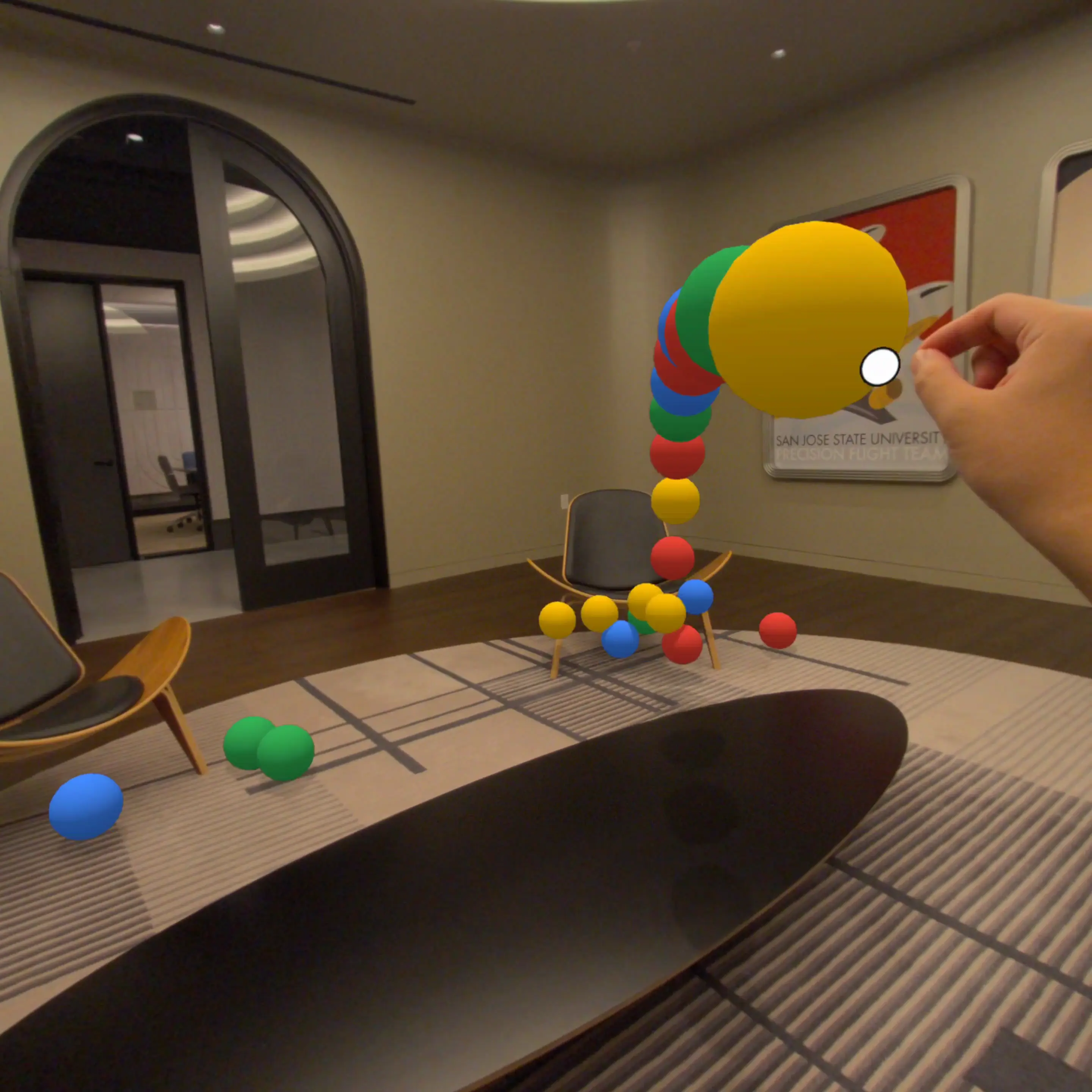
- Hand Tracking & Gestures: Access advanced hand tracking, custom gestures
with TensorFlow Lite / PyTorch models, and interaction events.
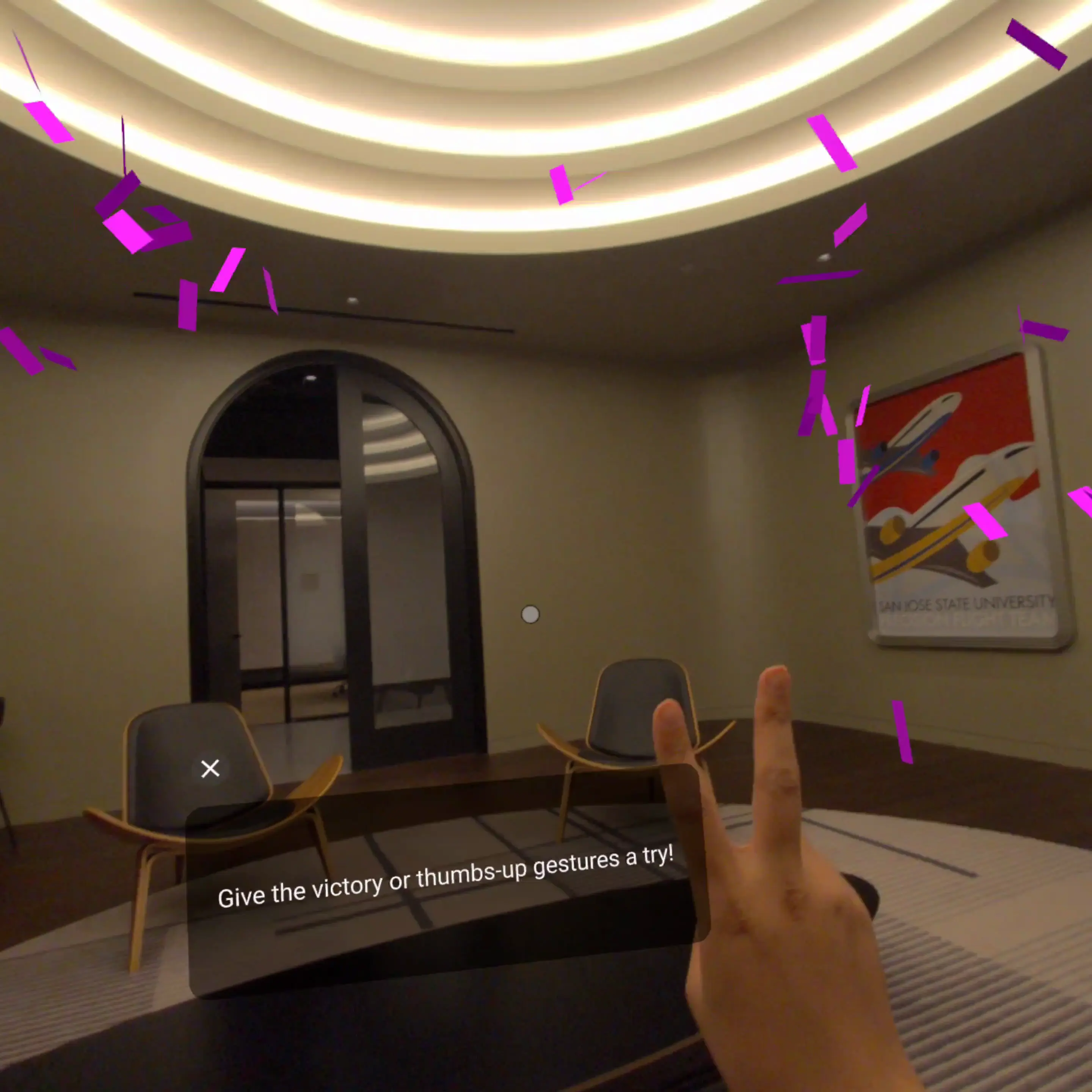
- Gesture Recognition: Opt into pinch, open-palm, fist, thumbs-up, point,
and spread detection with
options.enableGestures(), tune providers or
thresholds, and subscribe to gesturestart/gestureupdate/gestureend
events from the shared subsystem.
- Head Gestures: Detect completed nod and shake motions with
options.enableHeadGestures() and subscribe through
xb.input.headGestures on device or in the desktop simulator.
- World Understanding: Present samples with depth sensing, geometry-aware
physics, and object recognition with Gemini in both XR and desktop
simulator.
- Agent Context: Expose an agent-facing scene context with semantic trees,
visible-object state, and Set-of-Mark screenshots through
xb.context.
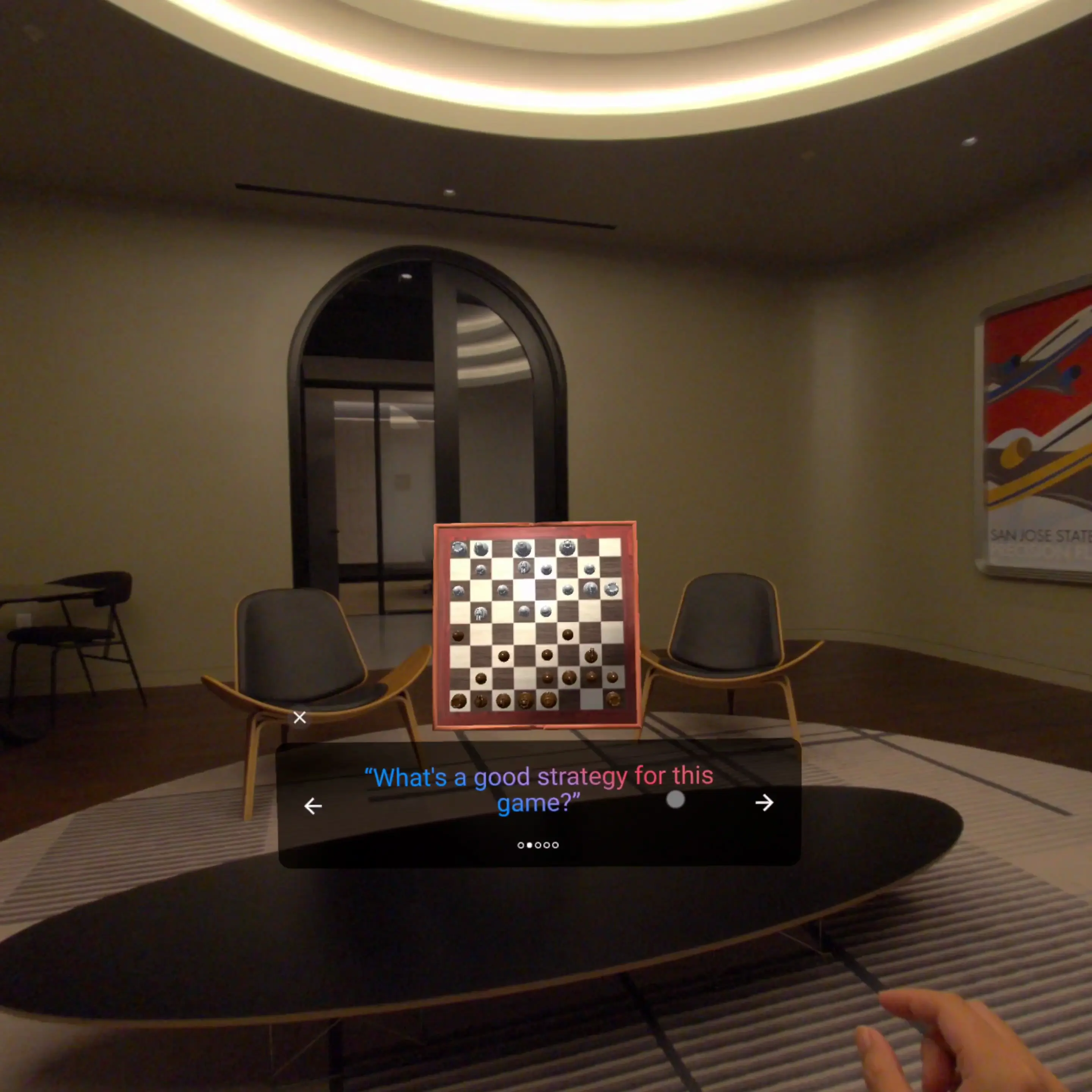
- AI Integration: Seamlessly connect to Gemini for multimodal
understanding and live conversational experiences.
- Cross-Platform: Write once and deploy to both XR devices and desktop
Chrome browsers.
- Automation-Friendly Simulator: Use
options.enableAutomationMode() or
?xrAutomation=1 to start a desktop simulator preset with context enabled.
- Browser Debugging: Add
?debug=1 to expose the SDK as window.xb and
await initialization through window.xbReady from browser tooling.
- Constrained Simulator Navigation: Opt into simulator navmesh grounding with
options.simulator.navMesh.enabled = true. The default Living Room
environment includes a pregenerated glTF/GLB navMeshPath; custom
environments can provide their own navmesh authored in the same local
coordinate space as the simulator scene.
We welcome all contributors to foster an AI + XR community! Read our
blog post
and white paper for a visionary roadmap.
Usage

XR Blocks can be imported directly into a webpage using an importmap. This code
creates a basic XR scene containing a cylinder. When you view the scene, you can
pinch your fingers (in XR) or click (in the desktop simulator) to change the
cylinder's color. Check out
this live demo with simple
code below:
<!DOCTYPE html>
<html lang="en">
<head>
<title>Basic Example | XR Blocks</title>
<meta charset="utf-8" />
<meta
name="viewport"
content="width=device-width, initial-scale=1.0, user-scalable=no"
/>
<link
type="text/css"
rel="stylesheet"
href="https://cdn.jsdelivr.net/gh/google/xrblocks@main/samples/main.css"
/>
<script type="importmap">
{
"imports": {
"three": "https://cdn.jsdelivr.net/npm/three@0.184.0/build/three.module.js",
"three/addons/": "https://cdn.jsdelivr.net/npm/three@0.184.0/examples/jsm/",
"three-pathfinding": "https://cdn.jsdelivr.net/npm/three-pathfinding@1.3.0/dist/three-pathfinding.module.js",
"xrblocks": "https://cdn.jsdelivr.net/gh/google/xrblocks@build/xrblocks.js",
"xrblocks/addons/": "https://cdn.jsdelivr.net/gh/google/xrblocks@build/addons/"
}
}
</script>
</head>
<body>
<script type="module">
import * as THREE from 'three';
import * as xb from 'xrblocks';
class MainScript extends xb.Script {
init() {
this.add(new THREE.HemisphereLight(0xffffff, 0x666666, 3));
const geometry = new THREE.CylinderGeometry(0.2, 0.2, 0.4, 32);
const material = new THREE.MeshPhongMaterial({
color: 0xffffff,
transparent: true,
opacity: 0.8,
});
this.player = new THREE.Mesh(geometry, material);
this.player.position.set(
0,
xb.user.height - 0.5,
-xb.user.objectDistance
);
this.add(this.player);
}
onSelectEnd(event) {
this.player.material.color.set(Math.random() * 0xffffff);
}
}
document.addEventListener('DOMContentLoaded', function () {
xb.add(new MainScript());
xb.init(new xb.Options());
});
</script>
</body>
</html>
Gem
For rapid prototyping, please refer to this
blog
and try out XR Blocks Gem on Android XR or
desktop using Chrome.
A video demonstration of XR Blocks Gem can be found
here.
Development Guide
Setup
git clone --depth=1 git@github.com:google/xrblocks.git
cd xrblocks
npm ci
After setup, either serve the samples and demos or develop locally, as described
below.
Serve samples and demos
Serve the repository to view samples and demos through http://localhost:8080/:
npm run serve
Develop locally
For active SDK development, run watch mode and local serving together:
npm run dev
Linting and formatting
XR Blocks uses ESLint for linting and Prettier for formatting. Run the following
commands to check your code before submitting a pull request:
npm run lint
npm run format
If you are using VS Code, install the
ESLint extension
and the
Prettier extension,
then set Prettier as your default formatter.
Notice
This is not an officially supported Google product, but will be actively
maintained by the XR Labs team and external collaborators. This project is not
eligible for the
Google Open Source Software Vulnerability Rewards Program.
User Data & Permissions
When using specific features in this SDK (e.g., WebXR, hand tracking, camera),
users will be prompted with permission requests and the application may not
function as expected with denied permissions.
XR Blocks is an open source software development kit that does not handle data
by itself; however, the use of other APIs may collect user data and require user
permissions:
When using WebXR and
LiteRT APIs (e.g., depth sensing, gesture
recognition), all data is stored and processed locally with on-device models.
When using AI features (e.g.,
Gemini Live, Gemini Flash), the
data will be sent to Gemini servers and please follow
Gemini's Privacy & Terms.
Keep Your API Key Secure
This SDK does not require any API keys for non-AI samples. In specific AI use
cases, this SDK provides an interface to use cloud-hosted Gemini services with
XR experiences, requiring an API key from
AI Studio. Please follow
this doc for best
practices to keep your API key secure.
Treat your Gemini API key like a password. If compromised, others can use your
project's quota, incur charges (if billing is enabled), and access your private
data, such as files.
Critical Security Rules
Never commit API keys to source control. Do not check your API key into version
control systems like Git.
Never expose API keys on the client-side. Do not use your API key directly in
web or mobile apps in production. Keys in client-side code (including our
JavaScript/TypeScript libraries and REST calls) can be extracted.
Uninstallation
To remove XR Blocks from your code, simply remove the lines from your <script type="importmap"> tag in HTML, or import * from xrblocks in JavaScript, or
use npm uninstall xrblocks from your project directory.
References
If you find XR Blocks inspiring or useful in your research, please reference it
as:
@misc{Li2025XR,
  title={{XR Blocks: Accelerating Human-centered AI + XR Innovation}},
  author={Li, David and Numan, Nels and Qian, Xun and Chen, Yanhe and Zhou, Zhongyi and Alekseev, Evgenii and Lee, Geonsun and Cooper, Alex and Xia, Min and Chung, Scott and Nelson, Jeremy and Yuan, Xiuxiu and Dias, Jolica and Bettridge, Tim and Hersh, Benjamin and Huynh, Michelle and Piascik, Konrad and Cabello, Ricardo and Kim, David and Du, Ruofei},
  year={2025},
  eprint={2509.25504},
  archivePrefix={arXiv},
  primaryClass={cs.HC},
  url={https://arxiv.org/abs/2509.25504},
}
@misc{Du2026Vibe,
  title={Vibe Coding XR: Accelerating AI + XR Prototyping with XR Blocks and Gemini},
  author={Ruofei Du and Benjamin Hersh and David Li and Nels Numan and Xun Qian and Yanhe Chen and Zhongyi Zhou and Xingyue Chen and Jiahao Ren and Robert Timothy Bettridge and Steve Toh and David Kim},
  year={2026},
  eprint={2603.24591},
  archivePrefix={arXiv},
  primaryClass={cs.HC},
  url={https://arxiv.org/abs/2603.24591},
}
Terms of Service