
Product
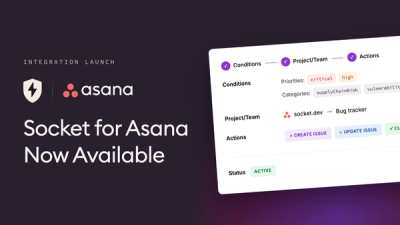
Socket for Asana Is Now Available
Create and manage Asana tasks directly from Socket alerts, with manual task creation, automated ticketing rules, and two-way sync.
By Jeppe Hasseriis - Aug 25, 2026
zettelscript
Advanced tools
Graph-first knowledge management system combining Zettelkasten-style notes, GraphRAG retrieval, and manuscript continuity tracking
Your notes aren't connected. They're buried.
Folders lie to you. They promise organization but deliver graveyards: ideas filed away, never to resurface. You've felt it: that nagging sense that you've written this before, somewhere.
ZettelScript doesn't organize your notes. It unleashes them.
Notes become nodes. Links become meaning. Structure emerges from chaos.



View Demo Graph — Download and open in your browser to explore a sample knowledge graph.
One command. Your entire knowledge graph, alive in your browser.
zettel go
ZettelScript Atlas renders every note and connection — and optionally extracted entities (characters, locations, events) — as an interactive force-directed graph. Every node is a portal to its connections—click to see related nodes, click again to navigate there. Color-coded edges show relationship types at a glance. Filter what you see. Search by name. Navigate with breadcrumbs.
This isn't a pretty picture. It's a thinking tool. Watch your ideas cluster. Spot the orphaned notes. Find the hidden hub you didn't know existed. Then click through to explore it.
Five visualization modes that turn your graph from a static picture into a discovery engine:
| Mode | What it does | Try it |
|---|---|---|
| Heat Vision | Nodes glow based on recency — hot orange for recently edited, cold for untouched. See where you've been working at a glance. | Toggle in left panel |
| Ghost Nodes | Unresolved [[links]] appear as translucent nodes floating near their references. In Live mode, click to create the missing note instantly. | Toggle in left panel |
| Constellations | Save any view (filters, focus, camera position) as a named constellation. Return to your exact vantage point later. | zettel constellation save "my-view" |
| Semantic Wormholes | Dotted lines connect similar-but-unlinked nodes. The AI found a connection you missed (embeddings required). Accept or reject from the sidebar. | zettel wormhole detect first |
| Narrative Pathfinder | Select two nodes and get the reading order between them. Export as a table of contents for your manuscript. | zettel path "Start" "End" |
These modes compose: Heat Vision + Ghost Nodes shows you where you're actively working and what's missing from that work.
npm install -g zettelscript
cd your-notes-folder
zettel go
That's it. Your vault is indexed, your graph is built, and Atlas opens in your browser.
Your graph lives at .zettelscript/graph.html — a single self-contained file you can share, bookmark, or open offline anytime.
Once Atlas opens:
Toggle Ghost Nodes (left panel) — Every unresolved [[link]] becomes visible. That character you mentioned but never created? It's floating there, waiting. Run zettel viz --live, then click it to create the note.
Toggle Heat Vision (left panel) — Your graph lights up with activity. Hot nodes are recent work; cold nodes haven't been touched. Immediately spot the corners of your vault gathering dust.
Still organizing notes into folders? That's archaeology, not knowledge management.
The repository includes a demo-vault/ with sample characters, locations, events, and a pre-built graph.
demo-vault/.zettelscript/graph.html in your browserNo installation required. See what your notes could look like.
| The Problem | What You Do Now | What ZettelScript Does |
|---|---|---|
| Lost connections | Hope you remember related notes | Graph traversal finds them automatically |
| Duplicate work | Rewrite ideas you've already captured | Unlinked mention detection surfaces them |
| Search hell | Keyword guessing games | Semantic (with embeddings) + graph + lexical retrieval |
| Fragile links | Rename a file, break everything | Renames are safe: identity is a stable ID stored in frontmatter, not the file path |
npm install -g zettelscript
zettel <command>
npm install -g github:RobThePCGuy/ZettelScript
zettel <command>
# From npm
npx zettelscript <command>

# From GitHub
npx github:RobThePCGuy/ZettelScript <command>
git clone https://github.com/RobThePCGuy/ZettelScript.git
cd ZettelScript
npm install
npm run build
node dist/cli/index.js <command>
| Command | What it does |
|---|---|
zettel go | Zero to hero: init, index, and open Atlas in one command |
zettel index | Re-index your vault after changes |
zettel viz | Open Atlas visualization |
zettel path "A" "B" | Find narrative paths between two nodes |
zettel wormhole detect | Find semantically similar but unlinked nodes |
zettel wormhole list | Show pending wormhole suggestions |
zettel wormhole accept <id> | Accept a wormhole as a permanent connection |
zettel constellation save "name" | Save current view as a named constellation |
zettel constellation list | List saved constellations |
zettel embed compute | Compute embeddings (required for wormholes) |
zettel discover --all | Find unlinked mentions across your vault |
zettel query stats | Show graph statistics |
For detailed options, run zettel <command> --help.
setup / goZero to hero. Initialize, index, and visualize in one command. Stack options for a full-featured setup.
zettel go                              # Basic: init + index + visualize
zettel go --extract                    # + AI entity extraction
zettel go --extract --wormholes        # + embeddings + semantic wormholes
zettel go --manuscript --extract       # Manuscript mode + extraction
| Option | Description |
|---|---|
-f, --force | Reinitialize even if already set up |
--manuscript | Enable manuscript mode with POV and timeline validation |
--extract | Extract entities (characters, locations, etc.) using Ollama |
--extract-model <model> | Ollama model for extraction (default: qwen2.5:7b) |
--embed | Compute embeddings for semantic features |
--wormholes | Detect semantic wormholes (implies --embed) |
--no-viz | Skip visualization generation |
-v, --verbose | Show detailed output |
Workflow with all features:
zettel go --manuscript --extract --wormholes
This runs: init → index → extract entities → re-index → compute embeddings → detect wormholes → visualize.
visualize / vizSee your graph. Generates an interactive force-directed visualization and opens it in your browser.
zettel viz
zettel viz --live                                    # Enable live updates + ghost creation
zettel viz --constellation "character-web"           # Load a saved view
zettel viz --path-from "Chapter 1" --path-to "End"   # Highlight paths between nodes
| Option | Description |
|---|---|
-o, --output <path> | Custom output path for the HTML file |
--no-open | Generate without opening browser |
-l, --live | Enable live updates via WebSocket (allows creating notes from ghosts) |
-c, --constellation <name> | Load a saved constellation view |
--list-constellations | List all saved constellations |
--path-from <node> | Starting node for path highlighting |
--path-to <node> | Ending node for path highlighting |
--path-k <n> | Number of paths to compute (default: 3) |
Output location: .zettelscript/graph.html in your vault directory (or custom path with -o).
Opens ZettelScript Atlas, a fully navigable knowledge exploration tool.
Clickable Navigation — Every node is a portal. Click any node to see its connections in the sidebar, grouped by relationship type. Click a connected node to navigate instantly. Your graph becomes a web you can traverse.
Navigation History — Breadcrumb trail appears at top-center as you explore. Back/forward buttons let you retrace your steps. Jump to any previous node with a click.
Edge Type Styling — Relationships are color-coded by type:
| Edge Type | Color | Style |
|---|---|---|
| Links to | Cyan | Solid |
| Backlinks | Violet | Dashed |
| Sequence | Emerald | Solid |
| Hierarchy | Amber | Solid |
| Causes | Red | Solid |
| Semantic | Gray | Dotted |
| Mention | Teal | Dotted |
Edge Filtering — Toggle edge types on/off in the left panel. Hide backlinks to see only forward links. Show only causal relationships. Focus on what matters.
Visualization Modes (toggle in left panel):
[[links]] appear as translucent nodes. Click to create the missing note. Adjustable threshold controls how many ghosts appear.zettel wormhole detect, dotted lines connect semantically similar but unlinked nodes. Accept or reject from the sidebar.Keyboard Shortcuts
| Key | Action |
|---|---|
/ | Focus search |
Escape | Close sidebar |
Alt+Left | Go back |
Alt+Right | Go forward |
The generated HTML is a single self-contained file (~45KB) that works offline.
initInitialize a ZettelScript vault in the current directory.
zettel init [options]
| Option | Description |
|---|---|
-f, --force | Overwrite existing initialization |
Creates .zettelscript/ directory containing the database and config.
indexIndex all markdown files in the vault.
zettel index [options]
| Option | Description |
|---|---|
-v, --verbose | Show detailed output including unresolved/ambiguous links |
--stats | Show nodes and edges by type after indexing |
watchWatch for file changes and incrementally index.
zettel watch [options]
| Option | Description |
|---|---|
-v, --verbose | Show detailed output for each file change |
Press Ctrl+C to stop watching.
queryQuery the knowledge graph. Has 6 subcommands:
query backlinks <node>Show incoming links to a node.
zettel query backlinks "Note Title"
zettel query backlinks path/to/note.md
| Option | Description |
|---|---|
-l, --limit <n> | Maximum results (default: 20) |
query neighbors <node>Show connected nodes (both incoming and outgoing).
zettel query neighbors "Note Title"
| Option | Description |
|---|---|
-l, --limit <n> | Maximum results (default: 20) |
-d, --direction <dir> | Filter: in, out, or both (default: both) |
query path <from> <to>Find the shortest path between two nodes.
zettel query path "Note A" "Note B"
query statsShow graph statistics including node counts, edge counts, and isolated nodes.
zettel query stats
query orphansFind nodes with no links.
zettel query orphans
| Option | Description |
|---|---|
-l, --limit <n> | Maximum results (default: 20) |
query hubsFind highly-connected nodes.
zettel query hubs
| Option | Description |
|---|---|
-l, --limit <n> | Maximum results (default: 10) |
-t, --threshold <n> | Minimum incoming connections (default: 5) |
validateValidate the vault for integrity issues.
zettel validate [options]
| Option | Description |
|---|---|
--links | Check for broken and ambiguous links |
--schema | Validate frontmatter schema |
--all | Run all validations (default if no options) |
-v, --verbose | Show detailed output |
discoverYour vault is full of hidden connections. Every time you type a character name, a concept, or a location without linking it, that's a connection lost.
zettel discover hunts them down.
zettel discover [options]
| Option | Description |
|---|---|
-n, --node <id> | Check specific node by title or path |
--all | Check all nodes |
-l, --limit <n> | Maximum mentions per node (default: 10) |
-t, --threshold <n> | Minimum confidence threshold 0-1 (default: 0.5) |
--approve | Interactive approval mode |
--batch <action> | Batch action: approve, reject, or defer |
retrieveSearch that actually understands what you're looking for.
Traditional search matches keywords. ZettelScript matches meaning, then follows the graph to find related ideas you didn't even think to search for.
zettel retrieve "<query>" [options]
| Option | Description |
|---|---|
-n, --max-results <n> | Maximum results (default: 10) |
-d, --depth <n> | Graph expansion depth (default: 2) |
-b, --budget <n> | Node expansion budget (default: 30) |
--no-semantic | Disable semantic search |
--no-lexical | Disable lexical search |
--no-graph | Disable graph expansion |
-t, --type <types> | Filter by node types (comma-separated) |
-v, --verbose | Show detailed provenance |
Requires embeddings configuration for semantic search.
extractLet AI find the entities you missed. Extract characters, locations, objects, and events from prose using a local LLM.
zettel extract [options]
| Option | Description |
|---|---|
-f, --file <path> | Extract from specific file |
--all | Extract from all markdown files |
-m, --model <model> | Ollama model to use (default: qwen2.5:7b) |
--dry-run | Show what would be extracted without creating files |
-o, --output <dir> | Output directory for entity files (default: entities/) |
-v, --verbose | Show detailed output |
Creates markdown files for each entity with frontmatter, then run zettel index to build the graph.
Requires Ollama. If the default model isn't installed, you'll be prompted to download it or shown alternatives:
# Extract entities (dry run to preview)
zettel extract --file notes.md --dry-run

# Create entity files
zettel extract --file notes.md

# Use a different model
zettel extract --model llama3.1:8b --all

# Re-index to include new entities
zettel index
Recommended models for extraction:
qwen2.5:7b (default) — Good balance of context and speedllama3.1:8b — Strong general purposeqwen2.5:14b — Better accuracy for large documentspathFind the narrative thread between any two nodes. Returns paths ranked by edge quality, with options to export as a reading order or table of contents.
zettel path "Elena Vance" "The Cascade Event"
zettel path "Chapter 1" "Chapter 10" --format md -o reading-order.md
| Option | Description |
|---|---|
-k, --max-paths <n> | Maximum paths to return (default: 3) |
--max-depth <n> | Maximum hops to search (default: 15) |
--format <type> | Output format: table, verbose, md, json |
-o, --output <file> | Write output to file |
--edge-types <types> | Comma-separated edge types to include |
--exclude-edges <types> | Comma-separated edge types to exclude |
embedCompute vector embeddings for semantic features. Required before using wormhole detect or semantic search in retrieve.
zettel embed compute              # Compute missing embeddings
zettel embed compute --force      # Recompute all embeddings
zettel embed stats                # Show embedding coverage
| Subcommand | Description |
|---|---|
compute | Compute embeddings for nodes that need them |
stats | Show embedding statistics |
clear | Clear all embeddings |
| Option (compute) | Description |
|---|---|
-p, --provider <name> | Embedding provider: openai, ollama, mock |
-m, --model <name> | Model name (provider-specific) |
--force | Recompute all embeddings |
--batch-size <n> | Batch size for API calls (default: 10) |
wormholeDiscover hidden connections. Semantic wormholes are pairs of nodes that are similar in meaning but not explicitly linked. The AI found a connection you missed.
zettel embed compute              # Required first
zettel wormhole detect            # Find similar unlinked nodes
zettel wormhole list              # Show pending suggestions
zettel wormhole accept abc123     # Accept a suggestion
zettel wormhole reject abc123     # Reject a suggestion
| Subcommand | Description |
|---|---|
detect | Detect wormholes and create suggestion edges |
list | List pending wormhole suggestions |
stats | Show wormhole statistics |
accept <id> | Accept a suggestion (converts to permanent semantic edge) |
reject <id> | Reject a suggestion (won't resurface unless content changes) |
clear | Remove all wormhole suggestions |
| Option (detect) | Description |
|---|---|
-t, --threshold <n> | Similarity threshold 0-1 (default: 0.75) |
-k, --top-k <n> | Max suggestions per node (default: 3) |
--skip-types <types> | Node types to skip |
Accepted wormholes appear in Atlas as dotted semantic edges.
constellationSave and restore graph views. A constellation captures your current filters, focus nodes, camera position, and display modes. Return to your exact vantage point later.
zettel constellation save "character-web"
zettel constellation list
zettel constellation show "character-web"
zettel constellation delete "character-web"
| Subcommand | Description |
|---|---|
save <name> | Save a constellation from JSON state |
list | List all saved constellations |
show <name> | Show details of a constellation |
delete <name> | Delete a constellation |
update <name> | Update an existing constellation |
Constellations are saved from within Atlas (click "Save View" in the left panel) and loaded via zettel viz --constellation "name".
Every note is a node. But not all nodes are equal.
| Type | Description |
|---|---|
note | General-purpose atomic note |
scene | Story scene or chapter |
character | Character profile |
location | Place or setting |
object | Significant item or prop |
event | Timeline event |
concept | Abstract idea or theme |
moc | Map of Content (hub note) |
timeline | Timeline or chronology |
draft | Work in progress |
Links aren't just links. They carry meaning.
| Type | Description |
|---|---|
explicit_link | User-authored wikilink |
backlink | Computed incoming link |
sequence | Chronological ordering |
hierarchy | Parent-child relationship |
participation | Character/entity involvement |
pov_visible_to | POV character visibility |
causes | Causal relationship |
setup_payoff | Narrative setup and payoff |
semantic | Inferred semantic similarity |
mention | Unlinked mention detected |
alias | Alternative name reference |
ZettelScript supports standard wikilink syntax:
[[Title]]                    # Link by title
[[Title|Display Text]]       # Link with custom display
[[id:abc123]]                # Link by node ID (for ambiguity)
[[id:abc123|Display Text]]   # ID link with display text
Resolution rules:
id: prefix is used, resolve directly to node IDZettelScript reads YAML frontmatter to populate node metadata.
---
id: unique-node-id          # Immutable identifier (auto-generated if missing)
title: Note Title           # Display title (defaults to filename)
type: note                  # Node type (see Node Types above)
aliases:                    # Alternative titles for linking
  - Alias One
  - Alias Two
tags:                       # Classification tags
  - topic/subtopic
  - status/active
created: 2024-01-15         # Creation date
updated: 2024-03-20         # Last modified date
---
Configuration is stored in .zettelscript/config.yaml. Key sections:
vault:
  path: "."
  excludePatterns:
    - "node_modules/**"
    - ".git/**"
    - ".zettelscript/**"
# OpenAI embeddings
embeddings:
  provider: openai
  model: text-embedding-3-small
  dimensions: 1536
  apiKey: ${OPENAI_API_KEY}  # Or set via environment variable

# Ollama embeddings (local)
embeddings:
  provider: ollama
  model: nomic-embed-text
  dimensions: 768
  baseUrl: http://localhost:11434
retrieval:
  defaultMaxResults: 20
  semanticWeight: 0.5        # Weight for semantic matches
  lexicalWeight: 0.3         # Weight for keyword matches
  graphWeight: 0.2           # Weight for graph expansion
  expansionMaxDepth: 3       # Max hops for graph traversal
  expansionBudget: 50        # Max nodes to expand
# Ollama (local)
llm:
  provider: ollama
  model: qwen2.5:7b
  baseUrl: http://localhost:11434
graph:
  defaultMaxDepth: 3         # Default traversal depth
  defaultBudget: 50          # Default node budget
  decayFactor: 0.7           # Score decay per hop
  scoreThreshold: 0.01       # Minimum score to include
discovery:
  confidenceThreshold: 0.5   # Minimum confidence for mentions
  ambiguityPenalty: 0.7      # Penalty for ambiguous matches
  weights:
    locality: 0.3            # Weight for graph proximity
    centrality: 0.2          # Weight for node importance
    frequency: 0.2           # Weight for mention frequency
    matchQuality: 0.3        # Weight for string match quality
ZettelScript uses Ollama for local LLM features (entity extraction, embeddings). Ollama runs as a separate local server on your machine. It is not bundled with ZettelScript.
Your Machine
┌─────────────────────────────────────────────┐
│  zettel extract / zettel retrieve           │
│       │                                     │
│       ▼ (HTTP to localhost:11434)           │
│  ┌─────────────┐                            │
│  │   Ollama    │  ← Install separately      │
│  │  (llama3.2) │                            │
│  └─────────────┘                            │
└─────────────────────────────────────────────┘
Setup:
ollama pull qwen2.5:7bOptional:
The dist/ directory is committed to the repository. This allows npx github:RobThePCGuy/ZettelScript to work without requiring users to build the project. If you modify source code, rebuild before committing:
npm run build
git add dist/
You didn't write all those ideas just to lose them in folders. ZettelScript finds the connections you forgot existed and shows you the ones you never knew were there.
npm install -g zettelscript && zettel go
Start seeing your thinking.
MIT
FAQs
Graph-first knowledge management system combining Zettelkasten-style notes, GraphRAG retrieval, and manuscript continuity tracking
We found that zettelscript demonstrated a healthy version release cadence and project activity because the last version was released less than a year ago. It has 1 open source maintainer collaborating on the project.
Product
Create and manage Asana tasks directly from Socket alerts, with manual task creation, automated ticketing rules, and two-way sync.
Security News
Open VSX has removed three extension IDs from its malicious-extension list as the legitimate publishers they impersonated move to claim the names for themselves.

Product
Socket’s PHP and Composer support is now in Beta for all customers, with PHP reachability analysis generally available.