

Security News
Federal Audit Finds NIST Wasted Funds With No Plan to Clear NVD Backlog
Federal audit finds NIST lacked a plan to clear the NVD backlog, wasted funds on duplicate work, and delayed use of CISA data.
By Sarah Gooding - Jun 03, 2026
Compile Zod schemas into zero-overhead validation functions at build time.


Keep your existing Zod schemas. Get 2-64x faster validation. No code changes required.
// vite.config.ts — add one line
import zodAot from "zod-aot/vite";
export default defineConfig({
plugins: [zodAot({ autoDiscover: true })],
});
// src/schemas.ts — write plain Zod, nothing else
import { z } from "zod";

export const UserSchema = z.object({
  name: z.string().min(3),
  email: z.email(),
  age: z.number().int().positive(),
});

// Use it anywhere — tRPC, Hono, React Hook Form, etc.
// At build time, zod-aot compiles it to a 3-64x faster validator.
npm install zod-aot zod@^4
| Runtime | Version |
|---|---|
| Node.js | 20+ |
| Bun | 1.3+ |
| Deno | 2.0+ |
There are three ways to use zod-aot. Choose the one that fits your project.
The plugin automatically detects and compiles all exported Zod schemas at build time. No wrappers, no imports from zod-aot in your source code.
vite.config.ts:
import zodAot from "zod-aot/vite";

export default defineConfig({
  plugins: [zodAot({ autoDiscover: true })],
});
Your schema file stays pure Zod:
// src/schemas.ts
import { z } from "zod";

export const CreateUserSchema = z.object({
  name: z.string().min(1).max(100),
  email: z.email(),
  age: z.number().int().min(0).max(150),
  role: z.enum(["admin", "editor", "viewer"]),
});

export const UpdateUserSchema = z.object({
  name: z.string().min(1).max(100).optional(),
  email: z.email().optional(),
});

export const ListUsersSchema = z.object({
  page: z.number().int().min(1).optional().default(1),
  limit: z.number().int().min(1).max(100).optional().default(20),
});
Use them as usual:
const user = CreateUserSchema.parse(data);          // throws on failure
const result = CreateUserSchema.safeParse(data);    // { success, data/error }
At build time, the plugin:
import ... from "zod" (skips type-only imports)What "preserves the full Zod API" means: The compiled schema inherits from the original Zod schema via Object.create(). So ._zod, .shape, Standard Schema (~standard), instanceof checks — all still work. Libraries that accept Zod schemas (tRPC, Hono, React Hook Form) work without changes.
If you prefer explicit opt-in, wrap specific schemas with compile():
import { z } from "zod";
import { compile } from "zod-aot";

const UserSchema = z.object({
  name: z.string().min(3),
  email: z.email(),
});

export const validateUser = compile(UserSchema);

// In dev: falls back to Zod's runtime validation
// After build: uses AOT-compiled optimized code
validateUser.parse(data);
validateUser.safeParse(data);
compile() and autoDiscover coexist — compile() schemas are detected first, then autoDiscover picks up remaining plain Zod exports.
Generate optimized validation files from the command line:
# Single file
npx zod-aot generate src/schemas.ts -o src/schemas.compiled.ts

# Directory
npx zod-aot generate src/ -o src/compiled/

# Watch mode
npx zod-aot generate src/ --watch
| Build Tool | Import |
|---|---|
| Vite | import zodAot from "zod-aot/vite" |
| webpack | import zodAot from "zod-aot/webpack" |
| esbuild | import zodAot from "zod-aot/esbuild" |
| Rollup | import zodAot from "zod-aot/rollup" |
| Rolldown | import zodAot from "zod-aot/rolldown" |
| rspack | import zodAot from "zod-aot/rspack" |
| Bun | import zodAot from "zod-aot/bun" |
| Farm | import zodAot from "zod-aot/farm" |
| Option | Type | Default | Description |
|---|---|---|---|
autoDiscover | boolean | false | Auto-detect all exported Zod schemas without compile() |
include | string[] | — | Only process files matching these substrings |
exclude | string[] | — | Skip files matching these substrings |
zodCompat | boolean | true | Preserve Zod API via Object.create(). Set false for smaller output |
verbose | boolean | false | Log per-schema compilation status during build |
zodAot({
  autoDiscover: true,
  include: ["src/schemas"],
  verbose: true,
})
Generated validators share a small runtime helper layer (__mkv validator
wrapper, issue factories like __zaTS/__zaIT, and well-known regexes for
email, uuid, cuid, ipv4, etc.).
On bundlers that support virtual modules — Vite, Rollup, Rolldown, esbuild,
Farm, Bun — the plugin imports these helpers from
virtual:zod-aot/runtime, so the bundler emits a single bundle-wide copy
regardless of how many files reference them. webpack and rspack fall back to
self-contained file-level helpers (a few hundred bytes per file) since they
reject the virtual: URI scheme at the resolver layer.
The result: a 5-file project with 10 schemas all using z.email() and
z.uuid() produces a bundle where each shared regex appears exactly once.
Set zodCompat: false to additionally drop the original Zod schema reference
when you don't need instanceof / .shape access on the compiled output.
With autoDiscover, the plugin executes files to inspect their exports. If a file imports Zod AND has side effects (starts a server, connects to a database), those side effects run at build time.
Fix: Use include to limit which files are scanned:
zodAot({
  autoDiscover: true,
  include: ["src/schemas", "src/validators"],
})
| autoDiscover | compile() | |
|---|---|---|
| Source code changes | None | Wrap each schema |
zod-aot import needed | No | Yes |
| What gets compiled | All exported Zod schemas | Only wrapped schemas |
| Build-time file execution | Files with import ... from "zod" | Files with import ... from "zod-aot" |
| Best for | New projects, framework integration | Gradual adoption, selective optimization |
// src/schemas.ts
import { z } from "zod";

export const CreateUserSchema = z.object({
  name: z.string().min(1).max(100),
  email: z.email(),
  age: z.number().int().min(0).max(150),
});

// src/router.ts
import { CreateUserSchema } from "./schemas";

export const appRouter = t.router({
  createUser: t.procedure
    .input(CreateUserSchema)
    .mutation(({ input }) => createUser(input)),
});
With autoDiscover: true, CreateUserSchema is compiled at build time. The tRPC router uses the optimized version automatically. No .input(compile(CreateUserSchema)) needed.
import { Hono } from "hono";
import { zValidator } from "@hono/zod-validator";
import { UserSchema } from "./schemas";

const app = new Hono();

app.post("/users", zValidator("json", UserSchema), (c) => {
  const user = c.req.valid("json");
  return c.json(user);
});
import { useForm } from "react-hook-form";
import { zodResolver } from "@hookform/resolvers/zod";
import { UserSchema } from "./schemas";

function UserForm() {
  const form = useForm({
    resolver: zodResolver(UserSchema),
  });
  // ...
}
zod-aot compiled schemas implement Standard Schema via prototype chain. Any library that accepts Standard Schema validators works automatically.
Analyze your schemas before compiling — check coverage, Fast Path eligibility, and get actionable hints:
npx zod-aot check src/schemas.ts
Output:
src/schemas.ts

  CreateUserSchema  [Fast Path]  100% compiled  (5 checks)
  ├─ name: string (min_length, max_length)
  ├─ email: string (string_format[email])
  ├─ age: number (number_format[safeint], greater_than)
  └─ role: enum

  OrderSchema  [Slow Path]  85% compiled  (3 checks)
  ├─ id: string (string_format[uuid])
  └─ metadata: object
      └─ audit: fallback(transform)
         Hint: Consider z.pipe() to keep inner schema compilable

  Summary: 2 schemas | 1 Fast Path, 1 Slow Path | 8/9 nodes (88.9%)
# JSON output
npx zod-aot check src/schemas.ts --json

# Fail if any schema below 80% coverage
npx zod-aot check src/schemas.ts --json --fail-under 80
| Flag | Description |
|---|---|
--json | Structured JSON output |
--fail-under <pct> | Exit code 1 if coverage below threshold |
--no-color | Disable colored output |
string, number, bigint, boolean, null, undefined, any, unknown, literal, enum, date, object, array, tuple, record, set, map, union, discriminatedUnion, intersection, pipe (non-transform), optional, nullable, readonly, default, catch, coerce, templateLiteral, symbol, void, nan, never, lazy (self-recursive)
All standard Zod checks are supported: min, max, length, email, url, uuid, regex, int, positive, negative, multipleOf, int32, uint32, float32, float64, includes, startsWith, endsWith, and more.
These types contain JavaScript closures that cannot be compiled to static code:
| Type | Why | Alternative |
|---|---|---|
transform | Runtime data transformation function | Use z.pipe() when possible |
refine / superRefine | Custom validation closures | Use built-in checks when possible |
custom | Arbitrary validation logic | — |
preprocess | Input preprocessing function | Use z.coerce when possible |
lazy (non-recursive) | Cannot resolve inner type | Use self-referencing lazy for recursion |
Partial fallback: If an object has 10 properties and 1 uses transform, the other 9 are still compiled. Only the transform property falls back to Zod.
Tip: Run npx zod-aot check to see exactly which parts of your schemas are compiled and which fall back.
5-way comparison: Zod v3 vs Zod v4 vs Zod AOT vs Typia vs AJV
| Scenario | Zod v3 | Zod v4 | Zod AOT | Typia | AJV | vs Zod v4 |
|---|---|---|---|---|---|---|
| simple string | 8.7M | 10.0M | 11.0M | 11.0M | 11.1M | 1.1x |
| string (min/max) | 8.3M | 6.0M | 11.1M | 11.3M | 9.5M | 1.8x |
| number (int+positive) | 8.2M | 5.8M | 10.9M | 10.7M | 10.9M | 1.9x |
| enum | 8.0M | 9.5M | 10.6M | 10.6M | 10.5M | 1.1x |
| bigint (min/max) | 8.0M | 6.0M | 10.9M | — | — | 1.8x |
| tuple [string, int, bool] | 4.0M | 4.4M | 10.5M | 10.8M | 10.5M | 2.4x |
| record<string, number> | 2.3M | 1.9M | 5.4M | 7.5M | 9.4M | 2.8x |
| set<string> (5 items) | 2.7M | 1.6M | 9.8M | — | — | 6.3x |
| set<string> (20 items) | 1.0M | 475K | 7.7M | — | — | 16x |
| map<string, number> (5 entries) | 1.5M | 946K | 8.5M | — | — | 9.0x |
| map<string, number> (20 entries) | 490K | 238K | 5.2M | — | — | 22x |
| pipe (non-transform) | 6.3M | 3.8M | 10.8M | — | — | 2.8x |
| discriminatedUnion (3 variants) | 2.3M | 2.9M | 9.8M | 10.4M | 5.6M | 3.4x |
| medium object (valid) | 1.3M | 1.7M | 5.4M | 7.3M | 5.0M | 3.1x |
| medium object (invalid) | 351K | 65K | 471K | 2.1M | 5.6M | 7.3x |
| large object (10 items) | 82K | 111K | 4.0M | 4.1M | 834K | 36x |
| large object (100 items) | 9.0K | 11.6K | 676K | 808K | 89K | 58x |
| recursive tree (7 nodes) | 424K | 1.5M | 6.4M | 8.1M | 3.1M | 4.1x |
| recursive tree (121 nodes) | 24K | 101K | 741K | 1.4M | 250K | 7.4x |
| event log (combined) | 260K | 479K | 4.5M | — | — | 9.4x |
| partial fallback obj (transform) | 817K | 1.4M | 3.3M | — | — | 2.3x |
| partial fallback arr 10 (transform) | 88K | 139K | 841K | — | — | 6.1x |
| partial fallback arr 50 (transform) | 18K | 28K | 175K | — | — | 6.3x |
ops/s, higher is better. "—" = not supported by the library. Measured with vitest bench on Apple M-series.
Performance scales with schema complexity. Nested objects and arrays see the biggest gains because zod-aot eliminates per-node traversal overhead. discriminatedUnion uses O(1) switch dispatch instead of Zod's sequential trial. Partial fallback schemas (containing transform/refine) still show 2-6x speedups.
pnpm bench # run locally
For eligible schemas, zod-aot generates a two-phase validator:
&& expression chain that validates the entire input with zero allocations. Valid input returns immediately.Additional optimizations: check ordering (cheap checks first), pre-compiled regex, Set-based enum lookups, small enum inlining (=== for 1-3 values).
Run npx zod-aot check --json to see which schemas qualify for Fast Path.
FAQs
Compile Zod schemas into zero-overhead validation functions at build time
The npm package zod-aot receives a total of 1,371 weekly downloads. As such, zod-aot popularity was classified as popular.
We found that zod-aot demonstrated a healthy version release cadence and project activity because the last version was released less than a year ago. It has 1 open source maintainer collaborating on the project.
Did you know?

Socket for GitHub automatically highlights issues in each pull request and monitors the health of all your open source dependencies. Discover the contents of your packages and block harmful activity before you install or update your dependencies.
Security News
Federal audit finds NIST lacked a plan to clear the NVD backlog, wasted funds on duplicate work, and delayed use of CISA data.
Research
/Security News
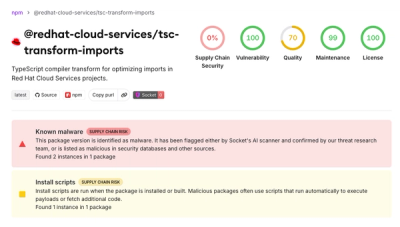
A mini Shai-Hulud campaign compromised Red Hat Cloud Services npm packages to steal developer and CI/CD secrets during installation.

Research
/Security News
The North Korean malware loader hides in a Packagist-listed package and its GitHub branch to fetch and execute remote code in a likely Contagious Interview-style lure.