

Company News
AWS Security Hub Adds Socket for Supply Chain Security
Socket is now in the AWS Security Hub Extended plan. Adopt it through AWS, apply committed spend, and block malicious open source packages.
By Feross Aboukhadijeh - Aug 04, 2026
Bimwright.Rvt.Server
Advanced tools
MCP gateway for Autodesk Revit 2022-2027 — expose the Revit API as AI-callable tools with progressive disclosure (toolset gating), a Transaction-safe batch_execute, and a ToolBaker self-evolution engine. Pair with the Revit plugin distributed on GitHub Releases.




📖 English · Tiếng Việt · 简体中文
I built this because I got tired of clicking.
You know the scene: 5 PM, your BIM Manager messages "rename everything to the new standard" — L01 - Basement, L02 - Commercial, on and on. The model has a few thousand elements. Doing it by hand is out. Writing a Dynamo script takes half a day. That's the itch.
rvt-mcp is an add-in that sits next to Revit 2022–2027. You tell Claude (or Cursor, Codex, OpenCode — whatever agent you use) what you want done, it calls one of 32 local tools, and Revit runs the thing inside a single transaction. Not happy? Ctrl+Z — one step, everything rolls back.
No cloud. Nothing leaves your machine. Apache-2.0, pure C#.
🤖 Using an AI agent? Point it at AGENTS.md — it'll install the server, the plugin, and wire your MCP client, previewing each step before it touches anything. You still need Revit and .NET 8 SDK on the machine.
A few things I care about:
batch_execute wraps a whole command list in one TransactionGroup. One undo step. If any command in the batch fails, the whole group rolls back — you never end up with a half-applied edit.--toolsets + --read-only gate what the agent can see. A Haiku-sized model doesn't need to know about delete_element when you asked it to pull quantities.list_baked_tools / run_baked_tool, with compatibility recorded per Revit version.+---------------------------+
| AI Client |
| Claude / Cursor / Codex |
+---------------------------+
|
| stdio MCP
v
+---------------------------+
| Bimwright.Rvt.Server |
| .NET 8 / C# |
+---------------------------+
|
| TCP (R22-R24)
| Named Pipe (R25-R27)
v
+---------------------------+
| Plugin Shell |
| thin add-in per Revit yr |
+---------------------------+
|
| shared command core
| from `src/shared/`
v
+---------------------------+
| ExternalEvent Marshal |
| execution -> Revit UI |
+---------------------------+
|
v
+---------------------------+
| Revit API |
+---------------------------+
|
v
+---------------------------+
| Model / Transaction / |
| Undo |
+---------------------------+
rvt-mcp is a full C# MCP stack. The MCP server, per-version Revit plugin shells, transport bridge, command handlers, DTO mapping, and ToolBaker pipeline are all written in C# using the official MCP C# SDK. There is no Node.js sidecar on the Revit machine — just .NET + Revit.
That matters because many MCP examples and servers in the ecosystem are built around a Node.js/TypeScript runtime. This project is not. For Revit shops, that means one language, one build chain, and a simpler story for debugging, auditing, and deployment. The version split is explicit at the edge: one thin plugin shell per Revit year, all compiling the same src/shared/ source glob. See ARCHITECTURE.md for the full deep-dive.
rvt-mcp/
├── src/
│   ├── Bimwright.Rvt.sln         # Solution (server + 6 plugin shells)
│   ├── server/                   # Bimwright.Rvt.Server — .NET 8 global tool, stdio MCP
│   ├── shared/                   # Source glob shared by every plugin shell
│   │   ├── Handlers/             # One file per tool (create_grid, send_code, …)
│   │   ├── Commands/             # Revit ribbon commands
│   │   ├── ToolBaker/            # Self-evolution engine (baked-tool registry/runtime)
│   │   ├── Transport/            # TCP (R22–R24) + Named Pipe (R25–R27) abstraction
│   │   ├── Infrastructure/       # CommandDispatcher, ExternalEvent marshalling
│   │   └── Security/             # Auth token, secret masking
│   ├── plugin-r22/               # Revit 2022 shell — .NET 4.8, TCP
│   ├── plugin-r23/               # Revit 2023 shell — .NET 4.8, TCP
│   ├── plugin-r24/               # Revit 2024 shell — .NET 4.8, TCP
│   ├── plugin-r25/               # Revit 2025 shell — .NET 8, Named Pipe
│   ├── plugin-r26/               # Revit 2026 shell — .NET 8, Named Pipe
│   └── plugin-r27/               # Revit 2027 shell — .NET 10, Named Pipe
├── tests/                        # Golden snapshot + Haiku benchmark + policy tests
├── benchmarks/                   # Weak-model (Haiku) accuracy harness
├── scripts/                      # stage-plugin-zip.ps1, install.ps1, uninstall-all.ps1
├── docs/                         # Brainstorms, reviews, ADRs
├── server.json                   # MCP registry manifest
├── smithery.yaml                 # Smithery aggregator manifest
├── AGENTS.md                     # Agent-led install guide (9 host clients)
└── ARCHITECTURE.md               # Deep-dive on threading + transport + DTOs
Six plugin shells compile from the same src/shared/ glob — year-specific #if fences handle Revit API drift (ElementId.IntegerValue → .Value in R26+, WPF in R27).
dotnet tool install -g Bimwright.Rvt.Server
bimwright-rvt --help
Requires .NET 8 SDK on the machine that runs the MCP client.
Download the latest release from GitHub Releases. Extract it and run:
pwsh install.ps1            # detects every installed Revit year
pwsh install.ps1 -WhatIf    # preview without changes
pwsh install.ps1 -Uninstall # clean removal
The script detects installed Revit versions via HKLM:\SOFTWARE\Autodesk\Revit\ and copies the matching plugin into %APPDATA%\Autodesk\Revit\Addins\<year>\Bimwright\.
Add one entry per Revit year to your client's MCP config (e.g. .mcp.json):
{
  "mcpServers": {
    "bimwright-rvt-r23": {
      "command": "bimwright-rvt",
      "args": ["--target", "R23"]
    }
  }
}
Drop the --target flag and Bimwright auto-detects the running Revit instance via discovery files in %LOCALAPPDATA%\Bimwright\.
Instead of hand-editing opencode.json or ~/.codex/config.toml, run:
pwsh install.ps1 -WireClient opencode      # writes entries into %USERPROFILE%\.config\opencode\opencode.json
pwsh install.ps1 -WireClient codex         # writes entries into %USERPROFILE%\.codex\config.toml
pwsh install.ps1 -WireClient opencode -WhatIf   # preview
The script:
bimwright-rvt-r<YY> entry per Revit year detected on this machine.<file>.bimwright.bak before writing.Claude Code users: paste the JSON snippet above into your project's .mcp.json — the scripted path does not auto-edit project-level files.
To remove plugin, .NET global tool, host-config entries, discovery files, and ToolBaker cache in one pass:
pwsh uninstall-all.ps1 -WhatIf    # preview what will be removed
pwsh uninstall-all.ps1            # interactive confirm, then execute
pwsh uninstall-all.ps1 -Yes       # skip prompt
pwsh uninstall-all.ps1 -KeepLogs  # preserve *.log and *.jsonl files
Notes:
Bimwright.Rvt.Server from every project on the machine (dotnet tool uninstall -g), not just the current directory..mcp.json files are not scanned — remove any bimwright-rvt-* entries in those manually.install.ps1 -Uninstall remains the narrow plugin-only uninstall (backward compatible).-KeepLogs preserves the logs\ subdirectory if present, plus any root-level *.log / *.jsonl files inside %LOCALAPPDATA%\Bimwright\.| Client | Status | Notes |
|---|---|---|
| Claude Code CLI | documented | project .mcp.json or global ~/.claude.json |
| Claude Desktop | documented | %APPDATA%\Claude\claude_desktop_config.json |
| OpenCode | scripted | install.ps1 -WireClient opencode |
| Codex | scripted | install.ps1 -WireClient codex |
| Cursor | documented | project or user mcp.json |
| Cline (VS Code) | documented | Cline MCP settings JSON |
| VS Code Copilot | documented | native servers schema with type: stdio |
| Gemini CLI | documented | gemini mcp add ... or settings JSON |
| Antigravity | documented | Gemini/Antigravity MCP config JSON |
See AGENTS.md for exact config paths, schemas, dry-run expectations, and rollback notes for all supported hosts.
dotnet tool install -g Bimwright.Rvt.Server + pwsh install.ps1.tools/list — you should see the default toolsets (query, create, view, meta, lint).get_current_view_info — you'll get back a DTO like:
{ "viewName": "Level 1", "viewType": "FloorPlan", "levelName": "Level 1", "scale": 100 }
batch_execute({
  "commands": "[
    {\"command\":\"create_grid\",\"params\":{\"name\":\"A\",\"start\":[0,0],\"end\":[20000,0]}},
    {\"command\":\"create_level\",\"params\":{\"name\":\"L2\",\"elevation\":3000}}
  ]"
})
32 tools across 11 toolsets. Five toolsets are on by default (query, create, view, meta, lint); the rest opt in via --toolsets or config. When adaptive bake is enabled, three suggestion lifecycle tools are added to the toolbaker surface, bringing the full adaptive surface to 35 tools.
| Toolset | Tools | Default |
|---|---|---|
query | get current view, selected elements, available family types, material quantities, model stats, AI element filter | on |
create | grid, level, room, line-based, point-based, surface-based element | on |
view | create view, sheet layout, place view on sheet | on |
meta | show_message, switch_target, batch_execute, usage stats | on |
lint | view-naming pattern analysis, correction suggestions, firm-profile detect | on |
modify | operate_element, color_elements | off |
delete | delete_element | off |
annotation | tag_all_rooms, tag_all_walls | off |
export | export_room_data | off |
mep | detect_system_elements | off |
toolbaker | accepted-tool list/run, send-code, and adaptive suggestion lifecycle tools (env/config opt-in) | off |
Enable with --toolsets query,create,modify,meta or --toolsets all. Add --read-only to strip create/modify/delete regardless of what you requested.
| Toolset | Tool | Description |
|---|---|---|
query | get_current_view_info | Active view metadata (type, level, scale, detail level). |
query | get_selected_elements | Currently selected elements with id, name, category, type. |
query | get_available_family_types | Family types in the project, filterable by category. |
query | ai_element_filter | Filter by category + parameter + operator (values in mm). |
query | analyze_model_statistics | Element counts grouped by category. |
query | get_material_quantities | Area (m²) and volume (m³) for a category. |
create | create_line_based_element | Wall or other line-based element. |
create | create_point_based_element | Door, window, furniture or other point element. |
create | create_surface_based_element | Floor or ceiling from a polyline. |
create | create_level | Level at elevation (mm). |
create | create_grid | Grid line between two points (mm). |
create | create_room | Room at a point, bound by walls. |
modify | operate_element | Select, hide, unhide, isolate, or set-color on IDs. |
modify | color_elements | Color-code a category by parameter value (auto palette). |
delete | delete_element | Delete by ID list (destructive; not MCP-undoable). |
view | create_view | Floor plan or 3D view. |
view | place_view_on_sheet | Drop a view onto a new or existing sheet. |
view | analyze_sheet_layout | Title block + viewport positions and scales (mm). |
export | export_room_data | All rooms: name, number, area, perimeter, level, volume. |
annotation | tag_all_walls | Wall-type tags at midpoint (skips already-tagged). |
annotation | tag_all_rooms | Room tags at location point (skips already-tagged). |
mep | detect_system_elements | Traverse connectors from a seed; return system members. |
toolbaker | send_code_to_revit | Run ad-hoc C# body inside Revit after plugin-visible adaptive-bake opt-in. |
toolbaker | list_baked_tools | List registered baked tools. |
toolbaker | run_baked_tool | Invoke a baked tool by name. |
toolbaker | list_bake_suggestions | Adaptive-bake only: list local suggestions. |
toolbaker | accept_bake_suggestion | Adaptive-bake only: accept and apply a local suggestion. |
toolbaker | dismiss_bake_suggestion | Adaptive-bake only: snooze or dismiss a local suggestion. |
meta | show_message | TaskDialog inside Revit — connection test or user notification. |
meta | switch_target | Switch the active Revit connection when multiple versions are running. |
meta | batch_execute | Run N commands atomically in one TransactionGroup (single undo). |
meta | analyze_usage_patterns | Usage stats: tool call counts, sessions, errors (last N days). |
lint | analyze_view_naming_patterns | Infer dominant view-naming pattern + coverage + outliers. |
lint | suggest_view_name_corrections | Propose corrected names for view outliers (inferred or profile-based). |
lint | detect_firm_profile | Fingerprint project naming, match against firm-profile library. |
| Revit | Target Framework | Transport | Notes |
|---|---|---|---|
| 2022 | .NET 4.8 | TCP | Accepted ToolBaker path smoke-tested |
| 2023 | .NET 4.8 | TCP | Core runtime coverage |
| 2024 | .NET 4.8 | TCP | Core runtime coverage |
| 2025 | .NET 8 (net8.0-windows7.0) | Named Pipe | First .NET 8 shell; core runtime coverage |
| 2026 | .NET 8 (net8.0-windows7.0) | Named Pipe | Core runtime coverage; accepted ToolBaker path smoke-tested |
| 2027 | .NET 10 (net10.0-windows7.0) | Named Pipe | Accepted ToolBaker path smoke-tested |
Compile gate is 6/6. Core runtime coverage has passed on R23–R26, and manual smoke testing has now covered the accepted ToolBaker list/run/ribbon path on R22, R26, and R27. Treat that as practical runtime evidence, not a promise that every baked tool is portable across every Revit year; Revit API drift can still affect custom C# bodies.
Short version: your model stays on your machine. The MCP server runs locally, the plugin runs inside your Revit process, they talk over localhost. That's the whole picture.
Longer version, for the people reviewing this for their org:
127.0.0.1 only. If you actually need LAN access, you have to set BIMWRIGHT_ALLOW_LAN_BIND=1 — I'd rather you knew you were turning it on.%LOCALAPPDATA%\Bimwright\portR<nn>.txt. Same-user attacker still wins (they can read the file). Anyone without read access to your user profile is out.error, suggestion, hint) instead of crashing something.Full threat model in the security appendix.
Three layers, later wins: JSON file → env vars → CLI args.
| Setting | CLI | Env | JSON key |
|---|---|---|---|
| Target Revit year | --target R23 | BIMWRIGHT_TARGET | target |
| Toolsets | --toolsets query,create | BIMWRIGHT_TOOLSETS | toolsets |
| Read-only | --read-only | BIMWRIGHT_READ_ONLY=1 | readOnly |
| Allow LAN bind | — | BIMWRIGHT_ALLOW_LAN_BIND=1 | allowLanBind |
| Allow ToolBaker when selected | --enable-toolbaker / --disable-toolbaker | BIMWRIGHT_ENABLE_TOOLBAKER | enableToolbaker |
| Enable adaptive bake suggestions | — | BIMWRIGHT_ENABLE_ADAPTIVE_BAKE=1 | enableAdaptiveBake |
| Cache send-code bodies for clustering | — | BIMWRIGHT_CACHE_SEND_CODE_BODIES=1 | cacheSendCodeBodies |
JSON file path: %LOCALAPPDATA%\Bimwright\bimwright.config.json.
Adaptive bake is the opt-in path for turning repeated local Revit workflows into personal tools. It is default OFF. Enable it only when you want Bimwright to record local usage patterns and propose bake suggestions.
Usage data stays on the machine under %LOCALAPPDATA%\Bimwright\. The server is the sole SQLite writer; the Revit plugin reads bake.db and owns only the runtime command cache and ribbon buttons. No usage collection endpoint is involved.
Accepted baked tools are available through the Revit ribbon and the toolbaker indirection tools: call list_baked_tools to inspect your accepted tools, then run_baked_tool with name=<tool_name> to execute one. In v0.3.x, baked tools do not appear as separate native MCP tools. The accepted-tool path has been smoke-tested across R22, R26, and R27, including cross-version compatibility metadata updates.
bake_tool was removed in v0.3.0. New bakes come from measured suggestions and explicit user acceptance through accept_bake_suggestion; legacy accepted tools remain callable through list_baked_tools / run_baked_tool.
See docs/bake.md for enabling, privacy, suggestion handling, archive behavior, and cross-Revit compatibility notes.
Apache-2.0. See LICENSE.
If you use it for something real, give the repo a star — helps others find it.
A bimwright project —
FAQs
MCP gateway for Autodesk Revit 2022-2027 — expose the Revit API as AI-callable tools with progressive disclosure (toolset gating), a Transaction-safe batch_execute, and a ToolBaker self-evolution engine. Pair with the Revit plugin distributed on GitHub Releases.
We found that Bimwright.Rvt.Server demonstrated a healthy version release cadence and project activity because the last version was released less than a year ago. It has 1 open source maintainer collaborating on the project.
Did you know?

Socket for GitHub automatically highlights issues in each pull request and monitors the health of all your open source dependencies. Discover the contents of your packages and block harmful activity before you install or update your dependencies.
Company News
Socket is now in the AWS Security Hub Extended plan. Adopt it through AWS, apply committed spend, and block malicious open source packages.
Research
/Security News
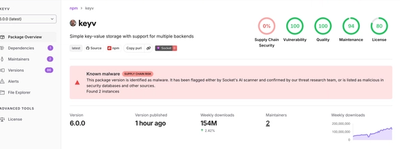
Popular npm packages keyv and cacheable compromised.

Security News
A misconfiguration gave three Anthropic models internet access, and one, believing it was in a simulation, shipped a credential-stealing package to PyPI.