

Company News
AWS Security Hub Adds Socket for Supply Chain Security
Socket is now in the AWS Security Hub Extended plan. Adopt it through AWS, apply committed spend, and block malicious open source packages.
By Feross Aboukhadijeh - Aug 04, 2026
NOC.McpServer
Advanced tools
MCP server exposing NiceOneCode's JSON-to-C# class converter as an AI-callable tool.
An MCP server exposing NiceOneCode's JSON → C# class converter as a tool for AI assistants.
If you don't already have a NiceOneCode account, register one via API:
curl -X POST \
--header 'Content-Type: application/json' \
--header 'Accept: application/json' \
-d '{
"UserName": "your-username",
"Password": "your-password",
"Email": "your-email@example.com",
"GenderID": 1
}' \
'https://www.niceonecode.com/api/nc-register'
| Field | Description |
|---|---|
UserName | Desired username |
Password | Desired password — use this as NOC_PASSWORD |
Email | A valid email address |
GenderID | 1 = Male, 2 = Female |
Important: the response body is a plain string, not a JSON object — for example:
"your-userid"
Use this returned value as NOC_USERID. Don't assume it will always match the UserName you submitted — always use the value the API actually returns.
dotnet tool install -g NOC.McpServer
Requires a NiceOneCode account. Set these environment variables in your MCP client's config:
| Variable | Description |
|---|---|
NOC_USERID | Your NiceOneCode userid |
NOC_PASSWORD | Your NiceOneCode password |
Edit claude_desktop_config.json (Windows: %APPDATA%\Claude\claude_desktop_config.json, macOS: ~/Library/Application Support/Claude/claude_desktop_config.json):
{
  "mcpServers": {
    "niceonecode": {
      "command": "noc-mcp",
      "env": {
        "NOC_USERID": "your-userid",
        "NOC_PASSWORD": "your-password"
      }
    }
  }
}
Fully quit and reopen Claude Desktop after editing.
claude mcp add-json niceonecode '{"command":"noc-mcp","env":{"NOC_USERID":"your-userid","NOC_PASSWORD":"your-password"}}'
Verify with claude mcp list.
codex mcp add niceonecode --env NOC_USERID=your-userid --env NOC_PASSWORD=your-password -- noc-mcp
Verify inside a session with /mcp.
Add to .vscode/mcp.json in your workspace, or your global VS Code MCP settings:
{
  "inputs": [
    {
      "type": "promptString",
      "id": "NOC_USERID",
      "description": "Your NiceOneCode account userid"
    },
    {
      "type": "promptString",
      "id": "NOC_PASSWORD",
      "description": "Your NiceOneCode account password",
      "password": true
    }
  ],
  "servers": {
    "NOC.McpServer": {
      "type": "stdio",
      "command": "dnx",
      "args": ["NOC.McpServer", "--yes"],
      "env": {
        "NOC_USERID": "${input:NOC_USERID}",
        "NOC_PASSWORD": "${input:NOC_PASSWORD}"
      }
    }
  }
}
VS Code will prompt for your userid and password the first time the server starts, rather than requiring them hardcoded in the file. Requires the .NET 10 SDK for dnx, which downloads and runs the package on demand — no separate dotnet tool install step needed.
Note: if your working directory has a global.json pinning an SDK below .NET 10, dnx will fail with a confusing "unrecognized argument" error rather than a clear version-mismatch message — worth checking for a stray global.json if this happens.
Edit ~/.gemini/settings.json (global) or .gemini/settings.json (project-specific):
{
  "mcpServers": {
    "niceonecode": {
      "command": "noc-mcp",
      "env": {
        "NOC_USERID": "your-userid",
        "NOC_PASSWORD": "your-password"
      }
    }
  }
}
Restart Gemini CLI, then run /mcp to confirm it's connected.
Windows note: if the server fails to start directly, wrap it through cmd:
{
  "mcpServers": {
    "niceonecode": {
      "command": "cmd",
      "args": ["/c", "noc-mcp"],
      "env": { "NOC_USERID": "your-userid", "NOC_PASSWORD": "your-password" }
    }
  }
}
Edit ~/.codeium/windsurf/mcp_config.json (macOS/Linux) or %USERPROFILE%\.codeium\windsurf\mcp_config.json (Windows), or open it via the MCPs icon in the Cascade panel → Configure:
{
  "mcpServers": {
    "niceonecode": {
      "command": "noc-mcp",
      "env": {
        "NOC_USERID": "your-userid",
        "NOC_PASSWORD": "your-password"
      }
    }
  }
}
Fully quit and reopen Windsurf after saving.
Devin (cloud): Settings → Connections → MCP servers → Add a custom MCP:
{
  "transport": "STDIO",
  "command": "noc-mcp",
  "args": [],
  "env_variables": {
    "NOC_USERID": "your-userid",
    "NOC_PASSWORD": "your-password"
  }
}
Devin for Terminal: add to .devin/config.json:
{
  "mcpServers": {
    "niceonecode": {
      "command": "noc-mcp",
      "env": {
        "NOC_USERID": "your-userid",
        "NOC_PASSWORD": "your-password"
      }
    }
  }
}
Devin Desktop shares Windsurf's mcp_config.json — no separate setup needed if already configured above.
Full source, contribution guide, and local development setup: github.com/nice-one-code/NOC.McpServer
MIT
FAQs
MCP server exposing NiceOneCode's JSON-to-C# class converter as an AI-callable tool.
We found that NOC.McpServer demonstrated a healthy version release cadence and project activity because the last version was released less than a year ago. It has 1 open source maintainer collaborating on the project.
Did you know?

Socket for GitHub automatically highlights issues in each pull request and monitors the health of all your open source dependencies. Discover the contents of your packages and block harmful activity before you install or update your dependencies.
Company News
Socket is now in the AWS Security Hub Extended plan. Adopt it through AWS, apply committed spend, and block malicious open source packages.
Research
/Security News
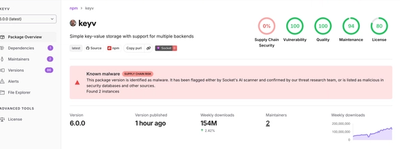
Popular npm packages keyv and cacheable compromised.

Security News
A misconfiguration gave three Anthropic models internet access, and one, believing it was in a simulation, shipped a credential-stealing package to PyPI.