


Company News
AWS Security Hub Adds Socket for Supply Chain Security
Socket is now in the AWS Security Hub Extended plan. Adopt it through AWS, apply committed spend, and block malicious open source packages.
By Feross Aboukhadijeh - Aug 04, 2026
MCP server for Architectural Decision Records (ADRs): navigate, author, validate, link, and analyze decisions on disk.
Every architectural decision, on the record — an MCP server that turns a folder of Markdown ADRs into live tools your AI agent can use: search, author, validate, link, and trace decisions.


🌐 atypical-consulting.github.io/AdrMcp
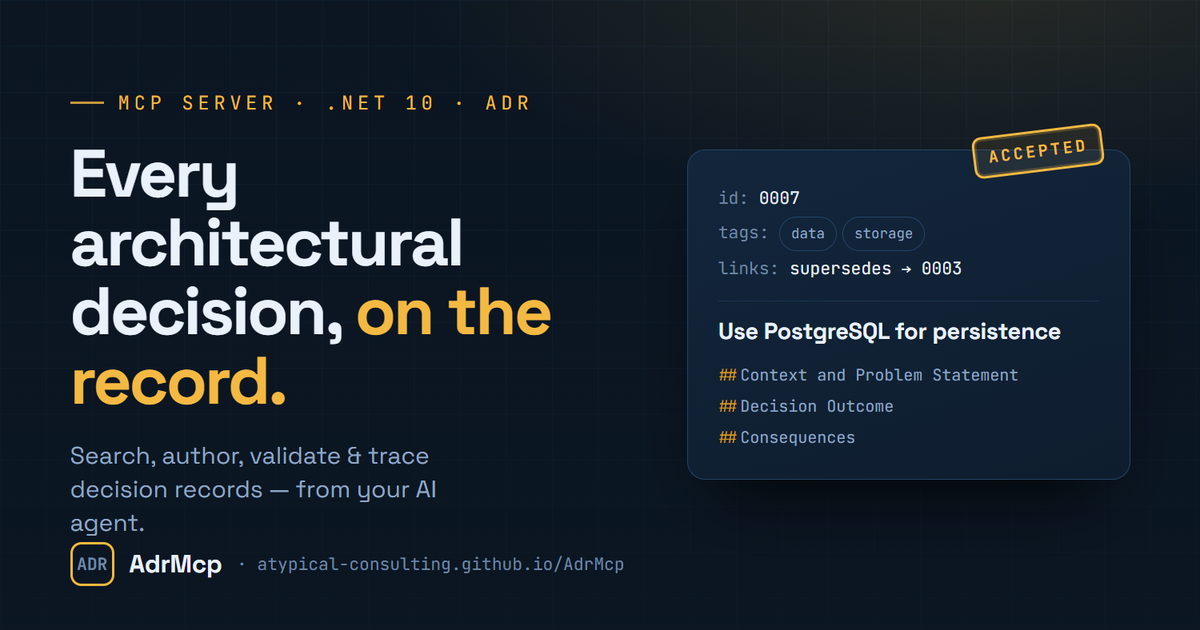
Architectural decisions get made in Slack threads, PR comments, and someone's head — then the
reasoning evaporates. Months later a teammate asks "why is it done this way?", nobody remembers, and
the decision gets silently re-litigated or accidentally reversed. ADRs fix that — if they're
written and kept honest. But a folder of Markdown files is inert: you can't ask it what's still
accepted, trace what superseded what, or notice a decision that no longer matches the code.
It's worse with AI coding agents: the one collaborator that could keep decisions current has no way to read, write, or reason about them.
AdrMcp makes that folder a live surface any MCP client can work. It gives your agent tools to list and search decisions, draft new ones from a MADR template, validate structure and links, supersede a decision while preserving its history, and flag stale or conflicting ones — all preview-by-default, so nothing is written without you seeing the diff.
The records stay plain Markdown in git; AdrMcp adds the tools. Built as a .NET 10 stdio MCP server,
architecturally modeled on RoselineMCP —
layered Tools → Services, [McpServerTool] attributes, shipped as a dotnet tool + Docker image.
ADRs are markdown files under an ADR root (default docs/adr/), one file per decision named
NNNN-kebab-title.md, using MADR 4.0 frontmatter + sections:
---
id: 1
title: Use PostgreSQL for persistence
status: accepted          # proposed | accepted | rejected | deprecated | superseded
date: 2026-07-08
tags: [data]
links:
  - { type: superseded-by, target: 5 }
code_refs:
  - { path: src/Data/Repository.cs, symbol: PostgresRepository }
---

# Use PostgreSQL for persistence

## Context and Problem Statement
...
## Decision Outcome
...
## Consequences
...
Everything is git-native, human-readable, and diff-able — no database.
| Tool | Kind | Description |
|---|---|---|
list_adrs | read | List/filter ADRs (status, tag, date range) |
get_adr | read | Get one ADR; optionally only selected ## sections |
search_adrs | read | Lexical (default) or semantic term-vector search |
get_adr_index | read | The decision log / timeline |
find_related_adrs | read | Incoming/outgoing links + supersession chain |
get_adr_graph | read | Full relationship graph (nodes + typed edges) |
create_adr | write | Create an ADR from a template (madr or nygard) |
update_adr | write | Replace/append a single ## section |
set_status | write | Transition status (enforces the lifecycle) |
supersede_adr | write | Create replacement + mark old superseded + link, in one call |
link_adrs | write | Typed link between two ADRs (adds inverse) |
validate_adr | read | MADR compliance: sections, status, dangling links, duplicate ids |
detect_conflicts | read | Explicit conflicts-with + highly similar accepted ADRs |
find_stale_adrs | read | ADRs whose code_refs no longer resolve |
coverage_report | read | ADR coverage per architectural area (tag); surfaces gaps |
suggest_adr_from_change | read | Draft an ADR proposal from a unified diff |
render_index | write | Regenerate the browsable README.md decision index |
diff_adr | read | Diff two ADRs, or a file vs its canonical rendering |
Writes are preview-by-default. Every mutating tool takes previewOnly (default true) and
returns a unified diff of the intended change; pass previewOnly=false to write to disk.
Resolved in order: CLI arg → env var → default.
| Setting | CLI | Env | Default |
|---|---|---|---|
| ADR root | --adr-root <path> | ADR_ROOT | <repo>/docs/adr |
Repo root (for code_refs) | --repo-root <path> | ADR_REPO_ROOT | current directory |
find_stale_adrs resolves code_refs through an ICodeLinkProvider. The default
FileSystemCodeLinkProvider is language-agnostic (a ref resolves if the file exists and, when a
symbol is given, that symbol's text is present). A Roslyn (.NET) or codebase-memory provider can be
plugged in behind the same interface — deep symbol resolution stays the client's job.
# from source
dotnet run --project AdrMcp -- --adr-root ./docs/adr

# as a global tool
dotnet tool install -g AdrMcp
adr-mcp --adr-root ./docs/adr
{
  "mcpServers": {
    "adr": {
      "command": "adr-mcp",
      "args": ["--adr-root", "/path/to/repo/docs/adr", "--repo-root", "/path/to/repo"]
    }
  }
}
docker build -t adr-mcp .
docker run --rm -i -v "$PWD:/workspace" adr-mcp --adr-root /workspace/docs/adr
Three project skills under .claude/skills/ add the judgment/workflow layer on top of the
MCP tools (the server provides the mechanics; the skills provide the craft). They activate
automatically in Claude Code when the connected AdrMcp server is available:
| Skill | Triggers on | What it does |
|---|---|---|
adr-author | "write an ADR", "record this decision" | Decide if a decision warrants an ADR, frame a sharp Context/Decision/Consequences, draft via create_adr + validate_adr |
adr-review | "review this ADR", "does this decision hold up" | Structural + substantive critique against a rubric, using validate_adr / detect_conflicts |
adr-supersede | "we changed our mind", "retire this decision" | Pick the right lifecycle move and drive supersede_adr / set_status with correct linking |
dotnet build AdrMcp.slnx
dotnet test AdrMcp.slnx        # unit tests + MCP-over-stdio integration tests
dotnet pack AdrMcp/AdrMcp.csproj -c Release -o ./artifacts
CI/CD runs on GitHub Actions, modeled on RoselineMCP:
| Workflow | Trigger | What it does |
|---|---|---|
ci.yml | push / PR to main/dev | Build + test matrix (ubuntu/windows/macos); 80% line-coverage gate on ubuntu |
codeql.yml | push / PR / weekly | CodeQL security analysis (C#) |
pages.yml | push to site/** on dev | Publish the landing page to GitHub Pages |
release-please.yml | push to dev | Maintain a release PR (Conventional Commits); on merge, publish NuGet + MCPB + MCP Registry + GHCR image |
Releases are automated with release-please: merge the release PR it opens to ship. See PUBLISH.md.
AdrMcp/
├── Interfaces/   service contracts (IAdrRepository, ICodeLinkProvider, …)
├── Services/     repository, templates, validation, graph, search, embeddings, code-links
├── Tools/        Navigation / Authoring / Intelligence / Utility MCP tools
├── Models/       Adr, AdrStatus, AdrLink, CodeRef, response DTOs
└── Program.cs    DI wiring + stdio MCP host
FAQs
MCP server for Architectural Decision Records (ADRs): navigate, author, validate, link, and analyze decisions on disk.
We found that AdrMcp demonstrated a healthy version release cadence and project activity because the last version was released less than a year ago. It has 1 open source maintainer collaborating on the project.
Did you know?

Socket for GitHub automatically highlights issues in each pull request and monitors the health of all your open source dependencies. Discover the contents of your packages and block harmful activity before you install or update your dependencies.
Company News
Socket is now in the AWS Security Hub Extended plan. Adopt it through AWS, apply committed spend, and block malicious open source packages.
Research
/Security News
Popular npm packages keyv and cacheable compromised.

Security News
A misconfiguration gave three Anthropic models internet access, and one, believing it was in a simulation, shipped a credential-stealing package to PyPI.