
Research
/Security News
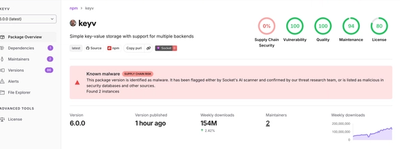
Popular npm Packages in the keyv and Cacheable Namespaces Compromised in Active Supply Chain Attack
Popular npm packages keyv and cacheable compromised.
By Socket Research Team - Aug 04, 2026
agent-harnesses-mcp
Advanced tools
MCP server for best-of-Agent-Harnesses: opinionated harness recommendations (recommend/pick_harness), search, and head-to-head decision guides over a hand-curated, weekly-rescored list of agent harnesses
mcp-name: io.github.RyanAlberts/agent-harnesses
The best-of-Agent-Harnesses list as an MCP server, so agents can recommend harnesses instead of you reading 100+ table rows.
Single file, stdio transport, no clone needed — it fetches harnesses.json from this repo at startup (or reads it locally from a checkout). Requires uv.
Published on PyPI and the official MCP registry as io.github.RyanAlberts/agent-harnesses. Claude Code:
claude mcp add agent-harnesses -- uvx agent-harnesses-mcp
Any other MCP client (Cursor, Codex, Gemini CLI, ...):
{
  "mcpServers": {
    "agent-harnesses": {
      "command": "uvx",
      "args": ["agent-harnesses-mcp"]
    }
  }
}
No-install alternative — run the single source file straight from this repo:
claude mcp add agent-harnesses -- uv run https://raw.githubusercontent.com/RyanAlberts/best-of-Agent-Harnesses/main/mcp/server.py
| Tool | What it does |
|---|---|
recommend(need, language?, must_run_unattended?, open_source_only?) | Opinionated single recommendation — a decision, not a list. Returns one top pick with the reason, up to two alternatives, any harnesses to avoid for this need (archived, or flagged for star manipulation — with why), and the most relevant decision guide to read next. |
pick_harness(use_case, max_complexity?, min_autonomy?, min_recovery?, open_source_only?, limit?) | Ranked recommendations for a use case, seeded by the list's hand-curated use-case index. max_complexity caps adoption surface (super simple → complex); min_autonomy requires a designed autonomy regime (step-gated → headless); min_recovery requires a failure-recovery tier (none → durable). |
compare(github_ids) | Side-by-side of 2–4 harnesses — "should I use X or Y?". Records aligned on the list's axes — including the researched deep-dive axes (sandboxing, context memory, lifecycle hooks, prompt optimization, build-vs-buy tier) — an edge summary naming who leads where, a warning when a requested repo is in the graveyard (archived or integrity-flagged), and the decision guide covering the matchup when one exists. |
compare_for(use_case, limit?, open_source_only?) | Task-based comparison — "compare the best options for X" in one call. Ranks candidates like pick_harness, takes the top 2–4, and returns the full side-by-side with each pick's ranking reason. |
search_harnesses(query, limit?) | Keyword search across names, descriptions, tags, and categories. |
get_harness(github_id) | Full record for one project. |
list_comparisons() | The head-to-head decision guides (OpenClaw vs Hermes, terminal coding agents, …) with summaries. |
get_comparison(slug) | Full markdown of one guide — architecture trade-offs, field reports, billing reality. Always current: served from the repo's main. |
list_categories() | The 10 categories, use-case intents, and the complexity/autonomy/recovery scales. |
Example: "recommend('an always-on personal assistant that lives in my chat apps', open_source_only=True)" → one top pick with the reason, two alternatives, anything to avoid for this need, and the guide to read next.
Example: "compare(['openclaw/openclaw', 'NousResearch/hermes-agent'])" → both records side by side, who leads on which axis, and a pointer to the OpenClaw vs Hermes guide.
Example: "pick_harness('sandboxed code execution for generated code', max_complexity='slightly complex', open_source_only=True)" → E2B, smolagents, Daytona... each with stars, tier, license signal, and a one-line reason.
Data is regenerated by scripts/generate.py; star counts carry a stars_captured date, and the comparisons index is rebuilt from comparisons/*.md on every refresh — the server always serves current main.
The server is packaged as agent-harnesses-mcp (this directory's pyproject.toml) and live in the official MCP registry as io.github.RyanAlberts/agent-harnesses (server.json at the repo root), which directories like Glama and PulseMCP crawl. The registry validates PyPI ownership via the mcp-name: marker at the top of this README — keep it.
Releases are automated by .github/workflows/publish-mcp.yml on a mcp-v* tag: it builds the wheel, publishes to PyPI via trusted publishing, and publishes server.json to the official MCP registry via GitHub OIDC.
One-time setup, then never again:
agent-harnesses-mcp → Settings → Publishing → add a trusted publisher: owner RyanAlberts, repo best-of-Agent-Harnesses, workflow publish-mcp.yml. No API tokens.io.github.RyanAlberts/* namespace automatically.Per release: bump the version in mcp/pyproject.toml and server.json (the workflow fails loudly on mismatch), then git tag mcp-v<version> && git push origin mcp-v<version>.
Directories like Glama, PulseMCP, and mcpservers.org crawl the official registry — no per-directory submissions needed. (Smithery's current publish flow takes hosted-HTTP servers or .mcpb bundles, not stdio-from-GitHub, so this server isn't listed there by design.)
FAQs
MCP server for best-of-Agent-Harnesses: opinionated harness recommendations (recommend/pick_harness), search, and head-to-head decision guides over a hand-curated, weekly-rescored list of agent harnesses
We found that agent-harnesses-mcp demonstrated a healthy version release cadence and project activity because the last version was released less than a year ago. It has 1 open source maintainer collaborating on the project.
Did you know?

Socket for GitHub automatically highlights issues in each pull request and monitors the health of all your open source dependencies. Discover the contents of your packages and block harmful activity before you install or update your dependencies.
Research
/Security News
Popular npm packages keyv and cacheable compromised.

Security News
A misconfiguration gave three Anthropic models internet access, and one, believing it was in a simulation, shipped a credential-stealing package to PyPI.

Security News
/Company News
Socket has joined the new Composer and Packagist sponsorship program as a launch sponsor, supporting the team that keeps PHP's package ecosystem secure.