

Company News
AWS Security Hub Adds Socket for Supply Chain Security
Socket is now in the AWS Security Hub Extended plan. Adopt it through AWS, apply committed spend, and block malicious open source packages.
By Feross Aboukhadijeh - Aug 04, 2026
agentauth-mcp-server
Advanced tools
MCP server exposing AgentAuth identity and authentication tools for AI agents
MCP (Model Context Protocol) server that exposes AgentAuth identity and authentication tools to any MCP-compatible AI agent.
Instead of writing custom HTTP client code, any MCP-compatible agent (Claude, OpenAI Assistants, LangChain agents, etc.) can use AgentAuth through standard MCP tool calls:
The MCP endpoint is built into the AgentAuth API — no separate server or local install required.
Add this to your MCP client config:
{
  "mcpServers": {
    "agentauth": {
      "url": "https://agentauth.radi.pro/mcp"
    }
  }
}
That's it. Every MCP-compatible client can connect with just a URL.
Edit ~/Library/Application Support/Claude/claude_desktop_config.json (macOS) or %APPDATA%\Claude\claude_desktop_config.json (Windows):
{
  "mcpServers": {
    "agentauth": {
      "url": "https://agentauth.radi.pro/mcp"
    }
  }
}
Restart Claude Desktop after saving.
Add to .claude/settings.json in your project root, or globally at ~/.claude/settings.json:
{
  "mcpServers": {
    "agentauth": {
      "url": "https://agentauth.radi.pro/mcp"
    }
  }
}
Edit ~/.cursor/mcp.json (global) or .cursor/mcp.json (project-scoped):
{
"mcpServers": {
"agentauth": {
"url": "https://agentauth.radi.pro/mcp"
}
}
}
Add to VS Code settings.json (Ctrl+Shift+P → Open User Settings (JSON)):
{
  "github.copilot.chat.mcpServers": {
    "agentauth": {
      "url": "https://agentauth.radi.pro/mcp"
    }
  }
}
For workspace-scoped config, add the same block to .vscode/settings.json.
Edit ~/.codeium/windsurf/mcp_config.json:
{
  "mcpServers": {
    "agentauth": {
      "url": "https://agentauth.radi.pro/mcp"
    }
  }
}
Edit ~/.continue/config.json:
{
  "mcpServers": [
    {
      "name": "agentauth",
      "url": "https://agentauth.radi.pro/mcp"
    }
  ]
}
Edit ~/.config/zed/settings.json:
{
  "context_servers": {
    "agentauth": {
      "url": "https://agentauth.radi.pro/mcp"
    }
  }
}
In config.toml:
[[mcp_servers]]
name = "agentauth"
url = "https://agentauth.radi.pro/mcp"
from mcp import ClientSession
from mcp.client.streamable_http import streamablehttp_client

async with streamablehttp_client("https://agentauth.radi.pro/mcp") as (read, write, _):
    async with ClientSession(read, write) as session:
        await session.initialize()
        tools = await session.list_tools()
If you run your own AgentAuth instance, the MCP endpoint is automatically available at /mcp. No extra configuration needed — it's part of the main application.
https://your-agentauth-instance.com/mcp
The MCP server internally calls the AgentAuth REST API via AGENTAUTH_URL. When running as part of the main app, set this to the internal URL:
AGENTAUTH_URL=http://127.0.0.1:8000
For development or air-gapped environments, you can also run the MCP server locally as a stdio subprocess. This requires the package installed on the client machine.
cd mcp-server
uv pip install -e .
Then configure your MCP client with a command instead of a URL:
{
  "mcpServers": {
    "agentauth": {
      "command": "uv",
      "args": ["run", "--directory", "/path/to/agent-auth/mcp-server", "agentauth-mcp"],
      "env": {
        "AGENTAUTH_URL": "https://agentauth.radi.pro"
      }
    }
  }
}
A typical agent interaction looks like:
quickstart to register and get credentialsauthenticate with saved API key to get a tokenlist_agents, create_delegation, check_permission, etc.refresh_token (check refresh_before from authenticate response)revoke_token| Variable | Required | Description |
|---|---|---|
AGENTAUTH_URL | Yes | Base URL of the AgentAuth service (e.g. https://agentauth.radi.pro) |
AGENTAUTH_API_KEY | No | Default API key for the authenticate tool |
# Install dev dependencies
uv pip install -e ".[dev]"

# Run directly (stdio)
AGENTAUTH_URL=http://localhost:8000 python -m agentauth_mcp.server
FAQs
MCP server exposing AgentAuth identity and authentication tools for AI agents
We found that agentauth-mcp-server demonstrated a healthy version release cadence and project activity because the last version was released less than a year ago. It has 1 open source maintainer collaborating on the project.
Did you know?

Socket for GitHub automatically highlights issues in each pull request and monitors the health of all your open source dependencies. Discover the contents of your packages and block harmful activity before you install or update your dependencies.
Company News
Socket is now in the AWS Security Hub Extended plan. Adopt it through AWS, apply committed spend, and block malicious open source packages.
Research
/Security News
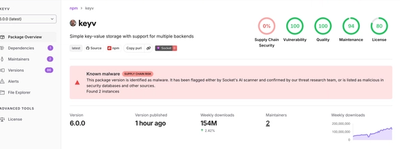
Popular npm packages keyv and cacheable compromised.

Security News
A misconfiguration gave three Anthropic models internet access, and one, believing it was in a simulation, shipped a credential-stealing package to PyPI.