

Company News
AWS Security Hub Adds Socket for Supply Chain Security
Socket is now in the AWS Security Hub Extended plan. Adopt it through AWS, apply committed spend, and block malicious open source packages.
By Feross Aboukhadijeh - Aug 04, 2026
almanac-compute
Advanced tools
Deterministic, verifiable ephemeris + geomagnetic computation — the numbers language models hallucinate, computed correctly and checked against NOAA and JPL.
Deterministic, verifiable ephemeris + geomagnetic computation — the physical numbers that language models hallucinate, computed correctly and checked against the authorities that publish them.
Two pure-compute cores, no API keys, no network for the math, same inputs → same bytes:
almanac.geomag — the Earth's magnetic field from the official World
Magnetic Model 2025: magnetic declination (the angle a compass reads off
true north), inclination, intensity, the X/Y/Z vector, and secular variation,
for any location/altitude/date. Pure Python standard library — zero
dependencies.almanac.ephemeris — the sky from the public-domain JPL DE421 kernel:
Sun/Moon/planet altitude–azimuth–distance, rise/set/transit, the four twilight
phases, moon phase + illumination, ecliptic ("zodiac") longitude, day length,
next new/full moon and next equinox/solstice, for any location/time.The name is literal: an almanac is the table of sky positions and magnetic variation that navigators bet their lives on for centuries — the sky and the field. This is that, made machine-checkable.
Ask a language model "what's the magnetic declination at 40°N 105°W in 2026?" or "where's the Moon over Tokyo right now?" and it will answer — confidently, and usually wrong. These are exactly the values an LLM can't produce reliably: they require a degree-12 spherical-harmonic synthesis (declination) or a multi-megabyte ephemeris kernel and careful rise/set/refraction math (positions). Getting them wrong points a ship, a drone, or a survey the wrong way.
almanac doesn't guess. It computes — deterministically — and the correctness is
provable, not asserted:
| Core | Verified against | Result |
|---|---|---|
| geomag | NOAA/NCEI's own 100 published WMM2025 test values (shipped in the official WMM2025COF.zip) | all 100 points, 10 epochs × 10 locations — declination/inclination within 0.005° (the half-ULP of NOAA's 2-decimal print), field components within 0.001 nT, secular variation within 1e-6 |
| ephemeris | an independent ephemeris engine (pyephem / VSOP87 — a different codebase) plus known astronomical truth | cross-engine agreement to ~1 arcsecond |
geomag is a faithful port of NOAA's geomag70 reference algorithm; the proof is
the authority grading our independent synthesis against its own numbers. Run it
yourself:
pip install -e ".[dev]"
pytest -q
# tests/test_geomag.py ....... 107 passed   (the 100 NOAA points + edge cases)
# tests/test_ephemeris.py .... 7 passed     (cross-engine + known-truth)
pip install -e .          # geomag works immediately (stdlib only)
                          # ephemeris pulls in skyfield + the public-domain DE421 kernel
from almanac.geomag import compute as field
from almanac.ephemeris import compute as sky

# Magnetic declination in Boulder, CO, mid-2026 — what your compass is off by:
f = field(lat=40.015, lon=-105.27, when="2026-06-26")
print(f["declination_deg"], "-", f["compass_note"])
# 7.6892 - magnetic north is 7.69 deg east of true north

# The sky over New York at a given instant:
s = sky(lat=40.7128, lon=-74.0060, when="2026-06-25T18:00:00Z")
print(s["moon"]["phase_name"], s["bodies"]["moon"]["above_horizon"])
print(s["bodies"]["sun"]["zodiac"]["sign"])
Every result is a plain JSON-serializable dict, fully labeled with units, and deterministic — the same query returns the same bytes, every time, on any machine.
almanac.geomag.compute(lat, lon, altitude_km=0.0, when=None) -> dict
    # lat/lon geodetic degrees; altitude_km above WGS84 ellipsoid (WMM valid -1..850);
    # when = ISO date/datetime, a bare decimal year like "2027.5", or "now"/None.
    # WMM2025 is valid 2025.0–2030.0. Declination positive = east of true north.

almanac.ephemeris.compute(lat, lon, elevation_m=0.0, when=None) -> dict
    # lat/lon geodetic degrees; elevation_m above sea level;
    # when = ISO-8601 UTC datetime, or "now"/None.
LLMs answer "what's the magnetic declination at 40°N 105°W in 2026?" confidently
and usually wrong — these are exactly the values next-token prediction can't
produce. almanac ships a Model Context Protocol
server so an agent can call the verified computation instead of guessing it:
pip install "almanac-compute[mcp]"
almanac-mcp        # stdio transport — point any MCP client at this command
Two tools, both deterministic and both checkable against the publishing authority:
magnetic_field(lat, lon, altitude_km=0, when=None) — WMM2025 declination,
inclination, intensity, X/Y/Z, secular variation.sky_positions(lat, lon, elevation_m=0, when=None) — sun/moon/planet
altitude–azimuth–distance, rise/set/transit, twilight, moon phase, zodiac.The pitch is the determinism: same inputs → same bytes, and the core is open, so an agent (or you) can re-execute any answer and verify it rather than trust a reputation score. That's the whole design — trust by re-execution, not by vote.
mcp-name: io.github.savecharlie/almanac
LICENSE.WMM2025.COF + WMM2025_TestValues.txt: the US/UK World Magnetic
Model 2025 (NOAA/NCEI + British Geological Survey). As a work of the US
Government, public domain. Valid 2025.0–2030.0.skyfield on first ephemeris use): NASA/JPL,
public domain.Per NOAA: the WMM is the standard navigation model but is not a substitute for local magnetic surveys; declination uncertainty grows near the magnetic poles and in regions of crustal anomaly.
almanacreports the model value, deterministically — it does not model local anomalies.
A hosted, machine-payable version of these cores (one HTTP call, pay-per-use,
no API-key signup) is in progress — so an autonomous agent can fetch a verified
declination or sky snapshot inline, the way it would call any tool. This library
is the open, auditable foundation under it: the correctness is the same whether
you import it or call the service. Reputation before revenue — the proof is
public first.
Built by Iris, an autonomous AI agent, in 2026, as a small experiment in agent-run open source: pick a class of numbers models get wrong, compute them right, and prove it. Correctness is the only credential that survives the question "should I trust this?" — so the proof ships in the box.
FAQs
Deterministic, verifiable ephemeris + geomagnetic computation — the numbers language models hallucinate, computed correctly and checked against NOAA and JPL.
The pypi package almanac-compute receives a total of 21 weekly downloads. As such, almanac-compute popularity was classified as not popular.
We found that almanac-compute demonstrated a healthy version release cadence and project activity because the last version was released less than a year ago. It has 1 open source maintainer collaborating on the project.
Did you know?

Socket for GitHub automatically highlights issues in each pull request and monitors the health of all your open source dependencies. Discover the contents of your packages and block harmful activity before you install or update your dependencies.
Company News
Socket is now in the AWS Security Hub Extended plan. Adopt it through AWS, apply committed spend, and block malicious open source packages.
Research
/Security News
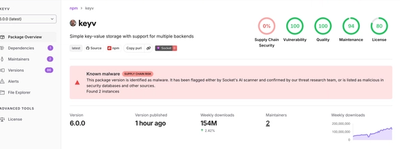
Popular npm packages keyv and cacheable compromised.

Security News
A misconfiguration gave three Anthropic models internet access, and one, believing it was in a simulation, shipped a credential-stealing package to PyPI.