
Research
/Security News
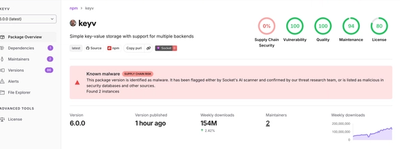
Popular npm Packages in the keyv and Cacheable Namespaces Compromised in Active Supply Chain Attack
Popular npm packages keyv and cacheable compromised.
By Socket Research Team - Aug 04, 2026
backburner-mcp
Advanced tools
An MCP server that lets AI agents run long jobs in the background and collect results later

Put your AI agent's slow work on the back burner. Keep cooking.
Background tasks for AI agents that outlive the conversation — start a long job, close the client, and the result is still waiting when you come back.
Durable & Restart-Proof ◦ Zero Infrastructure ◦ MCP Tasks (2026-07-28) ◦ Windows & Unix
📦 PyPI • 🗂️ MCP Registry • 🐛 Issues • 📄 MIT
io.modelcontextprotocol/tasks). A Tasks-capable client can turn a
start_task call into a durable task and drive it with tasks/get,
tasks/update, and tasks/cancel — the standard async-job protocol — while
the five plain tools keep working for every other client. Built against the
2026-07-28 spec (mcp 2.0).exit_code is no longer reported for cancelled/timed-out tasks
(it was an artifact of the kill, not a real result); new animated demo below.io.github.RohitYajee8076/backburner.backburner is an MCP server that gives any AI assistant — Claude, ChatGPT,
Gemini, GitHub Copilot, Cursor, and any other MCP client — the ability to run
long shell commands as background tasks — start a test suite, a build, a
scrape, a batch job — then keep working and check back for the results, instead
of sitting frozen until it finishes.

Because that lives inside the conversation — it disappears the moment the session ends. Close the chat, restart the client, reboot the laptop, and any in-session background work (and its output) is gone.
backburner keeps every task and its full output on disk (SQLite +
per-task log files under ~/.backburner/), so your work outlives the session
that started it:
interrupted, never silently dropped.See it for yourself — a real two-process proof (no mock-ups):
python docs/demo_restart.py
It starts a job in one process, exits, then a separate process — which never saw the task id — finds the finished work waiting on disk.
Built on the MCP Tasks pattern, formalized in the 2026-07-28 spec release
(SEP-2663):
backburner speaks it natively (tasks/get / tasks/update / tasks/cancel)
and exposes the same engine as plain tools, so it works with every client
today.
| Tool | What it does |
|---|---|
start_task(command, cwd?, timeout_seconds?) | Run a shell command in the background, returns a task id immediately |
task_status(task_id) | working / completed / failed / cancelled / timed_out / interrupted |
task_result(task_id, tail_lines?) | Captured output — works mid-run too, so you can peek at progress |
cancel_task(task_id) | Kill the task and its whole process tree |
list_tasks(limit?) | Recent tasks, newest first |
Survives restarts — tasks are tracked in SQLite under ~/.backburner/;
output is captured to per-task log files. If the server dies mid-task,
orphaned tasks are honestly marked interrupted, never silently lost.
Real cancellation — kills the full process tree (worker processes included), on Windows and Unix.
Peek at live progress — task_result on a running task returns the
output so far.
Timeouts — pass timeout_seconds and a runaway task is killed and
honestly marked timed_out instead of hanging forever.
Command policy — restrict what the AI may run with environment variables (regexes, comma-separated; deny always wins):
BACKBURNER_ALLOW="^pytest,^npm (test|run build)"   # only these may run
BACKBURNER_DENY="rm -rf,shutdown,format"           # these never run
Zero infrastructure — stdlib only (SQLite, subprocess, threads). No Redis, no Celery, no Docker.
Tested — a pytest suite covers the full job lifecycle: completion, failure, cancellation, timeouts, crash recovery, and the command policy.
backburner is a standard stdio MCP server — it works with any MCP-compatible
client, including:
Claude Code · Claude Desktop · OpenAI (ChatGPT desktop / Agents SDK) · Google Gemini (Gemini CLI) · GitHub Copilot (VS Code) · Cursor · Windsurf · Cline · Zed — and any other client that speaks MCP.
First install the package:
pip install backburner-mcp
claude mcp add backburner -- python -m backburner.server
Most clients use the same standard config block — add backburner to your
client's MCP config (see your client's docs for where that file lives):
{
  "mcpServers": {
    "backburner": {
      "command": "python",
      "args": ["-m", "backburner.server"]
    }
  }
}
backburner executes the shell commands the AI sends it, with your user's
permissions. That is its job — but treat it like giving your agent a
terminal. Run it only with clients whose tool-use you review/approve,
prefer permission modes that require confirmation for start_task, and
use BACKBURNER_ALLOW / BACKBURNER_DENY to scope what may run.
pip install backburner-mcptasks/get /
tasks/update / tasks/cancel alongside the plain toolsnotifications/tasks) — live status without pollingMIT
FAQs
An MCP server that lets AI agents run long jobs in the background and collect results later
We found that backburner-mcp demonstrated a healthy version release cadence and project activity because the last version was released less than a year ago. It has 1 open source maintainer collaborating on the project.
Did you know?

Socket for GitHub automatically highlights issues in each pull request and monitors the health of all your open source dependencies. Discover the contents of your packages and block harmful activity before you install or update your dependencies.
Research
/Security News
Popular npm packages keyv and cacheable compromised.

Security News
A misconfiguration gave three Anthropic models internet access, and one, believing it was in a simulation, shipped a credential-stealing package to PyPI.

Security News
/Company News
Socket has joined the new Composer and Packagist sponsorship program as a launch sponsor, supporting the team that keeps PHP's package ecosystem secure.