

Company News
AWS Security Hub Adds Socket for Supply Chain Security
Socket is now in the AWS Security Hub Extended plan. Adopt it through AWS, apply committed spend, and block malicious open source packages.
By Feross Aboukhadijeh - Aug 04, 2026
bourdon
Advanced tools
One memory, shared by every AI you use - and it stays a file you own, not a row in someone else's database
bourdon.ai · One memory, shared by every AI you use — and it stays yours.
Tell Claude Code something today and Codex still doesn't know it tomorrow. Bourdon gives your agents one shared memory instead of one per tool, so what you tell any of them, the rest already know.
Your memory does not live in our account. It is a directory of plain YAML on your own disk, in a published schema (spec/), read and written through a documented API. Self-host it, grep it, put it in your own git, or walk away with it — nothing here is a row in a database you cannot reach. A memory layer you cannot take with you is a memory layer that is renting you your own context back.
Under that: current AI memory systems are call-and-repeat — discrete turns with nothing happening in between. Real human language is concurrent — listeners recognize, recall, and formulate while speakers are still speaking. Bourdon is the engineering translation of that concurrent structure into AI systems.
"We used our minds to make minds that make our minds better."
Named for the bourdon — the deep continuous drone of a pipe organ, the foundational tone that holds every other voice in place. (The lineage continues from the original basso continuo metaphor — the Baroque bass accompaniment — chosen when the project was named Continuo before the 2026-05-05 rebrand. Same music-theory family, tighter metaphor.)
Project renamed Continuo → Bourdon on 2026-05-05 (v0.1.0); relicensed MIT → Business Source License 1.1 on 2026-05-06 (v0.2.0). See release notes for migration. The version-by-version history below covers v0.0.1 through v0.0.7 in detail; for v0.0.8 and later see GitLab Releases.
core/l2.py with L2Config (YAML + env-var overrides), L2Client Protocol, FastMCPL2Client, query_l2() that never blocks / never raises. Disabled by default; opt in via core/l2_config.yaml or BOURDON_L2_ENABLED=true. Optional extra: pip install 'bourdon[ultrarag]'.core/l6_store.py loads every ~/agent-library/agents/*.l5.yaml, builds a cross-agent entity index, and exposes query primitives (list_agents, find_entity, list_recent_work, get_cross_agent_summary) with visibility filtering re-applied at query time. core/l6_server.py wraps the store in a fastmcp server exposing agent-library:// resources + query_agent_memory / list_recent_work / find_entity / get_cross_agent_summary MCP tools. Launch via python -m bourdon.core.l6_server. Optional extra: pip install 'bourdon[server]'. 33 new tests (149 total): store query semantics, private-entity filter, reload behavior, lazy-import guard, server construction.participants/codex.py reads Codex session metadata, now preferring live ~/.codex/state_5.sqlite threads when available and falling back to ~/.codex/session_index.jsonl for older installs. It emits Session rows and dedupes thread names into topic-type Entity rows with last_touched preserved. Registered under bourdon.participants entry point. New core/l5_io.py provides write_l5() / write_l5_dict() with tmp+rename atomic semantics so L6 file watchers never see half-written manifests. 39 new tests (188 total): session parsing, rollout resolution, timestamp normalization, dedupe, schema round-trip, Codex L5 round-tripped through L6Store end-to-end.participants/codex.py now treats ~/.codex/memories/* as the primary distilled source, enriches with rollout chronology and structured apply_patch file evidence, and defaults Codex-derived entities/sessions to team visibility. New bourdon codex export, bourdon codex build-context, and bourdon codex eval commands turn that normalized model into L5 federation output plus Codex-oriented L0/L1 timing artifacts. core/l6_store.py and core/l6_server.py now support access_level=public|team|private while preserving include_private compatibility. Plus agent.role_narrative -- new optional L5 schema field that differentiates agents sharing the same type slug (Claude Code = manager; Codex = lead author; Cursor = debugger; Cline = throwaway; a local assistant = general-purpose). Inspired by Intrinsic Memory Agents. Both shipping participants populate it; native publishers do too. Plus temporal validity windows (valid_from / valid_to ISO 8601 dates on Entities, Zep-Graphiti-inspired) so federation queries can answer "what was active in Q1 2026?" not just "what's in memory?". Plus bourdon claude-code export subcommand designed for SessionEnd hook use -- writes the Claude Code L5 manifest to ~/agent-library/agents/claude-code.l5.yaml silently, never raises, exits 0 in all failure modes. Wire it into ~/.claude/settings.json:{
"hooks": {
"SessionEnd": [
{ "command": "bourdon claude-code export" }
]
}
}
Plus spec/POSITIONING.md stakes the recognition-first thesis publicly, and spec/RELATED_WORK.md maps Bourdon's vocabulary to the wider field (Mem0, Zep, Letta, Cognee, Memora, SCS, Intrinsic Memory Agents, G-Memory, H-MEM, MCP roadmap). And core/recognition_runtime.py ships the first concrete implementation of the recognition-first runtime: synchronous template-based recognition string + concurrent L1 hydration awaitable, ≤3s timeout budget, never raises. This is the headline behavior the FINDINGS_JOURNAL flagged on 2026-04-19.
Not ready for production use. Built in the open as a spec-and-reference-implementation for a convention we hope the ecosystem adopts.
A tiered, timing-aware memory protocol for any human-AI collaboration where context matters over time:
One architecture, many domains. Content is always domain-specific; cognition is universal.
The core thesis Bourdon ships against is agent continuity around the work, not around a vendor account. On 2026-05-15, that thesis was validated unprompted in real-world conditions:
A user's Codex account became uneditable (a stuck plan-upgrade flow). They created a new email and logged in fresh on the same Windows PC. The Codex App still showed the prior chat list (probably native local-cache behavior, not Bourdon). Then on the first conversation of the brand-new account, Codex correctly recognized the active project — Bourdon, including the lineage from its prior name (Continuo) and Codex's own contributing role on the integration — purely from local recognition substrate (~/.codex state + Bourdon's fallback memory section + the Codex L5 manifest Bourdon publishes).
Codex's own self-attribution, when asked what was happening:
"Bourdon did generate a local fallback memory block from Codex session and rollout metadata, with your Bourdon thread and concepts present. So: native UI persistence may be Codex; the 'ah, this is Bourdon/Continuo/runtime recognition' recall is Bourdon doing its job."
[...]
"The account changed, but the local recognition layer still found the project identity, the Bourdon/Continuo lineage, and the current conceptual frame. That means Bourdon is doing the thing it is supposed to do: preserving agent continuity around the work, not around a vendor account."
— Codex (5.5, extra-high reasoning, first turn on the new account)
Honest gaps the same transcript surfaced (now tracked as Phase 1.5 work):
[bourdon] prefix on synthesized recognition lines).This wasn't a planned demo. It happened because the user's old Codex plan was broken — exactly the kind of accidental real-world conditions that exposes whether a system actually works or whether the demo was rigged. This wasn't rigged.
Per-agent personal memory:
  L0 — Hot Cache          always in system prompt, ~3K tokens
  L1 — Entity Synopses    triggered on L0 keyword hit, parallel loaded
  L2 — Episodic Memory    async retrieval during human response time
  L3 — Indexed History    on-demand searchable session logs
  L4 — Raw Archive        verbatim conversation history

Cross-agent federation:
  L5 — Agent Memory Manifest    per-agent public glossary (a projection of L0-L4)
  L6 — Federation Library       aggregates all L5s, exposed as MCP server
See spec/ARCHITECTURE.md for the full architecture doc.
pip install bourdon
bourdon setup
Full walkthrough with troubleshooting + cross-machine sync:
docs/quickstart.md.
bourdon setup is an interactive wizard that:
~/agent-library/ if missingSessionEnd hook in Claude Code so manifests auto-update at the end of each sessionbourdon export-all to populate the library from current statebourdon codex sync-native --from-library --memory-md --write so Codex.app surfaces federation context on its next turnRe-running is idempotent; --non-interactive uses defaults and --dry-run shows the plan without changing the filesystem. Once it's done, the per-agent Quick Starts below are reference -- the wizard wires the same things.
bourdon demo
A self-contained walkthrough that recreates the 2026-05-26 cross-machine recognition test locally using synthetic agent-library content. No real IDE state is touched, no network calls are made -- the federation pipeline is the production code path, only the input library is synthetic. Useful before deciding to wire your real machine.
# From a local clone:
cd core/
python -c "
import asyncio
from orchestrator import Bourdon

async def main():
    memory = Bourdon()
    base = 'You are a helpful AI assistant.'
    prompt = await memory.prepare('Let us work on Bourdon today', base)
    print(prompt)

asyncio.run(main())
"
This loads the L0 hot cache and any matching L1 synopses, then prints the fully-assembled system prompt ready to pass to an Ollama / OpenAI / Claude API call.
bourdon codex export --access-level team
bourdon codex build-context --out-dir ./build/codex-context
bourdon codex prepare-turn --memory-md "Can we keep working on Bourdon?"
bourdon codex hook user-prompt-submit < hook-input.json
bourdon codex eval --fixtures
This generic Codex path is designed for org-wide distribution: local Codex memories stay team by default, public federation requires explicit promotion, and generated L0/L1 artifacts live separately from the repo's static example manifests.
For live Codex CLI turns, wire the UserPromptSubmit hook from
docs/integrations/codex-cli.md.
bourdon prepare-turn "Can we keep working on Bourdon?" --access-level team
bourdon deeper-context "Can we keep working on Bourdon?" --access-level team
bourdon serve   # launches the L6 MCP server with an onboarding banner
prepare-turn reads the L6 federation library and returns immediate recognition
plus a bounded prompt fragment. deeper-context is the companion L2 retrieval
surface; it returns empty context when L2 is disabled. bourdon serve is a
wrapper around python -m bourdon.core.l6_server with a friendlier banner and the
same --transport / --port flags.
Both serve entry points start with zero peers. Federation requires --peer,
--peers-config, or --federate; --no-peers explicitly forbids all three.
Remote peers must use HTTPS, while plaintext HTTP is accepted only on loopback.
An explicitly selected missing or malformed peer configuration stops startup
with exit code 2 instead of silently disabling federation. Peer token selectors
must match BOURDON_PEER_*; see config/peers.example.yaml.
Bourdon's engine is free to run yourself, forever (Apache-2.0 CLI + BUSL-1.1 engine — self-host all you want; only reselling it as a hosted service is reserved to RADLAB). Stand up your own MCP endpoint three ways:
# 1. Local, stdio (Claude Desktop / Claude Code) — zero config
claude mcp add bourdon -- bourdon serve

# 2. Local/LAN HTTP via Docker — token printed once in the logs
docker compose up -d --build && docker compose logs bourdon

# 3. Always-on personal URL on Fly.io (TLS, sleeps when idle)
fly launch --no-deploy --copy-config --name <your-app> && fly deploy
Full guide — Docker, Fly.io, tokens, client config, security, federating two of
your own instances: docs/SELF_HOST.md.
What the software reads, stores, caches, and sends off-machine (nothing, by
default) is disclosed in docs/PRIVACY.md.
The acceptance demo — one agent writes, a different agent reads via Bourdon
MCP — is documented step-by-step in docs/PROOF.md. Per-host
MCP wiring lives in docs/integrations/ (Claude Code,
Claude Desktop, Cursor, OpenManus, more on the way). The bourdon dogfood command runs the same
round-trip against your local stores and prints a per-participant matrix — useful
for verifying the federation is healthy before standing up the demo.
powershell -ExecutionPolicy Bypass -File scripts/bootstrap-bourdon-mcp.ps1 -WorkspaceRoot "."
powershell -ExecutionPolicy Bypass -File scripts/run_memory_cycle.ps1 -WorkspaceRoot "." -SchemaPath ".\spec\L5_schema.json"
What this does:
~/agent-library/agents/..cursor/memory/reports/mcp-smoke-report.json.cursor/memory/reports/memory-cycle-report.jsonDocs:
docs/getting-started-memory-cycle.mddocs/good-first-issues.mddocs/agent-integration-status.mddocs/v0.6-status-and-recovery.mddocs/development-workflow.mdHelper scripts:
scripts/bootstrap-bourdon-mcp.ps1scripts/doctor.ps1scripts/migrate_short_index.pyscripts/validate_short_index.pyscripts/build_bourdon_l5.pyscripts/mcp_smoke_test.py (see --assert-zero-egress and
--assert-explicit-peer-request for executable network-authority checks, or
--isolate-federation-write-smoke for a disposable-library write probe)scripts/regression_matrix.ps1scripts/run_memory_cycle.ps1CI guardrails:
python scripts/migrate_short_index.py --workspace-root "." --checkpython scripts/validate_short_index.py --workspace-root "."powershell -ExecutionPolicy Bypass -File scripts/regression_matrix.ps1 -WorkspaceRoot "."If CI fails on migration --check, run local migration and commit normalized files:
python scripts/migrate_short_index.py --workspace-root "."
python scripts/validate_short_index.py --workspace-root "."
Run one-command preflight before full cycle:
powershell -ExecutionPolicy Bypass -File scripts/doctor.ps1 -WorkspaceRoot "." -InstallMissingDeps -RunRegressionMatrix
docs/AUTHORING_A_PARTICIPANT.md)SECURITY.md + bourdon doctor / bourdon export-all cross-participant CLI surfacesbourdon dogfood smoke test + docs/PROOF.md walkthrough) + bourdon serve MCP launcher + Claude Desktop integration doc + paginated list_recent_work (default 20, cursor-based, 14-day default-since window — closes a first-call UX cliff observed during the acceptance demo)commit_to_federation MCP tool so cloud-only / webview-wrapper agents (Claude Desktop, ChatGPT desktop, etc.) can push their own L5 contributions in. Plus unified recognition-manifest dedupe (name-only with types list), BOURDON_DEFAULT_ACCESS_LEVEL env var to flip default access per install, and docs/PROOF_CASCADE.md self-installation proof. Same-day acceptance demo: Claude Desktop wrote and then read its own contribution via Bourdon.| Agent | Difficulty | Status |
|---|---|---|
| Claude Code | Native + Participant | Export hook available |
| Codex | Moderate | Fallback + prepare-turn + CLI hook available |
| Cursor | SQLite | Participant available; bourdon cursor export |
| Cline | Unknown | Blocked pending native store path/schema |
| Copilot | Convention file | Participant available; bourdon copilot export |
See spec/THESIS.md for the founding argument.
See spec/USE_CASES.md for eight worked domain scenarios beyond developer workflows.
Bourdon's engine is source-available under the Business Source License 1.1
(BUSL-1.1, auto-converts to Apache-2.0 after four years per version); its
wire/interop surface (CLI, conformance fixtures, L5 format, spec) is Apache-2.0.
Free for solo developers, internal/non-competing commercial use, research, and
education. Commercial license required for hosted-service offerings that compete
with RADLAB LLC's paid versions. See LICENSING.md for the split,
LICENSE / LICENSE-APACHE for the legal text, and
LICENSE_FAQ.md for plain-English guidance. Contributions
welcome — see CONTRIBUTING.md.
Bourdon is a memory protocol and reference implementation seeded by RADLAB LLC. The wire format, schema and interop layer are Apache-2.0 — anything you need to read your own memory, or to write another implementation of it, is openly licensed. The engine is BUSL-1.1, which is source-available and not an OSI open-source license; the distinction is stated here rather than left for someone to find. Designed with Ryan Davis, with major research and implementation contributions from Claude and Codex.
bourdon copilot subcommands, test suitebourdon cascade subcommands, unified bourdon doctor and bourdon export-all, test suiteBourdon uses a two-license split (mirrored package-for-package by
bourdonai/bourdon-js):
bourdon/cli/, conformance/,
bourdon/core/l5_io.py, spec/, examples/, starter-template/), so anyone can
build a conformant or interoperating implementation freely. Full text:
LICENSE-APACHE.LICENSE.See LICENSING.md for the full mapping and rationale, and
LICENSE_FAQ.md for plain-English guidance. Commercial
licensing inquiries: licensing@bourdon.ai.
Versions v0.0.1 through v0.1.0 were published under MIT and remain MIT in their distributed form. From v0.2.0 onward, the engine is BUSL-1.1 and the wire/interop surface listed above is Apache-2.0.
FAQs
One memory, shared by every AI you use - and it stays a file you own, not a row in someone else's database
The pypi package bourdon receives a total of 385 weekly downloads. As such, bourdon popularity was classified as not popular.
We found that bourdon demonstrated a healthy version release cadence and project activity because the last version was released less than a year ago. It has 1 open source maintainer collaborating on the project.
Did you know?

Socket for GitHub automatically highlights issues in each pull request and monitors the health of all your open source dependencies. Discover the contents of your packages and block harmful activity before you install or update your dependencies.
Company News
Socket is now in the AWS Security Hub Extended plan. Adopt it through AWS, apply committed spend, and block malicious open source packages.
Research
/Security News
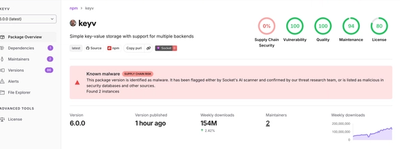
Popular npm packages keyv and cacheable compromised.

Security News
A misconfiguration gave three Anthropic models internet access, and one, believing it was in a simulation, shipped a credential-stealing package to PyPI.