

Product
PHP and Composer Support Is Now in Beta
Socket’s PHP and Composer support is now in Beta for all customers, with PHP reachability analysis generally available.
By Trevor Norris, Benjamin Barslev - Aug 21, 2026
chemglyph
Advanced tools
Publication-quality chemical structure and reaction rendering for AI agents. ChemGlyph is the KaTeX of chemistry: a rendering layer, a validation layer, and an MCP interface on top of RDKit.

pip install chemglyph
import chemglyph

result = chemglyph.render_molecule("c1ccccc1")  # benzene
open("benzene.svg", "w").write(result.data)
render_molecule takes SMILES, InChI, or molblock and returns SVG (or PNG)
plus canonical_smiles, mol_formula, mol_weight, and warnings.
Three styles, same molecule (benzoic acid, caffeine, (S)-ibuprofen):

chemglyph.render_molecule(smiles, style="acs")  # black/white, ACS journal
chemglyph.render_molecule(smiles, style="modern")  # colored heteroatoms, screens
chemglyph.render_molecule(smiles, style="textbook-cn")  # bold monochrome, textbook
All styles default to a transparent background (transparent=True) and
support fmt="png".
spec = {
    "steps": [
        {
            "reactants": ["OC(=O)c1ccccc1O", "CC(=O)OC(C)=O"],
            "products": ["CC(=O)Oc1ccccc1C(=O)O", "CC(=O)O"],
            "conditions": {"above": "H₂SO₄ (cat.)", "below": "rt, 15 min"},
            "yield": "89%",
            "arrow": "forward",
        }
    ],
    "style": "modern",
}
svg = chemglyph.render_reaction(spec)
Conditions are pre-formatted Unicode text, so pass H₂SO₄, not H2SO4.
ChemGlyph does not parse formulas out of text. The full schema
(multi-step chains, equilibrium and retro arrows, line wrapping) is in
docs/reaction_schema.md.
The aspirin demo writes a two-step route:
python examples/aspirin_synthesis.py # writes examples/aspirin_synthesis.svg
validate_structure reports parse errors and applies four quick fixes:
unmatched brackets and ring closures (reported, not guessed), kekulization
failures of lowercase aromatic atoms, and nitrogen valence errors via a
formal [N+]. Anything else passes RDKit's message through unchanged.
report = chemglyph.validate_structure("c1cccc1")
report.fixes[0].description  # 'lowercase aromatic atoms could not be kekulized...'
report.fixes[0].fixed_smiles  # 'C1CCCC1'
chemglyph.parse_name("aspirin") # 'CC(=O)Oc1ccccc1C(=O)O'
English IUPAC and common names resolve offline through OPSIN
(pip install 'chemglyph[opsin]', plus a Java runtime). Chinese names use
the built-in dictionary, and the library API accepts a translator callable
for names that are not in it:
chemglyph.parse_name("阿司匹林")  # 'CC(=O)Oc1ccccc1C(=O)O'
chemglyph.parse_name("六甲基苯", translator=to_english)
ChemGlyph itself never calls an online service, including for translation.
Run the bundled console script (stdio transport):
chemglyph-mcp
Claude Desktop registration (macOS:
~/Library/Application Support/Claude/claude_desktop_config.json):
{
  "mcpServers": {
    "chemglyph": {
      "command": "chemglyph-mcp"
    }
  }
}
| Tool | Use it when | Returns |
|---|---|---|
render_molecule | the user asks to draw one structure from SMILES/InChI/molblock | PNG image plus formula, MW, warnings (SVG source on request) |
render_reaction | the user asks for a reaction or synthesis route | PNG image of the reaction scheme |
validate_structure | a SMILES may be malformed and you need a repair | validation report JSON |
parse_name | the user gives a name like "aspirin" instead of SMILES | canonical SMILES or an error |
One thing to know about clients. Some MCP clients, LM Studio included, only
pass the text part of a tool result to the model and never display the
attached image. The render tools write their PNG to ~/Downloads/chemglyph/
and return that path in the text, so you can always open the file yourself.
If a model claims it rendered a figure but nothing shows up, ask it for the
saved path rather than having it redraw the structure by hand.
benchmarks/ holds the fixed 20-molecule blind test and a generator that
writes shuffled, numbered PNG/SVG figures plus answer_key.json:
python benchmarks/generate_blind_test.py --seed 1234
Pass criteria: two or three chemical practitioners blind-pick the figures they would publish; ChemGlyph passes at 40% or higher. Ferrocene and the free-base porphyrin are excluded from the denominator and recorded as known limitations. The procedure is documented in benchmarks/RUNBOOK.md.

Blind test vs ChemDraw: pending. The image above compares ChemGlyph modern
with RDKit's stock output; ChemDraw panels are added by hand during the
review, and the image is regenerated afterwards.
No structure editor GUI (Ketcher/ChemDraw competition), no 3D visualization, no retrosynthesis or property prediction, no online database queries, and no automatic mechanism generation. The full list is in the project specification.
python -m venv .venv
.venv/bin/pip install -e ".[dev]"
.venv/bin/ruff check . && .venv/bin/ruff format . && .venv/bin/pytest
Python 3.11+, RDKit 2024.9+, MIT license. All errors derive from
chemglyph.errors.ChemGlyphError.
FAQs
Publication-quality chemical structure & reaction rendering for AI agents
The pypi package chemglyph receives a total of 265 weekly downloads. As such, chemglyph popularity was classified as not popular.
We found that chemglyph demonstrated a healthy version release cadence and project activity because the last version was released less than a year ago. It has 1 open source maintainer collaborating on the project.
Product
Socket’s PHP and Composer support is now in Beta for all customers, with PHP reachability analysis generally available.
Product
Socket is bringing experimental protection to Firefox, scanning 97,000+ extensions in Mozilla's official directory for malware and risky updates.
Research
/Security News
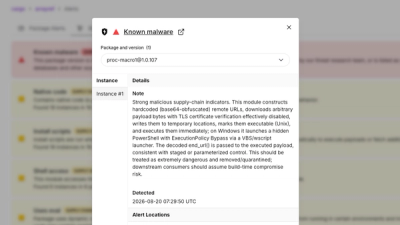
Three compromised Rust crates pulled in a malicious dependency that downloaded and executed cross-platform malware during Cargo builds.