

Company News
AWS Security Hub Adds Socket for Supply Chain Security
Socket is now in the AWS Security Hub Extended plan. Adopt it through AWS, apply committed spend, and block malicious open source packages.
By Feross Aboukhadijeh - Aug 04, 2026
cokodo-agent
Advanced tools
AI Agent Collaboration Protocol Generator - Create standardized .agent protocol for your projects
A CLI tool and MCP server for the AI Agent Collaboration Protocol (.agent). Generate, lint, sync, and serve standardized project context to any MCP-compatible IDE.
Similar to create-react-app, this tool helps you quickly set up an .agent directory with best practices for AI-assisted development.
v1.9.0+ adds spec-driven change units under .agent/project/changes/ (co change new | list | status), aligned with the planning workflow popularized by OpenSpec (proposal / specs / design / tasks). We are grateful to the OpenSpec project for the inspiration; our implementation stays Python-native and integrated with MCP and session state (status.md). See the main repo README and .agent/project/research/openspec-analysis.md for the full rationale.
v1.11.0+ (protocol 3.3.0) adds Agent Git/PR collaboration templates: project/AGENT-GIT-PR-WORKFLOW.md and project/sop/agent-git-pr-collaboration.md (PR tracks, journal.d workflow, merge gates). Run co scaffold -y on existing projects and co adapt all to refresh IDE rules. See docs/usage-guide.md § Agent Git and PR collaboration.
# Default install (CLI + MCP server support)
pip install cokodo-agent

# With network fetch (GitHub release). Omit for offline-only use.
pip install cokodo-agent[network]

# Or use pipx (recommended)
pipx install cokodo-agent
pipx install "cokodo-agent[network]"   # if you need co init to fetch from GitHub
Dependencies: Default install includes MCP support for co serve. It does not include httpx; use co init --offline or install with [network] to fetch the latest protocol from GitHub.
# Navigate to your project
cd my-project

# Run the generator (any of these commands work)
co init           # Short alias
cokodo init       # Full name
cokodo-agent init # Package name

# Or specify a path
co init ./new-project
$ co init

  Cokodo Agent v1.9.14
  ====================

  Fetching protocol...
    OK Protocol v3.0.0

? Project name: my-awesome-app
? Brief description: A task management web application

? Primary tech stack:
  > Python
    Rust
    Qt/C++
    Mixed
    Other

? AI tools to configure (at least one required):
  [x] Cokodo (Protocol Only)    # Default - only .agent/
  [ ] Cursor
  [ ] GitHub Copilot
  [ ] Claude Projects
  [ ] Gemini Code Assist

  Generating .agent/
  OK Created .agent/

  Success! Created .agent in /path/to/my-awesome-app

  Next steps:
    1. Review .agent/project/context.md
    2. Start coding with AI assistance!
# Use defaults, skip prompts (Cokodo mode - protocol only)
co init --yes

# Specify options directly
co init --name "my-app" --stack python -y
| Command | Description |
|---|---|
co init [path] | Create .agent in target directory |
co adapt <cursor|claude|copilot|cline|gemini|codex|all> [path] | Generate IDE entry files from existing .agent |
co mcp snippet cline [path] | Show Cline MCP snippet path (--show prints JSON) |
co mcp install cline [path] | Merge cokodo-agent into Cline MCP settings (--dry-run, --target, -y) |
co detect [path] | Detect IDE instruction files (read-only) |
co import [path] | Import rules from IDE files into .agent/project/ |
co lint [path] | Check protocol compliance |
co diff [path] | Compare local .agent with latest protocol |
co sync [path] | Sync local .agent with latest protocol |
co upgrade [path] | Run sync -> scaffold -> adapt(existing) in one step |
co context [path] | Get context files based on stack and task |
co status [path] | View or update project status |
co ref <action> | Manage cross-project references (list/add/remove/check/fetch/cache) |
co collab <action> | Manage collaborations (list/add/remove/status/diff/pull) |
co global <action> | Manage global project registry (list/info/status/search/gc/unregister) |
co serve [path] | Start MCP server (add --workspace for multi-project, --global for registry) |
co shared <action> | Manage the machine-wide shared MCP daemon and version store |
co journal [path] | Record a session entry to session-journal.md |
co journal-flush [path] | Flush fragment files into status.md (trim to cap, archive overflow) |
co branch start [branch] | Fetch trunk and create a task branch (--topic, --prefix, --dry-run) |
co branch cleanup [branch] | Mandatory post-merge cleanup — delete local + remote head |
co git hygiene | List merged remote branches not deleted; --apply --no-dry-run to clean up |
co policy <action> | Manage policy-as-code: check / install-hook / doctor |
co release <action> | Release helpers: plan (derive next version) / draft-note (generate release note skeleton) |
co release-docs check [path] | Gate: verify release-doc placeholders are filled for a version-governance track. Exit 0 = pass, 1 = fail, 2 = fatal. |
co release-docs refresh [path] | Print the canonical agent prompt to refresh release documentation (audit or apply mode). |
co prepare-release [path] --track | Move a track into release preparation (supports --auto to derive version + note) |
co cut-release [path] --track | Mark a track as released after the release flow |
co start-next-version [path] --track --version | Open the next working version |
co open-next-version [path] --track --version | Post-release: open the next iteration draft |
co update-checksums [path] | Update bundled manifest.json checksums (maintainer) |
co version | Show version information |
co init| Option | Description |
|---|---|
--yes, -y | Skip prompts, use defaults |
--name | Project name |
--stack | Tech stack (python/rust/qt/mixed/other) |
--force | Overwrite existing .agent directory |
--online | Fetch latest protocol from GitHub Release (default: use bundled) |
co lint| Option | Description |
|---|---|
--rule, -r | Check specific rule only |
--format, -f | Output format (text/json/github) |
co context| Option | Description |
|---|---|
--stack, -s | Tech stack (python/rust/qt/mixed) |
--task, -t | Task type (coding/testing/review/documentation/bug_fix) |
--output, -o | Output format (list/paths/content) |
co journal| Option | Description |
|---|---|
--title, -t | Session title (e.g., "Feature X implementation") |
--completed, -c | Completed items (comma-separated) |
--debt, -d | Technical debt items (comma-separated) |
--decisions | Key decisions made (comma-separated) |
--interactive, -i | Interactive mode with prompts |
co journal-flush| Option | Description |
|---|---|
--cap | Max items to keep in status.md (default: 5) |
--for-release | Archive all items under a version header (e.g. v1.9.15) |
--dry-run | Preview changes without writing files |
cokodo-agent includes a built-in MCP (Model Context Protocol) server that exposes .agent/ project context to any compatible IDE. MCP support is included in the default install (pip install cokodo-agent); no extra step required.
Cursor (.cursor/mcp.json):
{
  "mcpServers": {
    "cokodo-agent": {
      "command": "co",
      "args": ["serve", "--shared-launcher"]
    }
  }
}
Claude Code (.mcp.json):
{
  "mcpServers": {
    "cokodo-agent": {
      "command": "co",
      "args": ["serve", "--shared-launcher"],
      "type": "stdio"
    }
  }
}
VS Code (.vscode/mcp.json):
{
  "servers": {
    "cokodo-agent": {
      "command": "co",
      "args": ["serve", "--shared-launcher"],
      "type": "stdio"
    }
  }
}
Generated IDE configs now use co serve --shared-launcher by default so multiple IDE sessions can share one machine-wide daemon while still talking stdio locally.
co shared start
co shared status
co shared install-version 1.9.14
co shared use-version 1.9.14
co shared import-runtime C:/Python311/python.exe
| Tool | Description |
|---|---|
get_project_context | Get context files based on stack and task type |
update_status | Update project status with tasks, blockers, context |
lint_protocol | Run protocol compliance check |
list_files | List all .agent/ files with loading layers |
list_relations | List cross-project references and collaborations |
get_related_context | Read content from references (local or remote) |
get_collaboration_context | Get shared content from collaboration partners |
get_collaboration_status | Check collaboration sync status |
fetch_remote_references | Fetch/refresh remote git references |
check_relation_health | Verify all relationships are accessible |
list_global_projects | List all cokodo projects registered on this machine |
get_global_project_context | Get context files from any registered project by name or ID |
get_global_project_status | Get status.md from any registered project |
global_search | Search across all registered projects by keyword (name/stack/status) |
Serve multiple projects from a parent directory:
co serve --workspace /path/to/workspace
Adds workspace-level tools: list_workspace_projects, workspace_get_context, workspace_get_status, workspace_read_file, workspace_list_relations, workspace_health_check.
Serve all cokodo projects registered on this machine, without needing to be inside a specific project directory:
co serve --global
Projects are registered automatically each time any co command is run inside a directory that has .agent/. No manual registration needed.
cokodo-agent maintains a local registry of all cokodo projects at ~/.cokodo/cokodo.db (SQLite). Registration is automatic — run any co command in a project to register it.
co global list                  # List all registered projects
co global info <name>           # Show full details for a project
co global status <name>         # Show status.md for a project
co global search <keyword>      # Search by name, stack, or status
co global gc                    # Remove stale entries (deleted projects)
co global unregister <name>     # Remove a project from registry
When the MCP server is running (any mode), the AI can query all registered projects:
list_global_projects            → discover all projects on this machine
get_global_project_context      → load .agent/ context from any project
get_global_project_status       → read status.md from any project
global_search "keyword"         → find projects by name, stack, or status
The tool fetches the latest protocol from multiple sources with fallback:
| Priority | Source | Description |
|---|---|---|
| 1 | GitHub Release | Latest version from repository |
| 2 | Built-in | Bundled version in package |
Only generates .agent/ directory:
my-project/
+-- .agent/                     # Protocol directory
    +-- start-here.md           # * Entry point
    +-- quick-reference.md      # Cheat sheet
    +-- core/                   # Governance rules
    +-- project/                # Project-specific (customized)
    +-- skills/                 # Skill modules
    +-- adapters/               # Tool adapter templates
    +-- scripts/                # Helper scripts
Run co adapt <tool> (or co adapt all) in a project that already has .agent/. Generated files follow each IDE’s official spec:
For the most common post-upgrade flow, use co upgrade -y to sync .agent/, scaffold any newly required project/ files, and refresh the IDE adapters already present in the repo.
| Tool | Generated File |
|---|---|
| Cursor | .cursor/rules/agent-protocol.mdc (YAML frontmatter) |
| Claude Code | CLAUDE.md (project root) |
| GitHub Copilot | AGENTS.md (project root) |
| Gemini Code Assist | GEMINI.md (project root, supports @file imports) |
| Variable | Description |
|---|---|
COKODO_OFFLINE | Force offline mode (1 or true) |
COKODO_CACHE_DIR | Custom cache directory |
COKODO_HOME_DIR | Custom home directory (default: ~/.cokodo/) |
Downloaded protocols and the project registry are stored at:
~/.cokodo/ (cache at ~/.cokodo/cache/)~/.cache/cokodo/ is migrated automatically on first run# Clone repository
git clone https://github.com/dinwind/agent_protocol.git
cd agent_protocol/cokodo-agent
# Install in development mode
pip install -e ".[dev]"
# Run tests
pytest
MIT License - see LICENSE for details.
FAQs
AI Agent Collaboration Protocol Generator - Create standardized .agent protocol for your projects
We found that cokodo-agent demonstrated a healthy version release cadence and project activity because the last version was released less than a year ago. It has 1 open source maintainer collaborating on the project.
Did you know?

Socket for GitHub automatically highlights issues in each pull request and monitors the health of all your open source dependencies. Discover the contents of your packages and block harmful activity before you install or update your dependencies.
Company News
Socket is now in the AWS Security Hub Extended plan. Adopt it through AWS, apply committed spend, and block malicious open source packages.
Research
/Security News
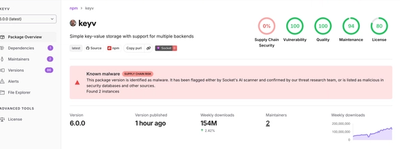
Popular npm packages keyv and cacheable compromised.

Security News
A misconfiguration gave three Anthropic models internet access, and one, believing it was in a simulation, shipped a credential-stealing package to PyPI.