

Company News
AWS Security Hub Adds Socket for Supply Chain Security
Socket is now in the AWS Security Hub Extended plan. Adopt it through AWS, apply committed spend, and block malicious open source packages.
By Feross Aboukhadijeh - Aug 04, 2026
cronometer-api-mcp
Advanced tools


Hosted version for Claude.ai, ChatGPT, and Grok coming soon. Join the waitlist →
An MCP (Model Context Protocol) server for Cronometer nutrition tracking, built on the reverse-engineered mobile REST API.
Unlike cronometer-mcp, which takes a comprehensive GWT-RPC approach against Cronometer's web backend, this server talks to the same JSON REST API used by the Cronometer Android app -- with clean payloads and stable, versioned endpoints.
curl -LsSf https://astral.sh/uv/install.sh | sh
export CRONOMETER_USERNAME="your@email.com"
export CRONOMETER_PASSWORD="your-password"
Diary entries are stamped in your Cronometer account's timezone, which the server reports at login. If that zone is wrong (for example, an older build had reset it) you can force a specific IANA zone without changing your account settings:
export CRONOMETER_ACCOUNT_TZ="America/Los_Angeles"
When set, this takes precedence over both the value reported at login and any cached session, so it also overrides a stale cached timezone.
uvx downloads and runs the server on demand -- no separate install step.
opencode.json){
"$schema": "https://opencode.ai/config.json",
"mcp": {
"cronometer": {
"type": "local",
"command": ["uvx", "cronometer-api-mcp"],
"environment": {
"CRONOMETER_USERNAME": "{env:CRONOMETER_USERNAME}",
"CRONOMETER_PASSWORD": "{env:CRONOMETER_PASSWORD}"
},
"enabled": true
}
}
}
claude_desktop_config.json){
"mcpServers": {
"cronometer": {
"command": "uvx",
"args": ["cronometer-api-mcp"],
"env": {
"CRONOMETER_USERNAME": "your@email.com",
"CRONOMETER_PASSWORD": "your-password"
}
}
}
}
| Tool | Description |
|---|---|
get_food_log | Diary entries for a date, each enriched with food name, source, serving measure/count, and that food's per-entry nutrient contribution, plus an energy_summary (target/consumed/remaining kcal) and a nutrition_summary of consumed totals for every tracked nutrient |
get_daily_nutrition | Consumed macro and micronutrient totals for every nutrient tracked in Cronometer |
get_nutrition_scores | Category scores (Vitamins, Minerals, etc.) with per-nutrient consumed amounts and confidence levels |
| Tool | Description |
|---|---|
search_foods | Search the Cronometer food database by name |
get_food_details | Full nutrition profile and serving sizes for a food |
| Tool | Description |
|---|---|
add_food_entry | Log a food serving to the diary |
remove_food_entry | Remove one or more diary entries |
add_custom_food | Create a custom food with specified nutrition |
copy_day | Copy all entries from the previous day |
mark_day_complete | Mark a diary day as complete or incomplete |
| Tool | Description |
|---|---|
get_macro_targets | Weekly macro schedule and saved target templates |
get_fasting_history | Fasting history within a date range |
get_fasting_stats | Aggregate fasting statistics |
list_biometrics | List trackable biometric metrics and their units |
get_biometrics | Biometric time series (e.g. weight, body fat) within a date range |
All date parameters use YYYY-MM-DD format and default to today when omitted.
stdio only. For remote/hosted use, the stdio server is wrapped by
supergateway (see Dockerfile),
which owns the HTTP listener and exposes MCP streamable-HTTP at /mcp. The
server has no built-in authentication — any remote deployment must sit
behind an authenticating gateway or reverse proxy.
For local development, copy .env.example to .env and fill in your credentials:
cp .env.example .env
# edit .env
uv run cronometer-api-mcp
The CLI auto-loads .env on startup (dev convenience only). Real environment variables always win over .env, so production deployments and MCP client env blocks are unaffected.
This server communicates with mobile.cronometer.com -- the same REST API used by the Cronometer Android/Flutter app. The API was reverse-engineered through:
libapp.so (Dart AOT snapshot) from the APK to discover endpoint namesThe API uses two protocols:
POST /api/v2/*) -- JSON-body auth, used for most operations (food search, diary read/write, nutrition, fasting, macros, biometrics)DELETE /api/v3/user/{id}/*) -- Header-based auth (x-crono-session), used for diary entry deletionYou can use the client directly:
from cronometer_api_mcp.client import CronometerClient
from datetime import date

client = CronometerClient()

# Search for foods
results = client.search_food("chicken breast")

# Get food details
food = client.get_food(results[0]["id"])

# Log a serving
client.add_serving(
    food_id=food["id"],
    measure_id=food["defaultMeasureId"],
    grams=200,
)

# Get today's diary
diary = client.get_diary()

# Get nutrition scores
scores = client.get_nutrition_scores()
MIT
FAQs
MCP server for Cronometer nutrition data using the mobile REST API
We found that cronometer-api-mcp demonstrated a healthy version release cadence and project activity because the last version was released less than a year ago. It has 1 open source maintainer collaborating on the project.
Did you know?

Socket for GitHub automatically highlights issues in each pull request and monitors the health of all your open source dependencies. Discover the contents of your packages and block harmful activity before you install or update your dependencies.
Company News
Socket is now in the AWS Security Hub Extended plan. Adopt it through AWS, apply committed spend, and block malicious open source packages.
Research
/Security News
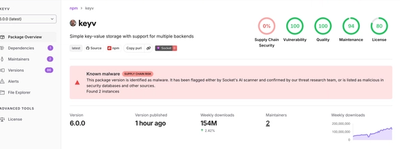
Popular npm packages keyv and cacheable compromised.

Security News
A misconfiguration gave three Anthropic models internet access, and one, believing it was in a simulation, shipped a credential-stealing package to PyPI.