

Company News
AWS Security Hub Adds Socket for Supply Chain Security
Socket is now in the AWS Security Hub Extended plan. Adopt it through AWS, apply committed spend, and block malicious open source packages.
By Feross Aboukhadijeh - Aug 04, 2026
data-breach-detector
Advanced tools
Read-only breach-intelligence MCP: reports THAT an organization was breached and which data types leaked, across full history from public feeds (HaveIBeenPwned, RansomLook, ransomwatch archive, SEC 8-K 1.05). Never the leaked data.
A read-only breach-intelligence MCP server. It answers "has this organization ever been breached, what's the recent breach news, what does two decades of breach history look like, how severe is this threat text" from public disclosure feeds — and reports intelligence, not contents: the existence, timing, scale, category and exposed data-types of a breach, never the leaked records themselves.
Built for defenders and for agents that work on their behalf.
Most breach tooling sits in one of three camps, and each has a structural gap:
This server takes a fourth position:
breach_history, breach_timeline and
breach_stats treat 2007→today as the product, not a cache: every breach
of 2013, an organization's full incident chronology, repeat-victim
flagging, per-year and per-actor aggregates..onion access, and every feed-authored
string is sanitized where the record is built, before any field is
assembled from it: emails, hashes, IPs, crypto addresses and
credential-shaped tokens are redacted, and the invisible channels used to
hide instructions from a human reader (Unicode Tags, zero-widths, bidi
overrides, variation selectors, terminal control codes) are stripped. That
matters because leak-site titles are written by ransomware crews and read
by agents: the same field is both intelligence and an injection surface.
Redacting only the two fields a human looks at is not enough, because ids,
actor names and statistic bucket keys are built from the same strings.feed_sources reports each feed's newest
item, a staleness flag and the last fetch error — a dead upstream is a
served fact, not a silent hole. (The ransomwatch project itself froze in
June 2025; this server says so instead of pretending.)pip install, stdio or
streamable-HTTP..onion marketplace access, no transactions./api/v3/breaches — the verified breach directory back
to 2007: domain, breach date, pwn count, exposed data categories.ransomlook.io) — live ransomware leak-site tracker.joshhighet/ransomwatch) — frozen archive of ~16k
leak-site posts, Jan 2020 → Jun 2025, retained as history.| tool | what it returns |
|---|---|
breach_news(since_days, sector, source, limit, offset) | recent disclosures — entity, date, scale, exposed data types, severity |
check_exposure(query, since_days, limit, offset) | does a domain/company appear anywhere in breach data — yes/no + metadata |
breach_history(query, year_from, year_to, sector, data_type, min_accounts, order, limit, offset) | search the full archive back to 2007 |
breach_timeline(entity, limit, offset) | one organization's incident-by-incident chronology + repeat-victim assessment |
breach_stats(group_by, sector, limit) | aggregates per year / source / data type / threat level / ransomware actor |
assess_threat(text) | classify a piece of security text — level, categories, action (no network) |
feed_sources() | feeds, per-source freshness, staleness flags, last fetch errors |
Every list tool reports count, limit, offset and returned, and
breach_stats reports buckets_total, so a truncated answer is visible as
truncated and the tail is reachable by paging rather than lost.
pip install data-breach-detector

data-breach-detector           # stdio (for MCP clients)
data-breach-detector --http    # streamable-HTTP on 127.0.0.1:8790/mcp
Or point an MCP client at the config:
{ "mcpServers": { "data_breach_detector": {
  "command": "data-breach-detector"
} } }
Hosted remote: https://breach.seiche.info/mcp
MIT. The breach data belongs to its sources (HaveIBeenPwned, RansomLook, ransomwatch, SEC EDGAR); this tool only aggregates their public disclosure metadata, with attribution.
FAQs
Read-only breach-intelligence MCP: reports THAT an organization was breached and which data types leaked, across full history from public feeds (HaveIBeenPwned, RansomLook, ransomwatch archive, SEC 8-K 1.05). Never the leaked data.
We found that data-breach-detector demonstrated a healthy version release cadence and project activity because the last version was released less than a year ago. It has 1 open source maintainer collaborating on the project.
Did you know?

Socket for GitHub automatically highlights issues in each pull request and monitors the health of all your open source dependencies. Discover the contents of your packages and block harmful activity before you install or update your dependencies.
Company News
Socket is now in the AWS Security Hub Extended plan. Adopt it through AWS, apply committed spend, and block malicious open source packages.
Research
/Security News
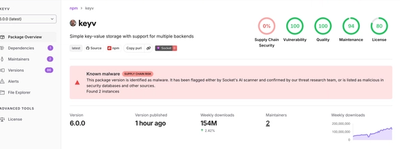
Popular npm packages keyv and cacheable compromised.

Security News
A misconfiguration gave three Anthropic models internet access, and one, believing it was in a simulation, shipped a credential-stealing package to PyPI.