

Research
/Security News
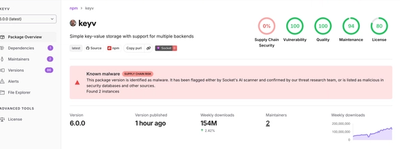
Popular npm Packages in the keyv and Cacheable Namespaces Compromised in Active Supply Chain Attack
Popular npm packages keyv and cacheable compromised.
By Socket Research Team - Aug 04, 2026
delego
Advanced tools
Intent-bound action authorization for AI agents — authorise before a credential is used, require human approval for sensitive actions, and prove every action traces back to the instruction that authorised it.


Website: delegohq.com · Docs: delegohq.com/docs · Spec: Delego-Dev/specification
Intent-bound action authorization for AI agents. It sits between an agent and whatever credential broker holds the user's secrets, and it answers the one question brokers don't: is this specific action the thing the human actually asked for?
agent ──propose──▶ delego ──if allowed──▶ credential broker ──▶ service
(LLM) (policy + (Agent Vault / (bank,
approval + OneCLI / SaaS,
audit) Browser Use…) API)
│
└── needs_approval ──▶ human (CLI)
📜 Protocol: delego implements protocol 0.3 of the open delego wire specification — canonicalization, the policy schema, intent/fingerprint binding including the §4.2 query-fold, and the signed audit chain. The authorization token (spec §9) is an optional profile, not yet implemented.
The "agent gets its own scoped credential, and never holds the user's secret directly" pattern is now a crowded, converging space — Infisical's Agent Vault, OneCLI, Browser Use, Nango, and others all do credential brokering.
The harder problem sits one level up — the confused deputy: the agent holds a valid credential, a prompt injection redirects it, the scope covers the action, so the broker happily injects the secret and the action goes through. The credential is the wrong place to catch this — it's valid. OAuth tokens carry no commitment to the original instruction.
Authorising the action (not just the credential) is an active area — see deterministic policy engines (OPA/Cedar, Permit), human-in-the-loop approval (HumanLayer), MCP gateways/firewalls, and the "pre-action authorization" line of research. delego is a small, deterministic, local, Apache-2.0 reference for it: no LLM in the decision path, no credential custody, approvals bound to the exact action fingerprint, and a signed, hash-chained audit trail — riding the existing broker layer rather than competing with it.
BrokerAdapter interface — you ride the existing layer instead
of rebuilding it.verify(expected_head=…);
for key safety, use an HSM/KMS. See SECURITY.md.pip install delego # the `delego` library + CLI
# pip install "delego[mcp]" # add the `delego-mcp` server (MCP is an optional extra)
delego init # creates ~/.delego with signing keys and an example policy
delego policy # inspect the active policy
To run the full loop end-to-end from a clone — an allowed read, a forbidden deny, an over-cap deny, an approval flow, the confused-deputy guard refusing a substituted action, and audit-chain tamper detection (no agent or live service needed):
git clone https://github.com/Delego-Dev/delego && cd delego
pip install -e ".[dev]"
python examples/demo.py
pytest
delego policy            # show the active policy
delego pending           # list actions awaiting approval
delego approve apr_xxxx  # release a parked action (or: delego deny apr_xxxx)
delego log -n 20         # read recent receipts
delego verify            # check the audit chain (hashes, linkage, signatures)
delego ships an MCP server (delego_mcp) over stdio — install it with the mcp
extra: pip install "delego[mcp]". Register it in your MCP
config (for Claude Code, .mcp.json at the project root) so the agent can
propose actions. Set DELEGO_HOME to keep the policy, signing keys, and ledger
project-scoped under .claude/.delego:
{
  "mcpServers": {
    "delego": {
      "command": "delego-mcp",
      "env": { "DELEGO_HOME": "/abs/path/to/project/.claude/.delego" }
    }
  }
}
Initialise that home and approve from the same one (the CLI and MCP server must share a home):
delego --home .claude/.delego init       # keys, example policy, and a .gitignore
delego --home .claude/.delego pending    # ...then: delego --home .claude/.delego approve apr_xxxx
If DELEGO_HOME is unset, the CLI also auto-uses ./.claude/.delego when run
from the project root, falling back to ~/.delego. (Use an absolute path in the
MCP env, since the server's launch directory isn't guaranteed.)
Tools exposed:
| tool | what it does |
|---|---|
delego_propose_action | submit an action; returns allow / deny / needs_approval |
delego_resolve_action | complete an approved action (fingerprint must match) |
delego_pending | list actions awaiting human approval (read-only) |
delego_audit_tail | read recent receipts |
delego_show_policy | show the active policy |
Approving and denying are deliberately not exposed over MCP — the agent that proposed an action must never be able to approve it; a human decides out-of-band.
Typical flow: the agent calls delego_propose_action. If it comes back
needs_approval with an approval_id, a human runs delego approve <id>, then
the agent calls delego_resolve_action with the identical action to complete it.
A rule matches on method / host / path (glob) / path_contains, decides
allow or needs_approval, and can attach constraints. Order is forbidden
(hard deny) → rules (first match wins) → default. A matched rule whose
constraints fail becomes a deny (fail-closed). See policy.example.yaml.
rules:
  - name: place-order
    decision: needs_approval
    match: { method: POST, host: api.example.com, path: /orders }
    constraints:
      amount:     { field: amount, max: 5000, currency: USD }
      allow_list: { field: destination, in: [internal] }
Supported constraints: amount (cap + currency), allow_list
(field-in-set), rate_limit (max per minute/hour/day, counted from the ledger).
Three ways to use it, lowest friction first:
delego init, add the delego-mcp server to your MCP
config, and your agent proposes actions instead of executing them. No code.pip install delego, write a policy + a BrokerAdapter, and
call fw.propose(...) in your tool-call path.Firewall in an HTTP API so many agents share
one decision point and one audit chain.The one extension point is the broker — where your credential lives and the authorised action actually runs. delego never holds the secret:
NullBroker (default) — simulates execution; for demos and tests.HTTPProxyBroker(gateway_url) — forwards the authorised action to an external
credential gateway (OneCLI / vault / proxy) that injects the secret upstream.execute(action) -> dict against the BrokerAdapter
protocol in delego/brokers.py.▶ Delego-Dev/sample-app — a FastAPI service built on the published package, with the full propose → approve → resolve loop and a copy-paste curl walkthrough. The best starting point for building your own.
See ROADMAP.md for where delego is going and where to help.
/orders?to=me and /orders?to=attacker are different actions), the
confused-deputy guard, intent-bound + single-use human approvals, the
signed, hash-chained audit ledger with verification and an external
head-anchor check (delego verify --expected-head), and the §9 authorization
token (optional profile) — a short-lived, EdDSA-signed JWS a separated broker
verifies before injecting a credential (build_firewall(..., mint_tokens=True);
verify_token / require_fingerprint).delego daemon): one long-running process owns the
ledger, so every client routes through it and rate_limit is exact across all
of them — not just one host's file lock. The CLI's approve/deny/pending
auto-route to a running daemon. Optional: with no daemon, everything works
file-backed as before.NullBroker holds no credentials and makes no real
request — it records what would be sent (for demos and tests). HTTPProxyBroker
forwards an authorised action — and its authorization token — to an external
credential gateway; or write your own against the BrokerAdapter protocol in
delego/brokers.py.rate_limit is exact only among processes sharing one home on one host.
Run delego daemon for exact rate limits across all clients (one writer).
The daemon serializes one action in flight at a time (a reserve-then-execute
throughput optimization, and a TCP transport for other hosts, are future work).
Path globbing is coarse (** and * collapse).Licensed under the Apache License 2.0.
FAQs
Intent-bound action authorization for AI agents — authorise before a credential is used, require human approval for sensitive actions, and prove every action traces back to the instruction that authorised it.
The pypi package delego receives a total of 64 weekly downloads. As such, delego popularity was classified as not popular.
We found that delego demonstrated a healthy version release cadence and project activity because the last version was released less than a year ago. It has 1 open source maintainer collaborating on the project.
Did you know?

Socket for GitHub automatically highlights issues in each pull request and monitors the health of all your open source dependencies. Discover the contents of your packages and block harmful activity before you install or update your dependencies.
Research
/Security News
Popular npm packages keyv and cacheable compromised.

Security News
A misconfiguration gave three Anthropic models internet access, and one, believing it was in a simulation, shipped a credential-stealing package to PyPI.

Security News
/Company News
Socket has joined the new Composer and Packagist sponsorship program as a launch sponsor, supporting the team that keeps PHP's package ecosystem secure.