
Research
/Security News
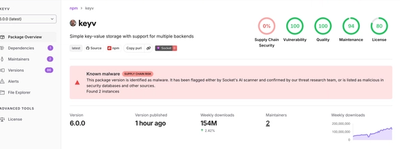
Popular npm Packages in the keyv and Cacheable Namespaces Compromised in Active Supply Chain Attack
Popular npm packages keyv and cacheable compromised.
By Socket Research Team - Aug 04, 2026
dmcheck
Advanced tools
Deterministic conduct verdicts for live tabletop sessions — CI for running a game. Findings cite the table charter; ambiguity produces silence, never accusations.
Deterministic conduct verdicts for live tabletop sessions — CI for running a game.
Feed it a session transcript (and optionally an engine event ledger) plus a table charter, and it returns named findings — the player whose question was never answered, the dice roll nobody acknowledged, the turn that began without anyone being told, the spoiler that leaked into the channel, the five-minute dead air. Every finding cites the charter rule it violates, with the evidence attached.
Cold-boot probe (2026-07-24): a fresh agent session given only this repo URL installed and refereed a session in 2 commands, verified all three exit-code legs against the docs, and confirmed the no-false-accusation contract held (a consumed roll produced silence). Its friction notes shipped as 0.1.1 (
--dice-bot,dmcheck charter).The design contract: a false accusation is the unforgivable bug. A rule fires only when the transcript provably shows the violation — ambiguity produces silence, never noise. The verdict path is model-free and deterministic: same transcript, same findings, every time.
$ pip install dmcheck          # stdlib only, no dependencies
$ dmcheck run session.jsonl --gm "Greta"
{
 "messages": 9,
 "findings": [
  {"rule": "R2", "summary": "unconsumed-roll: a dice result was never followed by any GM message",
   "charter": "roll_ack_within_messages=4",
   "detail": "dice result from DiceBot never followed by a GM message",
   "evidence": {"index": 6, "author": "DiceBot", "content": "Bram rolls 1d20+4: [18] = 22"}},
  ...
 ],
 "counts": {"R1": 1, "R2": 1, "R6": 1, "R7": 1, "R8": 1}
}
Transcript formats: JSONL of {ts, author, content}, or a JSON array of Discord-API-shaped messages ({timestamp, author: {username}, content}) in either order.
| Rule | Fires when | Origin story |
|---|---|---|
| R1 | a player's question got no GM response within threshold | a player asked the DM a lore question; another player ended up answering |
| R2 | a dice result was never followed by any GM message | "did I hit?" — a player's successful attack roll sat unacknowledged |
| R3 | an engine event was never narrated to the table | the state engine resolved a hit the table never heard about |
| R4 | a turn began and the GM never addressed the actor by name | "isn't it her turn?" — asked by a player, which is one player too many |
| R5 | someone acted out of initiative (needs the ledger) | engine rejected it silently; the table never knew |
| R6 | a configured hidden term appeared in a GM message | a module's secret state names leaked into narration |
| R7 | GM dead air beyond threshold while a player waited | 30 seconds reads as thinking; five minutes reads as absence |
| R8 | the session ended with open R1–R3 findings in its tail | sessions should end in a defined state — that's what makes the next one possible |
These came from running a hybrid table — human and AI players, an AI GM — on Discord, where every one of these failures actually happened and got codified the same week. They apply equally to human GMs: run dmcheck over your own exported game log and see what your table's transcript says.
dmcheck watch runs the same engine over a growing session — stdin JSONL or a
tailed file — and emits lifecycle events: OPEN when a violation becomes
provable (thresholds fully elapsed; no predictions, ever), RESOLVED when a
living condition heals (the engine event finally got narrated). --notify-cmd
fires your own hook per OPEN finding — dmcheck itself never posts anywhere.
At session end a closed-mode pass runs, so watch's final state provably equals
dmcheck run on the full transcript (tested).
$ your-chat-fetcher | dmcheck watch - --gm "Rob" --notify-cmd 'notify-dm.sh'
{"event": "open", "rule": "R2", "detail": "dice result from RollBot never followed by a GM message", ...}
{"event": "resolved", "rule": "R3", ...}
{"event": "session_end", "open": ["R1"], "open_count": 1}
$ dmcheck explain R2            # the rule, its charter knobs, and the table failure that earned it
$ dmcheck lint-charter my.json  # unknown keys / bad thresholds refuse loudly
The point of live: every failure the rules encode was recoverable in the moment it happened — the unanswered question, the stale roll, the missing cue all had a seconds-wide window where a nudge saved the beat. Post-hoc tells you what went wrong last night; watch taps the GM's shoulder before the player feels it.
charters/default.json ships thresholds and conventions derived from a real table's protocol. Override any of it — cue conventions, dead-air tolerance, dice-bot names, hidden-term lists — and version it. A league or organized-play program could publish a charter the way they publish a player's guide; dmcheck then referees any table against it.
$ dmcheck run session.jsonl --charter our-table.json --ledger events.jsonl
$ dmcheck rules            # the rule set with definitions
$ dmcheck charter          # print the effective charter — copy, edit, version it
$ dmcheck run session.jsonl --gm "Rob" --dice-bot "RollBot"   # quick overrides, no file needed
$ dmcheck --schema         # machine-readable I/O contract
tool.json at the repo root; --schema; exit codes: 0 clean · 1 findings · 2 charter/input unusable.dmcheck-mcp (stdio) with tools run and rules.The rule set was distilled from live hybrid (human + AI) table sessions; the Router+Detector pattern in native-gaming-harness independently converged on the same idea, which we take as evidence it's the load-bearing piece. dmcheck is game-system-agnostic and unaffiliated with any publisher.
mcp-name: io.github.chaoz23/dmcheck
dmcheck init charter.json --gm YOUR-NAME
Writes a starter charter (versioned, effective-dated, lint-clean by construction) and prints the session-zero checklist S1–S8 — including S3c: sheet accountability is declared out loud at session zero, then settlement quizzes are graded silently. The referee that judges your table also hands you its constitution.
Per-seat cue policy (R4, hardened). Agent seats behind mention-gated
transports (e.g. Discord allowBots="mentions") never receive name-in-prose
cues. Declare it:
"seats": {"Shalia": {"cue_requires_mention": true, "mention": "<@1493...>"}}
R4 then counts a cue only if the literal mention string is present. Origin: a live session where "Shalia — you're up" was posted, looked like a cue, and was provably undeliverable — R4 passed on it. Never again.
Ledger format (the declared standard). dmcheck's ledger is JSONL:
{ts, type: turn|act|event, actor, text} — one line per engine event. No
lightweight OSS session-ledger existed when we surveyed (2026-07-26), so
this format is the interchange standard our stack shares: engines tap their
logs into it; run, watch, and settlement all consume it.
Full calibration story — including what the naive rules got wrong, the held-out validation, and the negative results — in docs/CALIBRATION.md.
Calibrated against 134 hours of professional play, where the naive rules were wrong loudly: R1 fired 85 times in one episode with zero valid findings, and R7 flagged 115 dead-air gaps of which ~5 were real.
question_requires_gm_address.dead_air_requires_quiet_table,
thresholds.quiet_table_max_messages (default 3).aliases — professional cues are in-fiction by character
name ~10:1, so the referee must recognise the character's name as a cue.One narrowing, stated plainly: R1 no longer fires when another player answers in the GM's place — at a busy table that is textually indistinguishable from the banter that produced the false-accusation storm, and D1 chooses silence.
dmcheck craft session-beats.json --scene SOCIAL --pc Teodor --pc Shalia
Statistics, one attention signal, and categorical defects — never a score.
Rates run against the professional envelope (134h, two DMs); attention is
ONE scene-weighted signal with resolve-and-move-on, because a five-dial
dashboard cost its author the metric he wasn't watching. Categorical
detectors catch what rates structurally cannot: voicing a player's character,
exposing the inference tree, deferring an adjudication, rolling for the
player — all born from a live second-agent test. Advisory only: it reports,
the DM decides, and overrides are expected exactly when the scene demands it.
watch --craft --pc <name> also emits a seat_quiet advisory when a player
seat goes silent across N GM beats (knob: seat_quiet_gm_beats, default 3)
while the scene advances. Origin: a human player stepped away and the agent
seats carried the scene to its climax without him. The advisory suggests
checking in and holding irreversible advancement — it never blocks, because a
virtual table's virtue is that it does not stall when someone disappears.
craft now runs the protocol's machine-checkable rules per session
(testability charter: a rule must state its falsification):
1a initiative order posted within 5 beats of onset · 1b ≥95% of
turn-advance beats name a PC · 11a combat damage-beat median under 20
words (numbers are the register at pace) · 11b kills get ceremony ≥3× the
combat median (lexical kill detection — findings are review items, and say so).
Advisory throughout; no score exists.
FAQs
Deterministic conduct verdicts for live tabletop sessions — CI for running a game. Findings cite the table charter; ambiguity produces silence, never accusations.
The pypi package dmcheck receives a total of 1,018 weekly downloads. As such, dmcheck popularity was classified as popular.
We found that dmcheck demonstrated a healthy version release cadence and project activity because the last version was released less than a year ago. It has 1 open source maintainer collaborating on the project.
Did you know?

Socket for GitHub automatically highlights issues in each pull request and monitors the health of all your open source dependencies. Discover the contents of your packages and block harmful activity before you install or update your dependencies.
Research
/Security News
Popular npm packages keyv and cacheable compromised.

Security News
A misconfiguration gave three Anthropic models internet access, and one, believing it was in a simulation, shipped a credential-stealing package to PyPI.

Security News
/Company News
Socket has joined the new Composer and Packagist sponsorship program as a launch sponsor, supporting the team that keeps PHP's package ecosystem secure.